普通孩子的C++编程兴趣新入口_C++精灵库

在当今的C++领域,一个重要的趋势正在悄然改变:它的学习门槛正在大幅降低,甚至可以让那些只懂计算机打字、懂英文、会简单算术的学生,也能轻松上手。这种改变使得C++不再仅仅是竞赛的工具,而开始成为一种面向更广泛学生群体的、充满乐趣的兴趣类素质教育。

作为一名有着十余年教学经验的教育者,我同时教授图形化编程、Python和C++以及算法。相比于那些只专注于单一编程语言,并且为了自身利益而不遗余力地鼓吹该语言“天下第一”、贬低其他语言的同行(可以说是“王婆卖瓜,自卖自夸”),我始终秉持着客观的态度。我从不从个人利益出发去误导学生,因此,各位读者可以放心地阅读我的文章。

C++的广阔世界与短视的竞赛思维

C++的世界远比我们想象的要宽广。与Python相比,它同样精彩绝伦。C++是C语言的超集,是现代数字社会的坚实基石。它更接近计算机的底层,是大型游戏引擎的核心、操作系统的命脉,也是众多大型项目不可或缺的基础。因此,如果我们仅仅将C++视为竞赛的工具,无疑是大材小用,甚至可能扼杀普通学生学习编程的兴趣。

计算机语言本身并无好坏之分。它们都是人为制定的规则体系,其存在的价值在于解决特定的问题。有人认为学习某种语言能带来最大的利益,这种观点是短视的。例如,若目标是参加竞赛并获奖,那么学习算法与数据结构才是最终目的。但学习算法是否必须使用C++呢?答案是否定的。Python语言因其语法简洁、代码可读性高,甚至被称为“伪代码的编程语言”。当一位同学真正理解了某个算法的逻辑后,无论是用Python、Basic、C++,还是图形化编程语言来实现,都只是具体的实施手段。

我认识一个朋友,他没有自动完成功能的编辑器是一行代码也写不出来的。而我只靠记事本就能把代码全部写出来。这就是要基本功非常扎实。

这说明,编程的本质不在于具体的语言,而在于算法逻辑思维是否被打通。这需要多方面的训练,找到最适合自己的语言。思维打通了,大脑得到了锻炼,这才是真正的“以不变应万变”。因此,我看到网上许多人片面强调或贬低某种语言,本身就暴露了他们的无知。有些人可能只是为了推销自己的网课,或者为了引流而故意制造对立。这对那些不了解编程的普通家长来说,无疑是一种误导。

从“筛选人”到“培养人”:C++教育的范式转变

长期以来,社会上流传着一种说法:“学C++从来不是培养人,而是筛选人。”这句话虽然有一定道理,但一切都在动态变化之中。如今,C++也完全可以成为一种有效的培养工具。这背后的关键,在于我们引入了一种全新的教学方式——C++精灵库

这个库可以免费下载,其中包含了数百个精心设计的案例供学生学习。最开始的代码极其简单,我相信,只要具备高中以上的学历,都能轻松看懂。这标志着学习C++的门槛被彻底降低了。现在的C++学习,与过去那种枯燥、抽象的竞赛式学习截然不同。

为什么C++精灵库能激发学生的兴趣?因为它让编程变得直观、有趣且充满成就感。想象一下,只需一行代码,你就能创建一枚火箭,并让它飞向太空。这种亲手创造并看到成果的体验,是任何其他方式都无法比拟的。这正是C++精灵库的魅力所在,它将编程从一种“底层”的技术探索,转变为一种充满想象力的创意实践。

当然,有人可能会质疑:“这没有学到底层啊?”我想反问一句:“一开始就让学生接触`cout << “hello world”;`,这就算学到底层了吗?”学习是一个循序渐进的过程。对于普通小学生而言,激发他们对学习的内在兴趣,远比掌握几个底层知识点重要得多。世界上伟大的发明者,无一不是被强烈的兴趣所驱动。虽然孩子长大后不一定会从事程序员的工作,但能坚持学好编程,本身就是一项了不起的成就。

C++精灵库:中国普通孩子的福音

在传统的教育体系中,C++常常因为其复杂性和学习曲线陡峭,而成为少数精英学生的专利。这不仅限制了编程的普及,也扼杀了许多孩子对技术的热情。而C++精灵库的出现,打破了这一壁垒。它让编程的大门向更广泛的学生群体敞开,特别是为中国的普通孩子提供了一条友好、有趣的学习路径。

通过这个库,孩子们可以在没有巨大心理压力的情况下,逐步建立对编程的信心和兴趣。他们可以从模仿和修改简单的代码开始,逐步深入,最终创作出属于自己的小项目。这种“兴趣驱动”的学习模式,不仅能锻炼逻辑思维和创造力,更能培养耐心和解决问题的能力。

我相信,C++精灵库的出现,是中国编程教育领域的一个积极信号。它让编程回归其本质——一种创造的工具,而不仅仅是选拔的标尺。这将为更多孩子点燃科技梦想,为他们的未来发展打下坚实的基础。虽然我个人力量微薄,无法改变整个行业的现状,但我由衷地希望,未来会有更多这样的创新,让编程教育真正惠及每一个有好奇心和创造力的孩子。

发表在 C++, 杂谈 | 留下评论

C++小火箭的正弦曲线绘画之旅_C++精灵库绘图

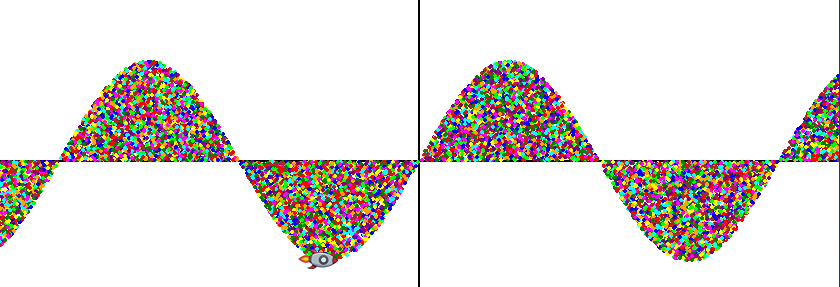
话说在C++精灵库的世界里,有一个叫rocket(小火箭)的家伙。它可是个多才多艺的小画家。今天它刚在数学课上学了正弦函数,就急不可耐地想要完成一个任务 —— 画一幅正弦曲线,咱们来看看它是怎么操作的吧!

首先,小火箭先给自己布置了绘画场地,它把背景调成了酷酷的纯黑色:rocket.bgcolor(“black”),还调整了自己的飞行(绘画)速度:speed(1),确保等会儿画画不会太快也不会太慢,稳稳当当才出精品。

接下来,小火箭要先画好坐标轴,这可是画画的基础哦。它先换上一支橙色的画笔,朝着正前方飞了3百步,画出了横轴的一半,然后又倒着往回飞了6百步,把横轴的另一半也画出来,最后再往前飞3百步,乖乖回到了坐标轴的原点。紧接着,它向左转了90度,换了一支蓝色的画笔,朝着上方飞了260步,画出了纵轴的上半部分,又倒着往回飞了520步画完纵轴下半部分,再飞回去260步回到原点,最后向右转90度,回到了最初的朝向。看看那代码,多么的简洁,倒是我用文字描述了这么久,可见汉语是代表不了编程语言的。

<span class="code-snippet__operator">//</span>这里是画坐标轴,前进倒退左转
rocket.color(<span class="code-snippet__number">33</span>).fd(<span class="code-snippet__number">300</span>).bk(<span class="code-snippet__number">600</span>).fd(<span class="code-snippet__number">300</span>).<span class="code-snippet__keyword">left</span>(<span class="code-snippet__number">90</span>);
rocket.color(<span class="code-snippet__number">230</span>).fd(<span class="code-snippet__number">260</span>).bk(<span class="code-snippet__number">520</span>).fd(<span class="code-snippet__number">260</span>).<span class="code-snippet__keyword">right</span>(<span class="code-snippet__number">90</span>);

画完坐标轴,小火箭觉得曲线得更醒目一点,就把画笔换成了黄色,还把笔的粗细调到了4号,这下准备工作就全部就绪啦。 (为什么color(50)能把画笔调整黄色呢?这是由于50表示颜色的色相!)

<span class="code-snippet__attribute">rocket</span>.color(<span class="code-snippet__number">50</span>).pensize(<span class="code-snippet__number">4</span>); 

最关键的绘画环节来咯!小火箭要开始画正弦曲线本身了。它给自己定了个规矩,要从左边180度的位置,一点点画到右边180度的位置。每到一个位置(咱们叫它x),小火箭都会先偷偷算两笔:一笔是当前x位置对应的高度y(用正弦公式算出来,还放大了1百倍,这样曲线能看得更清楚),另一笔是下一个位置(x+1)对应的高度 next_y。

//朝向下一个坐标点,然后到达(<span class="code-snippet__attribute">x</span>,<span class="code-snippet__attribute">y</span>)坐标 
rocket<span class="code-snippet__selector-class">.heading</span>(<span class="code-snippet__attribute">x</span>+<span class="code-snippet__number">1</span>,next_y)<span class="code-snippet__selector-class">.go</span>(<span class="code-snippet__attribute">x</span>,<span class="code-snippet__attribute">y</span>); 

更有意思的是,小火箭画画之前还会 “瞄准”,(代码是:rocket.heading(x+1,next_y))。它会先调整自己的飞行朝向,对准下一个要去的坐标点,就像射箭前要先对准靶心一样,然后再稳稳当当地飞到当前的 (x,y) 坐标点上。而且它还特别细心,飞过去之后会检查一下自己的画笔有没有落在 “画布” 上,如果没落下,就赶紧把画笔放下来,保证每一笔都能清晰地留在画面上。就这么一步一步,从左到右,一点点计算、一点点瞄准、一点点飞行,小火箭慢慢勾勒出了正弦曲线那弯弯的、优美的轮廓,一条顺滑的正弦曲线就这样渐渐出现在黑色背景上了。

画完曲线,小火箭还想给作品添点色彩,让它更生动。它找到了两个合适的位置,一个在自己左边1佰个单位、上边 20个单位的地方,另一个在左边220个单位、下边20个单位的地方,然后在这两个地方都填上了清新的嫩绿色,让整个正弦曲线看起来更饱满、更有层次感。

<span class="code-snippet__comment">//开始填充,在火箭左边100个单位,上边20的地方填充lime色(估计的)</span>   
rocket.<span class="code-snippet__title">fill</span>(<span class="code-snippet__string">"lime"</span>,-<span class="code-snippet__number">100</span>,<span class="code-snippet__number">20</span>);    
<span class="code-snippet__comment">//在火箭左边200个单位,下边20个单位填充lime色(估计值)</span>   
rocket.<span class="code-snippet__title">fill</span>(<span class="code-snippet__string">"lime"</span>,-<span class="code-snippet__number">220</span>,-<span class="code-snippet__number">20</span>); 

最后,就是给作品题字啦。小火箭先把画笔收起来,飞到坐标轴上方3佰步的高处,换上了一支红彤彤的画笔,然后写下了“C++ 正弦曲线示例”几个大字,还特意把字调整成居中对齐、48号的常规字体,让大家都能清楚地看到。

<span class="code-snippet__attribute">rocket</span>.pu().go(<span class="code-snippet__number">0</span>,<span class="code-snippet__number">300</span>).color(<span class="code-snippet__string">"red"</span>);
<span class="code-snippet__attribute">std</span>::string s = <span class="code-snippet__string">"C++正弦曲线示例"</span>;
<span class="code-snippet__attribute">rocket</span>.write(s,<span class="code-snippet__string">"center"</span>,{<span class="code-snippet__string">""</span>,<span class="code-snippet__string">"48"</span>,<span class="code-snippet__string">"normal"</span>});   

做完这一切,小火箭没有马上离开,它在原地停留了1秒钟,好像在欣赏自己的得意之作,然后才悄悄把自己藏了起来,结束了这次完美的绘画任务。

下面是C++精灵库画正弦曲线所有代码:

#include "sprites.h"  //包含C++精灵库 
#define z 3.1415926535798932/180.0
Sprite rocket;       //建立角色叫rocket 

int main(){        //主功能块     
   rocket.bgcolor("black").speed(0);
   //这里是画坐标轴,前进倒退左转
   rocket.color(33).fd(300).bk(600).fd(300).left(90);
   rocket.color(230).fd(260).bk(520).fd(260).right(90);
   rocket.color(50).pensize(4);   
   //画正弦曲线
   for(int x=-180;x<=180;x++){    //x实际代表的是角度
       float y = 100*sin(x*z);
       float next_y =100*sin((x+1)*z);
       //朝向下一个坐标点,然后到达(x,y)坐标
       rocket.heading(x+1,next_y).go(x,y); 
       if(!rocket.isdown())rocket.pendown();
   }  
   //开始填充,在火箭左边100个单位,上边20的地方填充lime色(估计的)
   rocket.fill("lime",-100,20); 
   //在火箭左边200个单位,下边20个单位填充lime色(估计值)
   rocket.fill("lime",-220,-20); 
   rocket.pu().go(0,300).color("red");
   std::string s = "C++正弦曲线示例";
   rocket.write(s,"center",{"","48","normal"});    
   rocket.wait(1).hide().done();  
   return 0;
}
发表在 C++, 杂谈 | 留下评论

C++精灵库并不适应场景:专业级图形应用或高性能游戏开发(非其设计目标)。

要了解一个东西,应该首先了解它当初的设计目标。C++精灵库的设计目标并不是专业级游戏开发!C++精灵库当初的设计目标就是为了更好地更有趣地进行C++入门教学。那么作者是如何解决这个问题的?C++精灵库的应用场景及核心价值体现在哪里?它又会为“人类”做出(或将?)做出哪些贡献?下面就含有解决方案并且进行了总结。

C++精灵库的核心价值在于以下几个方面:

  1. 教育普惠价值
    • 打破C++入门壁垒:通过移植Python Turtle的直观命令(如fd()right()),将传统C++入门教育的枯燥感,转化为“可视化绘图”的直观感受,使青少年、文科生甚至儿童能轻松上手。
    • 拓展教育覆盖人群:支持代码跨语言平滑迁移(某些C++精灵库程序稍作调整即可在Python IDE运行,降低跨语言学习成本。),彻底脱离“C++仅服务于竞赛”的单一定位,推动C++编程教育从精英化走向普惠化
  2. 兴趣驱动的过渡桥梁价值
    • 衔接兴趣与深度学习:以“做中学”模式(如绘图、小游戏开发“大炮打蝙蝠”),将数学坐标、循环逻辑等抽象知识可视化,避免初学者挫败感。
    • 搭建进阶路径:保留C++核心语法(头文件、类对象、标准库),为学习者从“兴趣探索”自然过渡到“系统编程”(如算法或SDL2)提供阶梯式支持,契合终身学习逻辑。
  3. 教育生态价值
    • 推动C++教育普及:通过降低门槛,显著提升青少儿对C++的兴趣,激发其进一步学习算法、系统原理的内驱力,客观上促进C++编程教育的规模化发展。

C++精灵库的核心特点主要体现在以下几个方面:

  1. 精准定位与门槛设计
    • 细分赛道第一:专为“青少儿C++兴趣素质教育”设计,非专业游戏开发(不要拿菜刀和大刀去比较),在同类工具中实现门槛极致降低。
    • 拒绝过度复杂:不追求高性能或工业级应用,明确界定为“入门教学工具”,避免与专业图形库(如SDL2)功能混淆。
  2. 技术设计的易用性与拓展性
    • 链式调用语法:如turtle.forward(100).right(90),代码简洁易读,学习者聚焦逻辑而非语法细节。
    • 命令增强相对于turtle,C++精灵库对某些命令进行了增强并重新设计了一些新的命令。如画笔的coloradd命令,是让画笔的色相增加,从而非常容易制作出彩虹效果的图形。如fill,是洪水填充命令。如画笔的penhsv命令,可以单独对颜色的色相、饱和度与明度进行调节。这无疑为美术生学习C++编程带来了福音。
    • 底层可靠整合:基于工业级SDL2库,支持图形渲染、音频交互、事件处理,既满足“所见即所得”入门需求,又为进阶开发(小游戏、动画)预留空间。
    • 无缝集成生态支持 DevC++主流 IDE减少配置成本学校/培训机构现有工具
  3. 教育支持的完整性
    • 一体化教学环境:内置详细教程、已有200多个示例程序、配套编辑器,覆盖“学习-实践-迁移”全流程,支持教师系统化教学。
    • 跨语言平滑迁移:部分采用C++精灵库的代码比较容易迁移到Python IDE,强化“可视化编程→C++语言”的过渡体验。

关键结论

  • 核心定位:C++精灵库是青少儿C++兴趣素质教育的精准解决方案,其价值不在技术深度,而在教育场景中的“破壁”能力——将C++从“难学难用”转化为“有趣易上手”。
  • 不可替代性:在细分赛道(少儿C++教育)中,它通过“教育普惠+技术简化+兴趣驱动”三位一体设计,成为名副其实的行业第一,无同类工具能同时满足低门槛、高趣味、教学闭环
  • 本质价值:它不是“工具库”,而是教育桥梁——让C++从“竞赛工具”蜕变为“兴趣启蒙载体”,为编程教育普及开辟新路径。

C++精灵库是一个定位精准、设计巧妙的C++入门教学工具。它就像一把精准的“菜刀”——在它擅长的领域(C++入门与兴趣启蒙)做到了极致。其核心贡献在于让C++教育更普惠、更有趣它不是一个通用的游戏开发引擎,而是一个优秀的C++教学辅助系统,成功地将复杂的C++语言包装成了学生乐于接受、易于掌握的形式,有效激发学习兴趣并引导后续的深度探索,完美地契合了终身学习路径。

发表在 C++, 杂谈 | 留下评论

C++精灵库(pxC++编辑器)正式发布公告

通知:C++精灵库V1.0.0版正式发布。它的定位是青少儿C++兴趣素质教育。为了更方便用户使用C++精灵库,已将C++精灵库内置于pxC++编辑器中。所以,发行C++精灵库将以发布pxC++编辑器的形式进行。

九大核心优势:

1. 入门C++,更加容易
会计算机打字,认识26个英文字母,会加减乘除,任何人即可以学习C++编程。C++精灵库为普及C++编程教育奠定了坚实的基础。

2. 配置简单,超低门槛
下载pxC++编辑器绿色版本,附有视频讲解,简易安装,即插即用。

3. 无缝衔接,一脉相承
C++精灵库移植Python turtle经典命令。无论先学哪个,用户都会感觉“似曾相识燕归来”。

4. 链式调用,简洁优雅
采用C++17标准,语法支持链式调用。编写得好的代码可以像自然语言一样,更加优雅简洁。

5. 基石稳固,拓展性强
C++精灵库基于工业级图形库SDL2库开发,高级用户可融入SDL2库命令进行拓展开发。

6. 适配性强,各取所需
C++精灵库可适配任一款基于GCC编译器的编辑器。对于想用DevC++5.11的用户,作者还准备内置C++精灵库的DevC++5.11升级包。

7. 案例丰富,不断更新
本次下载包除了pxC++编辑器自带的C++精灵库教程与练习外,还额外有200多个示例及部分创意C++程序。这些示例结合了各门学科知识。是你用C++进行兴趣素质教育的良好开端。一直更新,敬请关注。

8. 画笔控制,更加细腻
相对于Python turtle的画笔,C++精灵库对画笔的控制方法更加多样化。比如有penhsv命令,可直接对画笔的色相、饱和度与明度进行调节。这为审美能力更强的学生进行艺术创造打开了方便之门。

9. 开源软件,自由使用
C++精灵库使用MIT协议。无广告信息,绿色纯净版,下载后可放心自由使用,免除后顾之忧。比如,你可以给示例编写课程拿去售卖,赚的钱全归自己。

高级用户如果需要分离C++精灵库和pxC++编辑器,请记录以下信息:
C++精灵库的静态库文件在编译器文件夹(MinGW64)的lib子目录下,文件名是libsprites.a。还有头文件在include子目录下面,分别是sprites.h和cppsprites子目录。

C++精灵库官方网站: www.scratch8.net, 官方抖音号:pxcoding。


发表在 C++, 杂谈 | 留下评论

22_C++精灵库 C++精灵库 其它命令等 教程

C++精灵库 其它命令等 教程,本教程已内置于pxC++编辑器内。

初级用户主要掌握三个命令即可。randint命令,返回整数区间内随机整数。
random命令,返回的是一定范围内的小数。oneof命令,返回两者之一。

1. to_world_xy
作用: 转换为世界坐标系。应用场景主要在在获取鼠标指针坐标时,得到的坐标是屏幕坐标系的,根据情况需要转换成世界坐标系。
用法:
int x=100,y=100; //这里x,y当成屏幕坐标系(左上角为原点,y轴向下为正)
to_world_xy(x,y); //x,y当成引用调用,调用后其值被改变

2. to_screen_xy
作用: 转换为屏幕坐标系。
用法:
int x=100,y=100; //这里x,y当成世界坐标系(中间为原点,y轴向上为正)
to_world_xy(x,y); //x,y当成引用调用,调用后其值被改变

3. randint
作用: 在整数区间[a,b]随机选择一个整数。
用法:
int x = randint(1,100);

4. random
作用: 在浮点数区间[a,b]随机选择一个浮点数。
用法:
float x = random(1.0,100.0);

5. oneof
作用: 在两个对象之间随机选择一个。
用法:
int x = oneof(32,76); //在两个整数之间选择一个
Sprite *p = oneof(&turtle,&rocket);//两个角色间选择一个,注意返回的是指针

6. inputbox
作用: 弹出一个输入框,让用户输入文本。
用法: std::string name = inputbox(“姓名”, “请输入您的名字:”);

7. messagebox
作用: 弹出一个消息提示框。
用法:
信息框: messagebox(“提示”, “操作成功!”);
警告框: messagebox(“警告”, “文件未找到!”, SDL_MESSAGEBOX_WARNING);
错误框: messagebox(“错误”, “发生致命错误!”, SDL_MESSAGEBOX_ERROR);

8. svg2png
作用: 把svg图转换成png图。
举例:
const char* inputSvgFile = “F:\\萍乡风火轮编程基地\\blank.svg”; //输入svg
const char* outputPngFile = “F:\\萍乡风火轮编程基地\\blank.png”; //输出png
float scaleFactor = 2.0f; // 缩放因子,这里放大2倍
svg2png(inputSvgFile, outputPngFile, scaleFactor);
成功则返回真,失败返回假。

9. Point类
作用: 描述一个二维坐标点
用法: Point p0 = (100.0,100.0);
std::cout << p0.x << std::endl; //输入p0点的x坐标
std::cout << p0.y << std::endl; //输入p0点的y坐标
sprite.go(p0); //让角到到达p0点

在C++精灵库中的定义:
struct Point {
double x, y;
Point();
Point(double x, double y);
………..高级用户有兴趣可查阅polygon_offset.h头文件
};

10. get_angle
作用: 接收不共线的三个点坐标,返回一个角度的大小。
用法: float angle = get_angle({1.0,0},{0,1.0},{0,0} ); //得到45度

11. Color类
作用: 描述一种颜色
用法:
int h = 0; //色相
Uint8 r,g,b; //红,绿,蓝
Color temp;
temp.hsvToRgb(h,1.0,1.0,r,g,b); //hsv转rgb

定义:
class Color {
private:
SDL_Color color;

public:
// 构造函数
Color(Uint8 r = 0, Uint8 g = 0, Uint8 b = 0, Uint8 a = 255);
Color(const SDL_Color& sdlColor);

// 获取SDL2库中的SDL_Color
SDL_Color get() const;
std::string gethex() const; //获取16进制RGB字符串
void rgbToHsv(Uint8 r, Uint8 g, Uint8 b, float& h, float& s, float& v) const;
void hsvToRgb(float h, float s, float v, Uint8& r, Uint8& g, Uint8& b) const;
……….高级用户有兴趣可查阅coloradd.h头文件学习SDL_Color等知识。
}

12. SDL_Rect
作用: 它是一个类,用于描述一个矩形
用法:
SDL_Rect r = {-200,20,400,40};//矩形左上角坐标是(-200,20),宽高是400×40。
std::cout << r.x << std::endl; // 矩形左上角x坐标
std::cout << r.y << std::endl; // 矩形左上角y坐标
std::cout << r.w << std::endl; // 矩形宽度
std::cout << r.h << std::endl; // 矩形高度

13. 关于HSV

请看示例程序:

/*
非bug提示,设为黑色或者灰色与白色时,再增加画笔颜色的色相,将不会增加。
这个”特性”不是bug,而是HSV/HSL颜色模型的数学特性在图形库中的正确实现。
如果你想看到颜色变化的效果,需要先设定一个非黑、非灰、非白的颜色(即饱和度不为0的颜色)。
*/
#include “sprites.h” //包含C++精灵库
Sprite rocket; //建立角色叫rocket

int main(){ //主功能块
rocket.pencolor(“black”).speed(0);
std::cout << “饱和度=” << rocket.pensat() << std::endl; //输出结果是0
std::cout << “色调=” << rocket.pentone() << std::endl; //输出结果是0
for(int i=0;i<360;i++)
//这个现象的本质不是coloradd()方法失效,
//而是基于HSV(色相 – 饱和度 – 明度)颜色模型的颜色属性特性
rocket.coloradd(1).fd(1);
rocket.done();
return 0;
}

14. 关于造型名字映射
在C++精灵库中,有几个特殊的字符串可以直接指定造型。
这些字符串是: bug,rocket,turtle,classic,arrow,triangle,blank,square,circle,star, pointer。
它们和图片路径的映射关系如下:
std::map<std::string,std::string> named_shapes= { {“bug”,”res/bug.png”}, {“rocket”,”res/rocket.png”},
{“turtle”,”res/turtle.png”}, {“classic”,”res/classic.png”}, {“arrow”,”res/arrow.png”},
{“triangle”,”res/triangle.png”}, {“blank”,”res/blank.png”}, {“square”,”res/square.png”},
{“circle”,”res/circle.png”},{“star”,”res/star.png”},{“pointer”,”res/pointer.png”} };
设角色名为rocket,用户可以往这个映射里增加一个键值对,如下所示:
named_shapes[“pig”] = “res/pig.png”;
然后就可以用代码:
rocket.shape(“pig”);
来设定rocket,让它的造型为res目录下面的pig.png图片了。


发表在 C++ | 留下评论

21_C++精灵库 Screen 类方法教程

C++精灵库 Screen 类方法教程,本教程已内置于pxC++编辑器。

在C++精灵库中有两大类,一个是Sprite类,另一个就是Screen类。Screen类用于新建窗口屏幕。规则是先建立屏幕对象,再建立角色。如果先建立角色,则角色会自动建立一个屏幕对象,它的全局指针是g_screen。屏幕对象只要建立一个,后面建立的会自动无效。窗口默认宽度为屏幕计算机水平分辨率的1/2,高度为3/4。

1. Screen (构造函数)
作用: 创建一个屏幕窗口对象,默认原点在中心, x轴向右为正,y轴向上为正的世界坐标系。首次运行会建立res目录,释放一些图片。用户可以在res目录下放置更多的png图片以增加角色造型的丰富性。
用法:
Screen sc:创建一个名为sc,标题默认 “C++ Sprites Library” 的窗口。
Screen *sc = new Screen(“我的游戏”, 800, 600):创建一个 800×600 像素、标题为 “我的游戏” 的窗口,其指针赋值给sc。

2. title
作用: 设置或获取窗口的标题。
用法:
设置标题: screen.title(“中华C++精灵库”);
获取标题: std::string currentTitle = screen.title();

3. setup
作用: 设置窗口的宽度和高度。
用法: screen.setup(1024, 768); // 将窗口大小调整为 1024×768
返回对屏幕对象的引用。

4. clear
作用: 清空屏幕,将其填充为当前背景色。
用法: screen.clear(); // 屏幕变背景色
返回对屏幕对象的引用。

5. g_screen (全局屏幕指针)
作用: 它是在新建角色或者新建屏幕后的全局屏幕指针,用于通过指针调用屏幕的方法。
用法: g_screen->clear(); //清除角色所画图形
举例:
#include “sprites.h” //包含C++精灵库
Sprite rocket; //建立角色叫rocket

int main(){ //主功能块
// g_screen是全局屏幕对象的指针,要在新建角色后才有,如果没有建立角色或者屏幕,则  它是野指针,会导致内存错误!
g_screen->bgcolor(“lime”); //背景颜色为lime色
while(g_screen->exitonclick()){ //单击关闭窗口
g_screen->clear(); // 清除角色所画的图案
rocket.fd(1); //角色前进1个单位
g_screen->wait(0.01); //等待0.01秒
}
return 0;
}

6. update_mode / tracer (别名)
作用: 切换屏幕的自动/手动刷新模式。
用法:
screen.update_mode(true); 或 screen.tracer(true); // 启用自动刷新(默认)。每次绘图后屏幕会追踪(trace)角色的绘图及相关变化,会自动更新屏幕显示。
screen.update_mode(false); 或 screen.tracer(false); // 启用手动刷新。需要你显式调用 update() 方法才能看到画面变化,这在动画中能提升性能。
加参数时返回true或者false。
不加参数时返回对屏幕对象的引用。

7. update
作用: 手动刷新屏幕,将所有绘制操作显示出来。
用法: 在手动更新模式下(见 update_mode),完成所有绘制后调用 screen.update()来显示画面。
返回对屏幕对象的引用。
举例:
#include “sprites.h” //包含C++精灵库
Screen sc; //新建屏幕对象叫sc
Sprite rocket; //建立角色叫rocket

int main(){ //主功能块
sc.tracer(0); //关闭自动刷新
while(sc.exitonclick()){ //单击关闭窗口
sc.clear();
for(int i=0;i<4;i++)
rocket.fd(100).left(90);
sc.update(); //刷新,此时才显示画的图案
sc.wait(0.01); //等待0.01秒
rocket.fd(1);
}
return 0;
}

7. bgcolor / fill (别名)
作用: 设置屏幕的背景颜色。
用法 (多种颜色表示方式):
字符串: screen.bgcolor(“red”); 或 screen.fill(“lightblue”);
RGB值: screen.bgcolor(255, 0, 0); // 红色
HSV的色相值: screen.bgcolor(120); // 120度是绿色 (0-360)
SDL_Color: screen.bgcolor({0, 255, 0, 255}); // 绿色,关于SDL_Color类,请自行查阅SDL2库资料。
返回对屏幕对象的引用。

8. delay
作用: 设置或获取全局延迟(以毫秒为单位,默认为0毫秒)。
用法:
设置延迟: screen.delay(100); // 设置全局延迟为100毫秒,返回对屏幕对象的引用。
获取延迟: unsigned int curdelay= screen.delay();

9. mainloop / done (别名)
作用: 启动主事件循环,保持窗口打开并响应事件(如关闭按钮)。
用法: 在程序最后调用 screen.mainloop() 或 screen.done()。程序会在此处暂停,直到用户关闭窗口。

10. width / height
作用: 获取屏幕的宽度和高度。
用法:
int w = screen.width();
int h = screen.height();

11. exitonclick
作用: 让程序在用户点击窗口关闭按钮时退出主循环。
用法: 通常在 mainloop 之前调用。如果返回 false,表示用户已点击窗口的关闭按钮。
while(screen.exitonclick()) {
// 你的游戏循环代码
screen.update();
}
返回对屏幕对象的引用。

12. wait
作用: 让程序暂停指定的秒数。
用法: screen.wait(2.5f); // 暂停 2.5 秒
返回对屏幕对象的引用。

13. get_ticks
作用: 获取自程序启动以来经过的毫秒数。
用法: Uint32 startTime = screen.get_ticks(); // 常用于计时和控制帧率。

14. loadbackground / addbackground / addbg
作用: 加载一张图片作为背景,并将其添加到背景”列表”中。
用法: screen.addbackground(“path/to/background.jpg”);
返回SDL_Texture*。

15. removebackground / removebg
作用: 从背景列表中移除指定路径的背景图片。
用法: screen.removebackground(“path/to/background.jpg”);
返回对屏幕对象的引用。

16. bgpic
作用: 设置当前显示的背景图片。
用法: screen.bgpic(“path/to/my_bg.png”);
返回对屏幕对象的引用。

17. next_bg / nextbg / next_background
作用: 切换到背景列表中的下一张背景图。
用法: screen.next_bg();
返回对屏幕对象的引用。

18. pre_bg / prebg / pre_background
作用: 切换到背景列表中的上一张背景图。
用法: screen.pre_bg();
返回对屏幕对象的引用。

19. set_background
作用: 通过索引或文件路径直接设置当前背景。
用法:
按索引: screen.set_background(2); // 显示列表中的第3张图(索引从0开始)
按路径: screen.set_background(“my_image.png”);
返回对屏幕对象的引用。

20. xy_grid / xygrid
作用: 在屏幕上绘制或设置坐标网格。
用法:
绘制网格: screen.xy_grid(50); // 绘制间距为50像素的网格线
获取网格间距: int step = screen.xy_grid(); //即不加参数返回格子边长
加参数时返回对屏幕对象的引用。
不加参数时返回格子边长。

21. setpixel
作用: 在屏幕的指定坐标 (x, y) 处绘制一个像素点。
用法:
screen.setpixel(100, 200, {255, 0, 0, 255}); // 在(100,200)画一个红色像素
screen.setpixel(100, 200, “blue”); // 使用颜色名称
无返回值。

22. getpixel
作用: 获取屏幕指定坐标 (x, y) 处像素的颜色,返回颜色对象。
用法: Color color = screen.getpixel(100, 200); // 可通过color.gethex()得到16进制颜色值,如”#ff0000″
举例:
#include “sprites.h” //包含C++精灵库
Screen sc; //新建屏幕对象叫sc
Sprite rocket; //建立角色叫rocket

int main(){ //主功能块
rocket.speed(0).bk(180).pensize(20).color(0);
for(int i=0;i<360;i++)
rocket.fd(1).coloradd(1);
while(sc.exitonclick()){ //单击关闭窗口
int mouseX, mouseY; // 用于存储鼠标位置
Uint32 mouseState = SDL_GetMouseState(&mouseX, &mouseY);
to_world_xy(mouseX,mouseY); //转为世界座标
Color cc = sc.getpixel(mouseX,mouseY);
std::cout << cc.gethex() << ‘ ‘;
sc.wait(0.01); //等待0.01秒
}
return 0;
}

23. savepng
作用: 将当前屏幕内容保存为png图片文件。
用法:
截屏整个屏幕: screen.savepng(“screenshot.png”); //不是指windows整个屏幕,而是指窗口整个屏幕。
截屏指定区域: screen.savepng(“region.png”, {100, 100, 200, 200}); // 保存从矩形左上角(100,100)开始的200×200区域,如果再加是一个bool参数,为真的话表示只截绘画内容。
截屏指定区域并且不截角色本身:screen.savepng(“onlypaint.png”,{-10,10,100,200},true};
成功返回true,失败返回false。
举例:
#include “sprites.h” //包含C++精灵库
Screen sc; //新建屏幕对象叫sc
Sprite rocket; //建立角色叫rocket

int main(){ //主功能块
rocket.speed(0).bk(180).pensize(40).color(0);
for(int i=0;i<360;i++)
rocket.fd(1).coloradd(1);
//由于线宽是40,所以要完整截所绘的图形起始x坐标应该是-200。
SDL_Rect r = {-180-20,20,360+40,40} ;
//截取r指定区域内图形,但不截取角色本身。
sc.savepng(“res/testcapture.png”,r,true);
sc.mainloop();
return 0;
}


发表在 C++ | 留下评论

20_C++精灵库 Sprite(角色/精灵)类方法教程。

C++精灵库 Sprite(角色/精灵)类方法教程。本教程已内置于pxC++编辑器。

在C++精灵库中有两大类型,一个是Screen(屏幕)类,另一个就是Sprite(角色)类。Sprite类用于实例化一个角色。角色藏有一只看不见的画笔。用户可以通过角色的方法对画笔进行设定。如画笔颜色、线宽、填充颜色。角色可以前进、倒退、左转、右转、变大变小等等。用户通过符合逻辑的代码组合,不仅能画出漂亮的图案,还能制作动画与交互作品。在C++精灵库中,画笔的颜色最终由r,g,b,a值决定。所有通过设定颜色的色相、饱和度、明度最终都会转换为RGBA值。并且在规定色相的取值范围是0到360,而饱和度和明度的取值范围是0.0到100.0。至于画笔的shade值,它是一个综合的值,用于描述色彩的深浅度。shade值为0时表示颜色最深,值为100时表示颜色最浅(白色)。

1. Sprite (角色类的构造函数名)
作用: 创建一个角色对象,自动地关联到第一个新建立的屏幕,如果没有新建屏幕对象,则会自动建立一个,以后手动建立的屏幕对象无效。
用法:
Sprite rocket; //创建一个叫rocket角色,选型默认是一枚小火箭。
Sprite t(“turtle”); //创建一个叫t的角色,造型是海龟,自动关联到”res/turtle.png”图片为造型。
Sprite t(“blank”); //创建一个叫t的角色,没有造型。
Sprite t{“res/turtle.png”}; //创建一个叫t角色,造型是res目录下面的turtle.png图片。
Sprite turtle({“res/turtle_red.png”,”res/turtle_blue.png”}); //创建一个叫turtle角色,它有两个造型。
Sprite t{“turtle”,false,”object”,100,100,45}; //turtle造型、可见性、标签、x坐标、y坐标、朝向。
Sprite* haigui = new Sprite(“turtle”); //新建turtle造型的角色,返回地址赋值给haigui。
haigui->fd(200); //由于haigui是指针,所以要用->号来调用fd方法。

移动与方向控制
2. forward / fd
作用: 向当前朝向前进指定距离。sprite表示角色的名字,下同。
用法: sprite.fd(50);
返回对角色的引用。

3. backward / back / bk
作用: 向当前朝向后退指定距离。
用法: sprite.bk(30);
返回对角色的引用。

4. right / rt
作用: 向右旋转指定角度(顺时针)。
用法: sprite.rt(90); // 右转90度
返回对角色的引用。

5. left / lt
作用: 向左旋转指定角度(逆时针)。
用法: sprite.lt(45); // 左转45度
返回对角色的引用。

6. setheading / seth
作用: 设置角色的绝对朝向(0° 为正右方,90° 为正上方)。
用法: sprite.seth(0); // 面向右
返回对角色的引用。

7. heading
作用: 朝向某个角色(坐标点)或者获取角色当前的朝向角度(0~360)。
用法: float angle = sprite.heading(); //得到角色的方向值
sprite.heading(100,100); //让角色朝向(100,100)的方向
当有参数时,返回对角色的引用。
举例:
#include “sprites.h” //包含C++精灵库
Sprite rocket; //建立角色叫rocket
Sprite t;
int main(){ //主功能块
rocket.penup().speed(0).go(100,100);
t.color(“#ff0000”).speed(0).fd(100) ;
while(g_screen->exitonclick()){
rocket.heading(t); //朝向t的方向
t.circle(100,1); //画半径为100的圆弧,左转1度
}
return 0;
}

8. towards
作用: 计算并返回从角色当前位置指向 (x, y) 点的角度。
用法: float angle = sprite.towards(100, 200);

画笔控制
9. isdown
作用: 判断画笔是否处于“落下”状态(即移动时会画线)。
用法: bool drawing = sprite.isdown();

10. penup / pu / up
作用: 抬起画笔,移动时不画线。
用法: sprite.penup();
返回对角色的引用。

11. pendown / pd / down
作用: 落下画笔,移动时会画线。
用法: sprite.pendown();
返回对角色的引用。

12. pensize / width
作用: 设置或获取画笔的粗细(像素)。
用法:
sprite.pensize(5);
int w = sprite.pensize();
加参数时返回对角色的引用。

13. pencolor
作用: 设置画笔颜色(支持字符串、RGB、HSV 等多种格式)。
用法:
sprite.pencolor(“#ff0000”);
sprite.pencolor(“red”);
sprite.pencolor(255, 0, 0); // RGB形式
sprite.pencolor(0); // 设置HSV色相为0(红),同时设置饱和度和明度最大,注意和penhue的区别。
加参数时返回对角色的引用。
不加参数时返回字符串形式的画笔颜色。

14. penhue / pensat(penbhd) / penvalue / penshade
背景: C++精灵库规定画笔颜色默认的色相、饱和度、明度初始值都是0。至于shade值,是一个综合的值。关于hsv颜色模式,请先查阅相关资料学习。
作用: 分别设置画笔颜色的色相(Hue,0到360)、饱和度(Saturation,0.0到100.0)、明度(value,0到100)、色彩的深浅度(Shade,0到100)。
用法: sprite.penhue(120); // 只设置颜色的色相,这里120是绿色,注意和pencolor(120)的区别。如果此时明度为0,则是黑色。
返回对角色的引用。
举例:
#include “sprites.h” //包含C++精灵库
Sprite rocket; //建立角色叫rocket
int main(){ //主功能块
rocket.penup().speed(0).bk(180).pensize(20);
rocket.bgcolor(“black”).pendown();

//pencolor(0)设定色相为0(红色)同时设定饱和度和明度最大(100)
rocket.pencolor(0);

//只设定色相 ,hsv中的hue值
for(int h = 0;h<=360;h++)
rocket.penhue(h).fd(1);
rocket.pu().addy(60).bk(360).pd();

//只设定饱和度 ,hsv中的saturation值
for(int h = 0;h<=100;h++)
rocket.pensat(h).fd(2);
rocket.pu().addy(60).bk(200).pd();

//只设定明度 ,hsv中的v值
for(int v = 0;v<=100;v++)
rocket.penvalue(v).fd(2);
rocket.pu().addy(60).bk(200).pd();

//只设定色彩的深浅度 ,shade是一个综合的值
for(int sd = 0;sd<=100;sd++)
rocket.penshade(sd).fd(2);

rocket.done();
return 0;
}

15. penhsv
作用: 设置角色画笔的色相、饱和度和明度。
在C++精灵库中,规定的色相值范围是0到360,饱和度和明度的值范围是0到100。
用法: sprite.penhsv(0); //设置画笔的色相为0,饱和度和设调默认最大(100)。
用法: sprite.penhsv(0,50,50); //设置画笔为红色,饱和度为50,明度也是50
返回对角色的引用。
举例:
#include “sprites.h” //包含C++精灵库
Sprite rocket; //建立角色叫rocket

int main(){ //主功能块
rocket.speed(0).pu().bk(180).pensize(20).pd();
for(int i=0;i<360;i++)
rocket.penhsv(i).fd(1);//色相变大,饱和度和明度都是100
rocket.pu().bk(360).addy(50).pd();

for(int i=0;i<=100;i++)
rocket.penhsv(0,i,100).fd(2);//饱和度变大,越来越鲜艳
rocket.pu().bk(200).addy(50).pd();

for(int i=0;i<=100;i++)
rocket.penhsv(0,100,i).fd(2); //明度变大,亮度越来越亮

rocket.done();
return 0;
}

16. coloradd
作用: 颜色的色相增加(用于动态变色)。
用法: sprite.coloradd(1);
返回对角色的引用。

17. coloralpha / penalpha
作用: 设置画笔颜色的透明度(0~255,0 为完全透明)。其本质是设定画笔颜色的RGBA的alpha通道值。
用法: sprite.penalpha(128);
返回对角色的引用。

18. fillcolor
作用: 设置填充颜色(用于 begin_fill/end_fill方法)。
用法: sprite.fillcolor(“blue”);
加参数时返回对角色的引用。
不加参数时返回字符串形式的填充颜色。

19. filling
作用: 判断当前是否处于填充模式(即是否已调用 begin_fill 但未调用 end_fill)。
用法: bool inFill = sprite.filling();

20. begin_fill / end_fill
作用: 开始/结束一个填充区域。两者之间的所有绘图路径将被 fillcolor 填充。
用法:
sprite.begin_fill();
sprite.circle(50);
sprite.end_fill();
角色的begin_fill命令会返回对角色的引用。
角色的end_fill方法会返回路径的顶点向量(列表)

21. dot
作用: 在当前位置绘制一个实心圆点,size是直径。如果不指定color,则使用画笔颜色。
用法: sprite.dot(20, “green”);
返回对角色的引用。

22. circle
作用:
circle: 绘制完整圆形、弧形。
用法:
sprite.circle(30); //逆时针画半径为30的圆圈子
sprite.circle(50, 180); // 逆时针画半径为50的半圆
sprite.circle(-50, 180); // 顺时针画半圆
返回对角色的引用。

23. ellipse/oval
作用: 绘制椭圆(a 为长半轴,b 为短半轴)。
用法: sprite.ellipse(50, 30);
返回对角色的引用。

位置与坐标
24. home
作用: 将角色移回原点 (0, 0) 并重置朝向为 0°。
用法: sprite.home();
返回对角色的引用。

25. go / goxy / gotoxy / setxy / setpos / setposition
作用: 将角色移动到指定坐标 (x, y)。
用法: sprite.gotoxy(100, -50);
返回对角色的引用。
举例:
#include “sprites.h” //包含C++精灵库
Sprite rocket; //建立角色叫rocket

int main(){ //主功能块
rocket.speed(0).go(100,200);
Sprite t(“turtle”); //新建海龟造型角色情
t.go(rocket).wait(0.5);//t到达rocket的位置
Point p0 = {-100,0}; //新建坐标点
t.go(p0).home(); //t到达p0又回家了

rocket.done();
return 0;
}

26. move
作用: 相对当前位置在水平方向移动dx,在垂直方向移动dy。
用法: sprite.move(10, 20);
返回对角色的引用。

27. xcor / ycor / position / pos
作用: 获取角色的 X 坐标、Y 坐标或位置。
用法:
float x = sprite.xcor(); //获取x坐标
std::pair<float,float> p = sprite.pos(); //获取坐标

28. setx / gox / gotox
作用: 仅设置 X 坐标,Y 不变。
用法: sprite.setx(100);
返回对角色的引用。

29. sety / goy / gotoy
作用: 仅设置 Y 坐标,X 不变。
用法: sprite.sety(-30);
返回对角色的引用。

30. addx / addy
作用: 在当前 X/Y 坐标上增加偏移量。
用法: sprite.addx(5);
返回对角色的引用。

31. distance
作用: 计算角色当前位置到(x, y) 或其它角色的欧氏距离。
用法: float d = sprite.distance(0, 0);
//下面的bug是另一个角色的名称
用法: float d = sprite.distance( bug );

外观与造型
32. get_width / get_height
作用: 获取角色缩放后造型的原始宽高。
用法: int w = sprite.get_width();

33. scale 或 shapesize 变形命令
作用:
scale: 统一设置 X/Y 方向的缩放比例。
shapesize: 分别缩放。
用法:
sprite.scale(2.0);
sprite.shapesize(0.5,2.0);
加参数时返回对角色的引用。
不加参数时返回水平与垂直方向上的缩放比例,存储的数据结构是:std::pair<double,double> 。

34. addshape
在Sprite类中有私有的shapeslist向量,用于记录索引到造型图片路径的映射,有shapesdict(字典)用于记录造型图片路径到Shape的映射。Shape是一个纹理的包装类,如果对这些不懂,请忽略。
作用: 动态添加一个造型(图片)。
用法: sprite.addshape(“res/hero.png”); //添加造型
返回对角色的引用。

35. removeshape
作用: 移除一个造型
用法: sprite.removeshape(“res/hero.png”); //移去这个造型
用法: sprite.removeshape(0); //移去造型列表中索引为0的造型

36. next_costume / nextcostume / pre_costume / precostume
作用: 切换到下一个或上一个造型(用于动画)。
用法: sprite.nextcostume();
返回对角色的引用。

37. shape
作用: 切换到当前path指定图片为角色造型。
用法: sprite.shape(“idle.png”); //根据图片路径切换到此造型
用法: sprite.shape(0); //切换到索引为0的造型
用法: std::cout << sprite.shape(); //返回造型图片路径
shape方法返回对角色的引用。

38. shapeindex()
作用: 返回当前造型的索引号。
用法: std::cout << sprite.shapeindex(); //返回当前造型的索引号。

39. shapes
作用: 返回角色的造型数量。
用法: int amounts = sprite.shapes();

40. show / hide
作用: 显示/隐藏角色,show的别名是st,hide的别名是ht。
用法: sprite.show(); //显示角色
用法: sprite.st(); //显示角色
用法: sprite.hide(); //隐藏角色
用法: sprite.ht(); //隐藏角色
返回对角色的引用。

41. isvisible / ishide
作用: 判断角色是否可见 / 是否隐藏
用法: if (sprite.isvisible()) { … } //如果角色是可见的

42. rotate_mode / rotatemode
作用: 设置旋转模式(如 0 自由旋转)。
用法: sprite.rotatemode(0);
返回对角色的引用。

43. rotate_center
作用: 设置角色旋转的中心点(相对于角色原始造型中心点的水平与垂直偏移),同时角色也以这个点为基准坐标。
用法: sprite.rotate_center(0, 0); // 以中心为轴旋转,这是默认的,所以一般不需要设置。
返回对角色的引用。

碰撞与边界
44. bbox
作用: 获取角色在屏幕上的AABB包围盒(SDL_Rect)。
用法: SDL_Rect box = sprite.bbox();

45. contain
作用: 判断点 (cx, cy) 是否在角色的包围盒内。
用法: bool inside = sprite.contain(mouse_x, mouse_y);

46. rect_collide
作用: 检测与另一个角色 other 是否发生矩形碰撞。
用法: if (sprite.rect_collide(&enemy)) { … }

47. bounce_on_edge
作用: 如果角色碰到屏幕边缘,则自动反弹(改变朝向)。
用法: 在游戏循环中调用 sprite.bounce_on_edge();
返回对角色的引用。

图章(Stamp)
48. stamp
作用: 在当前位置“盖章”,留下角色当前造型的静态图像。
用法: sprite.stamp();
返回图章编号,注意,无法继续链式调用。

49. clearstamp / clearstamps
作用:
clearstamp: 清除指定 ID 的图章。
clearstamps: 清除部分或者所有图章。
用法: sprite.clearstamps();
都返回对角色的引用。
举例:
#include “sprites.h” //包含C++精灵库
Sprite rocket; //建立角色叫rocket

int main(){ //主功能块
for(int i=0;i<10;i++)
rocket.fd(30).stamp();
rocket.clearstamps(3); //清除最早盖的3个图章
rocket.wait(1);
rocket.clearstamps(-3); //清除最晚盖的3个图章
rocket.wait(1);
rocket.clearstamps(); //清除所有图章

rocket.done();
return 0;
}

50. stampitems
作用: 获取所有图章的 ID 列表。
用法: std::vector<Stamp> ids = sprite.stampitems();

高级绘图与填充
51. setpixel / getpixel
作用: 在角色所在窗口屏幕位置上设置/获取像素颜色(注意:不是windows屏幕)。
用法: sprite.setpixel(“white”);
setpixel返回对角色的引用,而getpixel返回的是Color对象。可以通过Color对象的gethex返回颜色的16进制形式的颜色字符串。
举例:
#include “sprites.h” //包含C++精灵库
Sprite rocket; //建立角色叫rocket

int main(){ //主功能块
rocket.hide().pu();
for(int i=0;i<100;i++)
rocket.setpixel(“red”).fd(1);
rocket.go(100,100).dot(33,”blue”);
Color ys = rocket.getpixel();
//输出应该是#0000ff
std::cout << ys.gethex() << std::endl;
rocket.done();
return 0;
}

52. fill
作用: 从角色当前位置开始进行泛洪填充(Flood Fill),填充封闭区域。
用法: sprite.fill(“yellow”); //如果不在封闭区域填充,则会填充整个窗口屏幕。
用法: sprite.fill(“yellow”,20,-50); //相对于角色坐标,右偏移20个单位,下偏移50个单位进行填充。
返回对角色的引用。

53. color
作用: 同时设置角色的画笔与填充颜色,有多种颜色表示方法。
用法: sprite.color(255, 0, 0, 255); //此处用的是r,g,b,a表示法
用法: sprite.color(“red”,”blue”); //画笔颜色为红色,填充颜色为蓝色
加参数时返回对角色的引用,不加参数时返回画笔颜色与填充颜色,数据结构为std::pair<SDL_Color,SDL_Color>。

文本与显示
54. write
作用: 参数分别是字符串: text, 对齐方式: align, 字体样式: font, 倾斜角度: angle)。write命令在角色当前位置书写文本。
参数:
text: 要写的字符串。
align: 对齐方式,”center”或”left”或”right”。
font: 字体信息,如 {“宋体”, “24”, “bold”}。 //注意数字要加双引号,因为用的是vector<string>来保存font信息。
angle: 文字旋转角度。
用法: sprite.write(“Hello!”, “center”, {“Arial”, “18”,”italic”}); //除了italic(斜体),还有normal(标准),bold(粗体),underline(下划线),strikethrough(中划线)。
返回对角色的引用。

状态与管理
55. speed
作用: 设置角色移动和绘图的速度(内部可能影响延迟)。
用法: sprite.speed(10);
加参数时返回对角色的引用。
不加参数时返回对角色的“速度”。

56. kill / destroy /isdestroyed
作用: kill是彻底销毁角色,destroy只清除角色占用的大部分内存资源,没有彻底delete它,而isdestroyed是标记角色为“已销毁”,后续可被delete。用new新建的角色才可用kill命令,不要在循环中动态地kill角色,否则会导致野指针产生,导致内存错误。
用法: sprite.destroy(); if (sprite.isdestroyed()) { … }
无返回值。

57. set_tag / get_tag
作用: 为角色设置/获取一个自定义标签(用于分类或识别)。
用法: sprite.set_tag(“player”);
用法: std::string tag = sprite.get_tag(); //返回角色的标签
set_tag方法返回对角色的引用。

58. get_screen / getscreen
作用: 获取角色所绑定的 Screen 对象。
用法: Screen* s = sprite.getscreen();
提示: 也可以直接使用全局的屏幕指针来使用屏幕对象,即g_screen。
用法: g_screen->bgcolor(“black”);

代理 Screen 方法(快捷调用)
以下方法实际上是调用其绑定的 Screen 对象的同名方法,提供便捷访问:

done() → screen.mainloop() → 进入事件循环
bgpic(path) → 设置背景图
title(s) → 设置窗口标题
setup(w, h) → 设置窗口大小
bgcolor(…) → 设置背景色
delay(ms) → 全局延迟
tracer(bool) → 设置是否自动刷新
wait(seconds) → 等待
update() → 手动刷新屏幕
clear() → 全部擦除

这些方法让角色可以直接控制屏幕,无需持有 Screen 指针。

曲线绘图(高级)
59. bezierQuad(start, end, control,steps=12)
作用: 绘制二次贝塞尔曲线。
用法: sprite.bezierQuad({0,0}, {100,100}, {50,200});
返回对角色的引用。

60. bezier / bezierCubic(start, end, ctrl1, ctrl2,steps=20)
作用: 绘制三次贝塞尔曲线。
用法: sprite.bezier({0,0}, {100,100}, {30,200}, {70,-50});
返回对角色的引用。

61. bspline(controlPoints,steps=20)
作用: controlPoints是存储Point的向量。这个方法会绘制B样条曲线(需要至少4个控制点)。
用法: sprite.bspline({{0,0}, {50,100}, {100,50}, {150,0}});
返回对角色的引用。

62. cubicspline(points,steps=10)
作用: 绘制三次样条插值曲线(平滑通过所有给定点)。
用法: sprite.cubicspline({{0,0}, {50,80}, {100,20}, {150,100}});
返回对角色的引用。

63. 动态属性
作用: 给角色随时设立一个属性。角色有公共的property映射(类似Python字典)。通过建立从字符串到字符串或者其它数据类型的映射来完成角色的动态属性设立。
举例:
#include “sprites.h” //包含C++精灵库
#include <string>
using namespace std;
Screen sc;
Sprite *bug = new Sprite(“res/bug.png”);//new Sprite命令建立角色返回的地址给bug指针

int main(){ //命令行参数接收表,也可以不写
bug->property[“life”] = 10; //设生命有10条
while(true){
bug->property[“life”]–;
//to_string为把整数转换成字符串
sc.title(to_string(static_cast<int>(bug->property[“life”]))); //要用static_cast<int>强制转换
if(!bug->property[“life”]){ bug->kill();break;} //只有用new命令建立的角色才能用kill!
sc.wait(0.01);
}
sc.done();
return 0;
}

64. txt2png命令
作用:这是一个有趣的命令,角色的txt2png命令能把文字转换成图像,生成的文字颜色采用角色的画笔颜色。
它会返回一个pair<int,int>,存储图像的宽度和高度,以下都是把”C++精灵库”转换成图片,共有三种用法:

0 表示颜色的色相,这里就是红色,也可用RGB等形式。
sprite.color(0);
std::string s=”C++精灵库”;

一. 默认字体风格,
自动生成输出文件名,生成的文件名是filePath=”res/” + s + “_.png”;
语法: sprite.txt2png(s); //把s字符串转换成png,存储在filePath。

二. 默认字体风格,但指定文件名
语法: sprite.txt2png(s,”res/pxC++编辑器.png”);

三. 指定字体风格,指定文件名
语法: sprite.txt2png(s,{“楷体”,”32″,”italic”}, “res/pxC++编辑器.png”);
生成了图片后,可以把这些图片再次加载进来,形成新的角色。

65. set_flag命令
作用: 设置角色的标志
语法: sprite.set_flag(“dead”); //标记sprite已经死了

66. get_flag命令
作用: 获取角色的标志
语法: sprite.get_flag();

67. begin_poly命令
作用: 开始画多边形并记录顶点
语法: sprite.begin_poly()
返回对角色的引用。

68. end_poly命令
作用: 结束画多边形
语法: sprite.end_poly()
返回对角色的引用。

69. get_poly命令
作用: 得到所画的多边形的顶点
语法: std::vector<std::pair<float,float> > vers= sprite.get_poly();


发表在 C++ | 留下评论

19_C++精灵库之sprites.h头文件源代码(2026年1月15日版)

这个是总的头文件。

/* 
   sprites.h,它是C++ Sprites库(C++精灵库)的头文件。它包含的是cppsprites目录下面的一些头文件。 
  版本V1.0.0,copyright@2025年12月22号。 
*/
#ifndef SPRITES_H
#define SPRITES_H
#define SDL_MAIN_HANDLED         //禁用 SDL2 对 main() 的重写

#define Surface SDL_Surface
#define Texture SDL_Texture
#include "cppsprites/screen.h"
#include "cppsprites/sprite.h"
#include "cppsprites/color_map.h"
#include "cppsprites/functools.h"
#include "cppsprites/polygon_region_filler.h"
#include "cppsprites/polygon_offset.h"
#include "cppsprites/coloradd.h"
#include "cppsprites/writetxt.h"
#include <sstream>
#include "cppsprites/dynamicproperty.h"
#define Create(name) Sprite name("res/" #name ".png", #name)
#endif // SPRITES_H


发表在 C++ | 留下评论

19_C++精灵库之writetxt.h头文件源代码(2026年1月15日版)

#ifndef WRITETXT_H
#define WRITETXT_H

#include <SDL2/SDL.h>
#include <SDL2/SDL_ttf.h>
#include <string>
#include <vector>
#include <memory>
#include <unordered_map>
#include "functools.h"

// 字体样式结构体
struct FontStyleInfo {
    std::string name;   // 字体名称
    int size;           // 字体大小
    std::string type;   // 字体类型(normal, bold, italic)
};

// 文本信息结构体
struct TextData {
    std::string text;
    SDL_Color color;
    float x, y;
    std::string align;
    FontStyleInfo font;
    double angle;  // 旋转角度
    // 新增:缓存纹理和尺寸(仅当文字/字体/颜色不变时有效)
    SDL_Texture* cachedTexture = nullptr;
    int cachedWidth = 0;
    int cachedHeight = 0;
    // 新增:判断是否需要更新缓存
    bool needsUpdate(const TextData& other) const {
        return text != other.text ||  x!=other.x || y!=other.y ||
               color.r != other.color.r || color.g != other.color.g || 
               color.b != other.color.b || color.a != other.color.a || 
               font.name != other.font.name || font.size != other.font.size || 
               font.type != other.font.type;
    }
};

// 文本渲染管理器
class TextRenderer {
private:
    std::vector<TextData> textList;  // 存储所有需要渲染的文本
    // 字体缓存:键为"字体名_大小_类型",值为加载的字体
    std::unordered_map<std::string, TTF_Font*> fontCache;     
    // 添加:生成字体缓存的键
    std::string getFontCacheKey(const FontStyleInfo& font) {
        return font.name + "_" + std::to_string(font.size) + "_" + font.type;
    }

public:
    TextRenderer();
    ~TextRenderer();
    std::vector<TextData> & get_textList();
    // 添加文本到渲染队列
    void addText(const TextData& textData);
    TTF_Font* loadFont(FontStyleInfo& font);  // 保持不变
    // 渲染所有文本
    void renderAll(SDL_Renderer* renderer);
    void removeText(const std::string& text);
    // 清除所有文本
    void clear();
};

#endif // WRITETXT_H
发表在 C++ | 留下评论

17_C++精灵库之stb_image_write.h头文件源代码(2026年1月15日版)

非本人编写,来自公开项目!

/* stbiw-0.92 - public domain - http://nothings.org/stb/stb_image_write.h
   writes out PNG/BMP/TGA images to C stdio - Sean Barrett 2010
                            no warranty implied; use at your own risk


Before including,

    #define STB_IMAGE_WRITE_IMPLEMENTATION

in the file that you want to have the implementation.


ABOUT:

   This header file is a library for writing images to C stdio. It could be
   adapted to write to memory or a general streaming interface; let me know.

   The PNG output is not optimal; it is 20-50% larger than the file
   written by a decent optimizing implementation. This library is designed
   for source code compactness and simplicitly, not optimal image file size
   or run-time performance.

USAGE:

   There are three functions, one for each image file format:

     int stbi_write_png(char const *filename, int w, int h, int comp, const void *data, int stride_in_bytes);
     int stbi_write_bmp(char const *filename, int w, int h, int comp, const void *data);
     int stbi_write_tga(char const *filename, int w, int h, int comp, const void *data);

   Each function returns 0 on failure and non-0 on success.
   
   The functions create an image file defined by the parameters. The image
   is a rectangle of pixels stored from left-to-right, top-to-bottom.
   Each pixel contains 'comp' channels of data stored interleaved with 8-bits
   per channel, in the following order: 1=Y, 2=YA, 3=RGB, 4=RGBA. (Y is
   monochrome color.) The rectangle is 'w' pixels wide and 'h' pixels tall.
   The *data pointer points to the first byte of the top-left-most pixel.
   For PNG, "stride_in_bytes" is the distance in bytes from the first byte of
   a row of pixels to the first byte of the next row of pixels.

   PNG creates output files with the same number of components as the input.
   The BMP and TGA formats expand Y to RGB in the file format. BMP does not
   output alpha.
   
   PNG supports writing rectangles of data even when the bytes storing rows of
   data are not consecutive in memory (e.g. sub-rectangles of a larger image),
   by supplying the stride between the beginning of adjacent rows. The other
   formats do not. (Thus you cannot write a native-format BMP through the BMP
   writer, both because it is in BGR order and because it may have padding
   at the end of the line.)
*/

#ifndef INCLUDE_STB_IMAGE_WRITE_H
#define INCLUDE_STB_IMAGE_WRITE_H

#ifdef __cplusplus
extern "C" {
#endif

extern int stbi_write_png(char const *filename, int w, int h, int comp, const void *data, int stride_in_bytes);
extern int stbi_write_bmp(char const *filename, int w, int h, int comp, const void *data);
extern int stbi_write_tga(char const *filename, int w, int h, int comp, const void *data);

#ifdef __cplusplus
}
#endif

#endif//INCLUDE_STB_IMAGE_WRITE_H

#ifdef STB_IMAGE_WRITE_IMPLEMENTATION

#include <stdarg.h>
#include <stdlib.h>
#include <stdio.h>
#include <string.h>
#include <assert.h>

typedef unsigned int stbiw_uint32;
typedef int stb_image_write_test[sizeof(stbiw_uint32)==4 ? 1 : -1];

static void writefv(FILE *f, const char *fmt, va_list v)
{
   while (*fmt) {
      switch (*fmt++) {
         case ' ': break;
         case '1': { unsigned char x = (unsigned char) va_arg(v, int); fputc(x,f); break; }
         case '2': { int x = va_arg(v,int); unsigned char b[2];
                     b[0] = (unsigned char) x; b[1] = (unsigned char) (x>>8);
                     fwrite(b,2,1,f); break; }
         case '4': { stbiw_uint32 x = va_arg(v,int); unsigned char b[4];
                     b[0]=(unsigned char)x; b[1]=(unsigned char)(x>>8);
                     b[2]=(unsigned char)(x>>16); b[3]=(unsigned char)(x>>24);
                     fwrite(b,4,1,f); break; }
         default:
            assert(0);
            return;
      }
   }
}

static void write3(FILE *f, unsigned char a, unsigned char b, unsigned char c)
{
   unsigned char arr[3];
   arr[0] = a, arr[1] = b, arr[2] = c;
   fwrite(arr, 3, 1, f);
}

static void write_pixels(FILE *f, int rgb_dir, int vdir, int x, int y, int comp, void *data, int write_alpha, int scanline_pad)
{
   unsigned char bg[3] = { 255, 0, 255}, px[3];
   stbiw_uint32 zero = 0;
   int i,j,k, j_end;

   if (y <= 0)
      return;

   if (vdir < 0) 
      j_end = -1, j = y-1;
   else
      j_end =  y, j = 0;

   for (; j != j_end; j += vdir) {
      for (i=0; i < x; ++i) {
         unsigned char *d = (unsigned char *) data + (j*x+i)*comp;
         if (write_alpha < 0)
            fwrite(&d[comp-1], 1, 1, f);
         switch (comp) {
            case 1:
            case 2: write3(f, d[0],d[0],d[0]);
                    break;
            case 4:
               if (!write_alpha) {
                  // composite against pink background
                  for (k=0; k < 3; ++k)
                     px[k] = bg[k] + ((d[k] - bg[k]) * d[3])/255;
                  write3(f, px[1-rgb_dir],px[1],px[1+rgb_dir]);
                  break;
               }
               /* FALLTHROUGH */
            case 3:
               write3(f, d[1-rgb_dir],d[1],d[1+rgb_dir]);
               break;
         }
         if (write_alpha > 0)
            fwrite(&d[comp-1], 1, 1, f);
      }
      fwrite(&zero,scanline_pad,1,f);
   }
}

static int outfile(char const *filename, int rgb_dir, int vdir, int x, int y, int comp, void *data, int alpha, int pad, const char *fmt, ...)
{
   FILE *f;
   if (y < 0 || x < 0) return 0;
   f = fopen(filename, "wb");
   if (f) {
      va_list v;
      va_start(v, fmt);
      writefv(f, fmt, v);
      va_end(v);
      write_pixels(f,rgb_dir,vdir,x,y,comp,data,alpha,pad);
      fclose(f);
   }
   return f != NULL;
}

int stbi_write_bmp(char const *filename, int x, int y, int comp, const void *data)
{
   int pad = (-x*3) & 3;
   return outfile(filename,-1,-1,x,y,comp,(void *) data,0,pad,
           "11 4 22 4" "4 44 22 444444",
           'B', 'M', 14+40+(x*3+pad)*y, 0,0, 14+40,  // file header
            40, x,y, 1,24, 0,0,0,0,0,0);             // bitmap header
}

int stbi_write_tga(char const *filename, int x, int y, int comp, const void *data)
{
   int has_alpha = !(comp & 1);
   return outfile(filename, -1,-1, x, y, comp, (void *) data, has_alpha, 0,
                  "111 221 2222 11", 0,0,2, 0,0,0, 0,0,x,y, 24+8*has_alpha, 8*has_alpha);
}

// stretchy buffer; stbi__sbpush() == vector<>::push_back() -- stbi__sbcount() == vector<>::size()
#define stbi__sbraw(a) ((int *) (a) - 2)
#define stbi__sbm(a)   stbi__sbraw(a)[0]
#define stbi__sbn(a)   stbi__sbraw(a)[1]

#define stbi__sbneedgrow(a,n)  ((a)==0 || stbi__sbn(a)+n >= stbi__sbm(a))
#define stbi__sbmaybegrow(a,n) (stbi__sbneedgrow(a,(n)) ? stbi__sbgrow(a,n) : 0)
#define stbi__sbgrow(a,n)  stbi__sbgrowf((void **) &(a), (n), sizeof(*(a)))

#define stbi__sbpush(a, v)      (stbi__sbmaybegrow(a,1), (a)[stbi__sbn(a)++] = (v))
#define stbi__sbcount(a)        ((a) ? stbi__sbn(a) : 0)
#define stbi__sbfree(a)         ((a) ? free(stbi__sbraw(a)),0 : 0)

static void *stbi__sbgrowf(void **arr, int increment, int itemsize)
{
   int m = *arr ? 2*stbi__sbm(*arr)+increment : increment+1;
   void *p = realloc(*arr ? stbi__sbraw(*arr) : 0, itemsize * m + sizeof(int)*2);
   assert(p);
   if (p) {
      if (!*arr) ((int *) p)[1] = 0;
      *arr = (void *) ((int *) p + 2);
      stbi__sbm(*arr) = m;
   }
   return *arr;
}

static unsigned char *stbi__zlib_flushf(unsigned char *data, unsigned int *bitbuffer, int *bitcount)
{
   while (*bitcount >= 8) {
      stbi__sbpush(data, (unsigned char) *bitbuffer);
      *bitbuffer >>= 8;
      *bitcount -= 8;
   }
   return data;
}

static int stbi__zlib_bitrev(int code, int codebits)
{
   int res=0;
   while (codebits--) {
      res = (res << 1) | (code & 1);
      code >>= 1;
   }
   return res;
}

static unsigned int stbi__zlib_countm(unsigned char *a, unsigned char *b, int limit)
{
   int i;
   for (i=0; i < limit && i < 258; ++i)
      if (a[i] != b[i]) break;
   return i;
}

static unsigned int stbi__zhash(unsigned char *data)
{
   stbiw_uint32 hash = data[0] + (data[1] << 8) + (data[2] << 16);
   hash ^= hash << 3;
   hash += hash >> 5;
   hash ^= hash << 4;
   hash += hash >> 17;
   hash ^= hash << 25;
   hash += hash >> 6;
   return hash;
}

#define stbi__zlib_flush() (out = stbi__zlib_flushf(out, &bitbuf, &bitcount))
#define stbi__zlib_add(code,codebits) \
      (bitbuf |= (code) << bitcount, bitcount += (codebits), stbi__zlib_flush())
#define stbi__zlib_huffa(b,c)  stbi__zlib_add(stbi__zlib_bitrev(b,c),c)
// default huffman tables
#define stbi__zlib_huff1(n)  stbi__zlib_huffa(0x30 + (n), 8)
#define stbi__zlib_huff2(n)  stbi__zlib_huffa(0x190 + (n)-144, 9)
#define stbi__zlib_huff3(n)  stbi__zlib_huffa(0 + (n)-256,7)
#define stbi__zlib_huff4(n)  stbi__zlib_huffa(0xc0 + (n)-280,8)
#define stbi__zlib_huff(n)  ((n) <= 143 ? stbi__zlib_huff1(n) : (n) <= 255 ? stbi__zlib_huff2(n) : (n) <= 279 ? stbi__zlib_huff3(n) : stbi__zlib_huff4(n))
#define stbi__zlib_huffb(n) ((n) <= 143 ? stbi__zlib_huff1(n) : stbi__zlib_huff2(n))

#define stbi__ZHASH   16384

unsigned char * stbi_zlib_compress(unsigned char *data, int data_len, int *out_len, int quality)
{
   static unsigned short lengthc[] = { 3,4,5,6,7,8,9,10,11,13,15,17,19,23,27,31,35,43,51,59,67,83,99,115,131,163,195,227,258, 259 };
   static unsigned char  lengtheb[]= { 0,0,0,0,0,0,0, 0, 1, 1, 1, 1, 2, 2, 2, 2, 3, 3, 3, 3, 4, 4, 4,  4,  5,  5,  5,  5,  0 };
   static unsigned short distc[]   = { 1,2,3,4,5,7,9,13,17,25,33,49,65,97,129,193,257,385,513,769,1025,1537,2049,3073,4097,6145,8193,12289,16385,24577, 32768 };
   static unsigned char  disteb[]  = { 0,0,0,0,1,1,2,2,3,3,4,4,5,5,6,6,7,7,8,8,9,9,10,10,11,11,12,12,13,13 };
   unsigned int bitbuf=0;
   int i,j, bitcount=0;
   unsigned char *out = NULL;
   unsigned char **hash_table[stbi__ZHASH]; // 64KB on the stack!
   if (quality < 5) quality = 5;

   stbi__sbpush(out, 0x78);   // DEFLATE 32K window
   stbi__sbpush(out, 0x5e);   // FLEVEL = 1
   stbi__zlib_add(1,1);  // BFINAL = 1
   stbi__zlib_add(1,2);  // BTYPE = 1 -- fixed huffman

   for (i=0; i < stbi__ZHASH; ++i)
      hash_table[i] = NULL;

   i=0;
   while (i < data_len-3) {
      // hash next 3 bytes of data to be compressed 
      int h = stbi__zhash(data+i)&(stbi__ZHASH-1), best=3;
      unsigned char *bestloc = 0;
      unsigned char **hlist = hash_table[h];
      int n = stbi__sbcount(hlist);
      for (j=0; j < n; ++j) {
         if (hlist[j]-data > i-32768) { // if entry lies within window
            int d = stbi__zlib_countm(hlist[j], data+i, data_len-i);
            if (d >= best) best=d,bestloc=hlist[j];
         }
      }
      // when hash table entry is too long, delete half the entries
      if (hash_table[h] && stbi__sbn(hash_table[h]) == 2*quality) {
         memcpy(hash_table[h], hash_table[h]+quality, sizeof(hash_table[h][0])*quality);
         stbi__sbn(hash_table[h]) = quality;
      }
      stbi__sbpush(hash_table[h],data+i);

      if (bestloc) {
         // "lazy matching" - check match at *next* byte, and if it's better, do cur byte as literal
         h = stbi__zhash(data+i+1)&(stbi__ZHASH-1);
         hlist = hash_table[h];
         n = stbi__sbcount(hlist);
         for (j=0; j < n; ++j) {
            if (hlist[j]-data > i-32767) {
               int e = stbi__zlib_countm(hlist[j], data+i+1, data_len-i-1);
               if (e > best) { // if next match is better, bail on current match
                  bestloc = NULL;
                  break;
               }
            }
         }
      }

      if (bestloc) {
         int d = data+i - bestloc; // distance back
         assert(d <= 32767 && best <= 258);
         for (j=0; best > lengthc[j+1]-1; ++j);
         stbi__zlib_huff(j+257);
         if (lengtheb[j]) stbi__zlib_add(best - lengthc[j], lengtheb[j]);
         for (j=0; d > distc[j+1]-1; ++j);
         stbi__zlib_add(stbi__zlib_bitrev(j,5),5);
         if (disteb[j]) stbi__zlib_add(d - distc[j], disteb[j]);
         i += best;
      } else {
         stbi__zlib_huffb(data[i]);
         ++i;
      }
   }
   // write out final bytes
   for (;i < data_len; ++i)
      stbi__zlib_huffb(data[i]);
   stbi__zlib_huff(256); // end of block
   // pad with 0 bits to byte boundary
   while (bitcount)
      stbi__zlib_add(0,1);

   for (i=0; i < stbi__ZHASH; ++i)
      (void) stbi__sbfree(hash_table[i]);

   {
      // compute adler32 on input
      unsigned int i=0, s1=1, s2=0, blocklen = data_len % 5552;
      int j=0;
      while (j < data_len) {
         for (i=0; i < blocklen; ++i) s1 += data[j+i], s2 += s1;
         s1 %= 65521, s2 %= 65521;
         j += blocklen;
         blocklen = 5552;
      }
      stbi__sbpush(out, (unsigned char) (s2 >> 8));
      stbi__sbpush(out, (unsigned char) s2);
      stbi__sbpush(out, (unsigned char) (s1 >> 8));
      stbi__sbpush(out, (unsigned char) s1);
   }
   *out_len = stbi__sbn(out);
   // make returned pointer freeable
   memmove(stbi__sbraw(out), out, *out_len);
   return (unsigned char *) stbi__sbraw(out);
}

unsigned int stbi__crc32(unsigned char *buffer, int len)
{
   static unsigned int crc_table[256];
   unsigned int crc = ~0u;
   int i,j;
   if (crc_table[1] == 0)
      for(i=0; i < 256; i++)
         for (crc_table[i]=i, j=0; j < 8; ++j)
            crc_table[i] = (crc_table[i] >> 1) ^ (crc_table[i] & 1 ? 0xedb88320 : 0);
   for (i=0; i < len; ++i)
      crc = (crc >> 8) ^ crc_table[buffer[i] ^ (crc & 0xff)];
   return ~crc;
}

#define stbi__wpng4(o,a,b,c,d) ((o)[0]=(unsigned char)(a),(o)[1]=(unsigned char)(b),(o)[2]=(unsigned char)(c),(o)[3]=(unsigned char)(d),(o)+=4)
#define stbi__wp32(data,v) stbi__wpng4(data, (v)>>24,(v)>>16,(v)>>8,(v));
#define stbi__wptag(data,s) stbi__wpng4(data, s[0],s[1],s[2],s[3])

static void stbi__wpcrc(unsigned char **data, int len)
{
   unsigned int crc = stbi__crc32(*data - len - 4, len+4);
   stbi__wp32(*data, crc);
}

static unsigned char stbi__paeth(int a, int b, int c)
{
   int p = a + b - c, pa = abs(p-a), pb = abs(p-b), pc = abs(p-c);
   if (pa <= pb && pa <= pc) return (unsigned char) a;
   if (pb <= pc) return (unsigned char) b;
   return (unsigned char) c;
}

unsigned char *stbi_write_png_to_mem(unsigned char *pixels, int stride_bytes, int x, int y, int n, int *out_len)
{
   int ctype[5] = { -1, 0, 4, 2, 6 };
   unsigned char sig[8] = { 137,80,78,71,13,10,26,10 };
   unsigned char *out,*o, *filt, *zlib;
   signed char *line_buffer;
   int i,j,k,p,zlen;

   if (stride_bytes == 0)
      stride_bytes = x * n;

   filt = (unsigned char *) malloc((x*n+1) * y); if (!filt) return 0;
   line_buffer = (signed char *) malloc(x * n); if (!line_buffer) { free(filt); return 0; }
   for (j=0; j < y; ++j) {
      static int mapping[] = { 0,1,2,3,4 };
      static int firstmap[] = { 0,1,0,5,6 };
      int *mymap = j ? mapping : firstmap;
      int best = 0, bestval = 0x7fffffff;
      for (p=0; p < 2; ++p) {
         for (k= p?best:0; k < 5; ++k) {
            int type = mymap[k],est=0;
            unsigned char *z = pixels + stride_bytes*j;
            for (i=0; i < n; ++i)
               switch (type) {
                  case 0: line_buffer[i] = z[i]; break;
                  case 1: line_buffer[i] = z[i]; break;
                  case 2: line_buffer[i] = z[i] - z[i-stride_bytes]; break;
                  case 3: line_buffer[i] = z[i] - (z[i-stride_bytes]>>1); break;
                  case 4: line_buffer[i] = (signed char) (z[i] - stbi__paeth(0,z[i-stride_bytes],0)); break;
                  case 5: line_buffer[i] = z[i]; break;
                  case 6: line_buffer[i] = z[i]; break;
               }
            for (i=n; i < x*n; ++i) {
               switch (type) {
                  case 0: line_buffer[i] = z[i]; break;
                  case 1: line_buffer[i] = z[i] - z[i-n]; break;
                  case 2: line_buffer[i] = z[i] - z[i-stride_bytes]; break;
                  case 3: line_buffer[i] = z[i] - ((z[i-n] + z[i-stride_bytes])>>1); break;
                  case 4: line_buffer[i] = z[i] - stbi__paeth(z[i-n], z[i-stride_bytes], z[i-stride_bytes-n]); break;
                  case 5: line_buffer[i] = z[i] - (z[i-n]>>1); break;
                  case 6: line_buffer[i] = z[i] - stbi__paeth(z[i-n], 0,0); break;
               }
            }
            if (p) break;
            for (i=0; i < x*n; ++i)
               est += abs((signed char) line_buffer[i]);
            if (est < bestval) { bestval = est; best = k; }
         }
      }
      // when we get here, best contains the filter type, and line_buffer contains the data
      filt[j*(x*n+1)] = (unsigned char) best;
      memcpy(filt+j*(x*n+1)+1, line_buffer, x*n);
   }
   free(line_buffer);
   zlib = stbi_zlib_compress(filt, y*( x*n+1), &zlen, 8); // increase 8 to get smaller but use more memory
   free(filt);
   if (!zlib) return 0;

   // each tag requires 12 bytes of overhead
   out = (unsigned char *) malloc(8 + 12+13 + 12+zlen + 12); 
   if (!out) return 0;
   *out_len = 8 + 12+13 + 12+zlen + 12;

   o=out;
   memcpy(o,sig,8); o+= 8;
   stbi__wp32(o, 13); // header length
   stbi__wptag(o, "IHDR");
   stbi__wp32(o, x);
   stbi__wp32(o, y);
   *o++ = 8;
   *o++ = (unsigned char) ctype[n];
   *o++ = 0;
   *o++ = 0;
   *o++ = 0;
   stbi__wpcrc(&o,13);

   stbi__wp32(o, zlen);
   stbi__wptag(o, "IDAT");
   memcpy(o, zlib, zlen); o += zlen; free(zlib);
   stbi__wpcrc(&o, zlen);

   stbi__wp32(o,0);
   stbi__wptag(o, "IEND");
   stbi__wpcrc(&o,0);

   assert(o == out + *out_len);

   return out;
}

int stbi_write_png(char const *filename, int x, int y, int comp, const void *data, int stride_bytes)
{
   FILE *f;
   int len;
   unsigned char *png = stbi_write_png_to_mem((unsigned char *) data, stride_bytes, x, y, comp, &len);
   if (!png) return 0;
   f = fopen(filename, "wb");
   if (!f) { free(png); return 0; }
   fwrite(png, 1, len, f);
   fclose(f);
   free(png);
   return 1;
}
#endif // STB_IMAGE_WRITE_IMPLEMENTATION

/* Revision history

      0.92 (2010-08-01)
             casts to unsigned char to fix warnings
      0.91 (2010-07-17)
             first public release
      0.90   first internal release
*/
发表在 C++ | 留下评论

16_C++精灵库之stamp.h头文件源代码(2026年1月15日版)

// stamp.h
#ifndef STAMP_H
#define STAMP_H

#include <vector>
#include <SDL2/SDL.h>

struct Stamp {
    int id;
    float x, y;
    float heading;
    int m_rotate_mode;  //继承角色的旋转模式 
    float xscale, yscale;
    SDL_Texture* texture;  // 当前造型纹理
    bool visible;

    Stamp(int id, float x, float y, float heading, int rotate_mode,
          float xscale, float yscale, SDL_Texture* tex);
};

// 图章渲染管理器
class StampRenderer {
private:
    SDL_Renderer* renderer;

public:
    explicit StampRenderer(SDL_Renderer* renderer);
    ~StampRenderer() = default;

    // 绘制一个图章
    void draw(const Stamp& stamp);

    // 批量绘制图章
    void drawAll(const std::vector<Stamp>& stamps);
};

#endif // STAMP_H
发表在 C++ | 留下评论

15_C++精灵库之sprite.h头文件源代码(2026年1月15日版)

// sprite.h by 李兴球,风火轮编程基地 
#ifndef SPRITE_H
#define SPRITE_H
#include "screen.h"
#include <SDL2/SDL.h>
#include "shape.h"
#include "stamp.h"
#include "polygon_offset.h"
#include <string>
#include <unordered_map>
#include <vector>
#include "writetxt.h"
#include "dynamicproperty.h"

class Sprite {
public:
	std::unordered_map<std::string,DynamicProperty> property;
	 
    void _load_pic_as_shape( std::string &shapeimage);
    Sprite(std::vector<std::string> shapes={"res/rocket.png"},bool visible=true,std::string tag="",float x=0.0f,float y=0.0f,float heading=0.0);
    Sprite(std::initializer_list<std::string> shapes, bool visible = true, std::string tag = "",  float x = 0.0f, float y = 0.0f, float heading = 0.0f);
    Sprite(std::string shape, bool visible = true, std::string tag = "",  float x = 0.0f, float y = 0.0f, float heading = 0.0f);
    //以下两个是一样的 
	Sprite& setlayer(int layer);  //设置角色所在的层
    Sprite& set_layer(int layer);  //设置角色所在的层    

     ~Sprite();
    Sprite& forward(float distance);   //朝角色的方向移动一定的距离  
    Sprite& fd(float distance);        //作为forward的别名之用, 朝角色的方向移动一定的距离 
	Sprite& backward(float distance); // 朝角色的反方向移动一定的距离 
    Sprite& back(float distance);  // 作为backward的别名,朝角色的反方向移动一定的距离 
	Sprite& bk(float distance);  // 作为backward的别名,朝角色的反方向移动一定的距离 
	  
    Sprite& right(float angle);  //让角色顺时钟旋转angle度 
    Sprite& left(float angle);  //让角色逆时钟旋转angle度
    Sprite& rt(float angle);   //让角色顺时钟旋转angle度 
    Sprite& lt(float angle);  //让角色逆时钟旋转angle度 
    Sprite& setheading(float angle); // 设定角色方向, 0=东, 90=北, 180=西, 270=南
    Sprite& seth(float angle); //  设定角色方向,0=东, 90=北, 180=西, 270=南
    float heading();  //返回角色的角度方向值 
    Sprite& heading(float x,float y);  //让角色朝向某个坐标 
    Sprite& heading(Sprite& other);   //让角色朝向另一个角色
	Sprite& heading(Point &point); //让角色朝向某个点 
    
    bool isdown();     //画笔是否落下 
    Sprite& penup();             //抬笔
    Sprite& pu();               //抬笔  
    Sprite& up();              //抬笔
    Sprite& pendown();        //落笔
    Sprite& pd();            //落笔 
    Sprite& down();         //落笔 
    float pensize();      //返回画笔线宽 
    Sprite& pensize(float width);  //设定画笔线宽 
    float width();    //返回画笔线宽 
    Sprite& width(float width);  //设定画笔线宽 
    
	std::string pencolor();  //以16进制RGB字符串,返回画笔颜色 
	Sprite& pencolor(SDL_Color color);     //设定画笔颜色 
	Sprite& pencolor(Color color);     //设定画笔颜色 
    Sprite& pencolor(Uint8 r, Uint8 g, Uint8 b,Uint8 a=255);  ////设定画笔颜色 ,r,g,b,a
    Sprite& pencolor(std::string pc);         ////设定画笔颜色 ,字符串形式的颜色如red或#FF0000
    Sprite& pencolor(float hue);   //设定画笔颜色 ,hue被当成颜色的色相,把这个单精度浮点数转换成RGB形式 
    Sprite& pencolor(double hue);    //设定画笔颜色 ,hue被当成颜色的色相,把这个双精度浮点数转换成RGB形式 
	Sprite& pencolor(int hue);    //设定画笔颜色 ,hue被当成颜色的色相,把这个整数转换成RGB形式 
	Sprite& penhue(int hue);    //设定画笔颜色 ,hue被当成颜色的色相,把这个整数转换成RGB形式 
	Sprite& penbhd(float bhd);   //设定画笔的饱和度,0到100.0 
	Sprite& pensat(float bhd);   //设定画笔的饱和度,0到100.0 	
	Sprite& coloradd(float step);    //画笔颜色的色相增加 
	float penhue();          //返回画笔的色相 
	float penbhd();          //返回画笔的饱和度
	float pensat();          //返回画笔的饱和度	
	float pentone();           //返回画笔的明度 
	Sprite& pentone(float tone);   //明度0到100.0的 
	float penvalue();           //返回画笔的明度 
	Sprite& penvalue(float tone);   //明度0到100.0的 
	
	Sprite& penshade(float sd);   //设定画笔的shade 
    float penshade() const; // 获取当前画笔的 shade 值 
    Sprite& penhsv(float hue,float sat=100.0,float value=100.0); //设定画笔的色相,饱和度和明度 
		
	std::string fillcolor();              //返回填充颜色 
    Sprite& fillcolor(Color fc);   //设定填充颜色 
    Sprite& fillcolor(SDL_Color fc);   //设定填充颜色 
	Sprite& fillcolor(Uint8 r, Uint8 g, Uint8 b,Uint8 a=255); //设定填充颜色 
    Sprite& fillcolor(std::string fc);         //设定填充颜色 ,字符串形式的颜色如red,#FF0000
    Sprite& fillcolor(float hue);   ////设定填充颜色 ,当成色相,把这个浮点数转换成RGB形式 
    Sprite& fillcolor(double hue);   ////设定填充颜色 ,当成色相,把这个浮点数转换成RGB形式 
	Sprite& fillcolor(int hue);   ////设定填充颜色 ,当成色相,把这个浮点数转换成RGB形式 
	
	Sprite& dot(float diameter);      //打圆点,参数是直径,默认为画笔颜色 
	Sprite& dot(float diameter,std::string color,int alpha=255);    //打一个直径为diameter的圆点 
    Sprite& dot(float diameter,int hue);    //打一个直径为diameter的圆点,hue表示色相 
    Sprite& dot(float diameter,SDL_Color color);    //打一个直径为diameter的圆点 
    //以下_dot方法不公开 
    void _dot(float diameter,SDL_Color color);    //打一个直径为diameter的圆点 
    
    Sprite& setpixel(Color px);//在角色坐标设置一个像素值,就是调用打直径为1的dot命令,颜色就是Color类型 
    Sprite& setpixel(SDL_Color px);//在角色坐标设置一个像素值,,就是调用打直径为1的dot命令,颜色就是SDL_Color类型 
    Sprite& setpixel(Uint8 r, Uint8 g, Uint8 b,Uint8 a=255);//在角色坐标设置一个像素值,,就是调用打直径为1的dot命令,颜色就RGB三元色整数值 
    Sprite& setpixel(std::string px);//在角色坐标设置一个像素值,,就是调用打直径为1的dot命令,px是颜色字符串或者16进制字符串 
    Sprite& setpixel(float px);//在角色坐标设置一个像素值,,就是调用打直径为1的dot命令,px表示色相
    Sprite& setpixel(double px);//在角色坐标设置一个像素值,,就是调用打直径为1的dot命令,px表示色相 
    Sprite& setpixel(int px);//在角色坐标设置一个像素值,,就是调用打直径为1的dot命令,px表示色相    
    Sprite& setpixel();//在角色坐标设置一个像素值,就是调用打直径为1的dot命令,颜色就是画笔颜色    
    Color getpixel();  //在角色坐标位置,调用屏幕的getpixel得到某个点的像素值 
    
    Sprite& color(int cc); //同时设定画笔颜色和填充颜色
    Sprite& color(float cc); //同时设定画笔颜色和填充颜色
    Sprite& color(double cc); //同时设定画笔颜色和填充颜色
    Sprite& color(int r,int g,int b,int a=255); //同时设定画笔颜色和填充颜色    
    Sprite& color(std::string cc); //同时设定画笔颜色和填充颜色
	Sprite& color(std::string pc, std::string fc); //设定画笔颜色和填充颜色
	Sprite& color(SDL_Color cc);         //同时设定画笔颜色和填充颜色
	Sprite& color(Color cc);         //同时设定画笔颜色和填充颜色
	Sprite& color(SDL_Color pc, SDL_Color fc); //分别设定画笔颜色和填充颜色
	std::pair<SDL_Color,SDL_Color> color();          //返回画笔颜色和填充颜色
	
	Sprite& coloralpha(Uint8 pa,Uint8 fa=255); //设置画笔颜色和填充颜色的透明通道 
	Sprite& penalpha(Uint8 pa,Uint8 fa=255); //设置画笔颜色和填充颜色的透明通道 
	
	Sprite& home();                     //回家,让角色朝向90度和回到原点 
	Sprite& setposition(float x,float y);   //设置角色坐标 
	Sprite& setpos(float x,float y); //设置角色坐标
 
    Sprite& gotoxy(float x, float y); //设置角色坐标
    Sprite& goxy(float x, float y); //设置角色坐标
    Sprite& setxy(float x,float y);  //设置角色坐标
    Sprite& go(float x,float y);    //设置角色坐标
    Sprite& go(std::pair<float,float> point );//设置角色坐标
    Sprite& go(std::pair<int,int>);    //设置角色坐标
    Sprite& go(Sprite &other);        //到达其它角色的位置
	Sprite& go(Point &point);         //到达某个点
	Sprite& move(float dx,float dy);  //水平与垂直位置相对移动 ,dx是水平相对位移,dy是垂直相对位移 
	 
    float xcor();  //获取角色的x坐标 
    float ycor();  //获取角色的y坐标 
    std::pair<float,float> position();   //获取角色的x,y坐标 
    std::pair<float,float> pos();   //获取角色的x,y坐标
    Sprite& setx(float x);  //设定x坐标
	Sprite& sety(float y);  //设定y坐标
	Sprite& gotox(float x);  //设定x坐标
	Sprite& gotoy(float y);  //设定y坐标
	Sprite& gox(float x);  //设定x坐标
	Sprite& goy(float y);  //设定y坐标
	
	Sprite& addx(float dx);  //x坐标增加dx
	Sprite& addy(float dy);  //y坐标增加dy 
    float distance(float x,float y);  //返回角色到x,y的距离
    float distance(std::pair<float,float>);  //返回角色到 pair<float,float>的距离
    float distance(Sprite &other); //返回到其它角色的距离
    float distance(Point &point); //返回到其它点的距离
        
    // 速度控制
    Sprite& speed(int speed);  // 设置速度 0~10
    int speed() const { return m_speed; }  //返回速度值 
    
    bool filling();            //返回正在填充 
	Sprite& begin_fill();     //开始填充 
	
	std::vector< Point > end_fill(int mode=0); //结束填充,模式为0为默认采用的扫描线填充算法 
	std::vector< Point > _end_fill_scanline(); //结束填充 ,扫描线算法的结束填充 
	std::vector< Point > _end_fill_floodfill(); //结束填充 ,洪水填充算法的结束填充 
	Sprite& _drawPolygon(std::vector<Point> polygon);
	
	Sprite& circle(double radius, double extent=360.0, int steps=0);//画圆圈,radius为半径,正数表示逆时钟,负数表示顺时钟画,extent表示画的度数,为负数时会倒着画。steps表示画的步长,比如为3时是画立着的正三角形。 
	Sprite& arc(double radius, double extent=60.0, int steps=0);  //画圆弧,参数同circle方法,只不过extent值默认为60.0	
	Sprite& ellipse(double semiMajor, double semiMinor, double extent=360);  //画椭圆 
	Sprite& oval(double semiMajor, double semiMinor, double extent=360);//画椭圆
		
    Screen *get_screen();  //返回屏幕指针 
    Screen *getscreen(); //返回屏幕指针
	Sprite& removeshape(const std::string& name);
	Sprite& removeshape(const int index);
	Sprite& _removeshape(const std::string& name);    //移除某个造型 
    Sprite& addshape(const std::string& name);      // 添加造型
    Sprite& addshape(const std::string& name,  Shape *shape);// 添加造型
    Sprite& _addshape(const std::string& name,  Shape *shape);// 添加造型
    Sprite& next_costume();  // 切换到下一个造型    
    Sprite& pre_costume();   // 切换到上一个造型   
    Sprite& nextcostume();  // 切换到下一个造型    
    Sprite& precostume();   // 切换到上一个造型
	Sprite& next_shape();  // 切换到下一个造型    
    Sprite& pre_shape();   // 切换到上一个造型   
    Sprite& nextshape();  // 切换到下一个造型    
    Sprite& preshape();   // 切换到上一个造型   
    Sprite& shape(int index);   // 通过索引切换造型
    Sprite& shape(const std::string& name);      // 通过名称切换造型
    int shapeindex();            //返回当前造型的索引号 cur_shape_index 
    std::string shape() const;       // 获取当前造型名称
    int shapes(); //返回角色当前的造型数量 
   
    Sprite& show();      //显示角色(精灵)
	Sprite& hide();      //隐藏角色(精灵)
    Sprite& st();      //显示角色(精灵)
	Sprite& ht();      //隐藏角色(精灵)
	bool isvisible();  //是否可见
	bool ishide();  //是否不可见
	
	int get_width();       //得到当前缩放后的造型宽度 
	int get_height();     //得到当前缩放后的造型高度 
	SDL_Rect bbox();    //返回AABB绑定盒 
	
	bool contain(int cx,int cy);    //某个点是否在角色绑定盒内 
	bool rect_collide(Sprite *other); //缩放旋转后的矩形碰撞检测 
	 	
    void kill();      // 杀死角色,销毁角色并从屏幕中移除,在堆上生成的角色才能用kill,否则会崩溃(需要用new Sprite来新建)

    bool isdestroyed();         //返回角色是否销毁      
    void destroy();   // 销毁角色,只清理资源,不 delete,
    
    Sprite& scale(double sc);              //缩放角色 
    Sprite& shapesize(double xscale,double yscale); //让角色变形 
    std::pair<double,double> shapesize() const;    //返回角色的变形参数,即xscale和yscale 
    
    //以下asbackground方法不公开 
    Sprite& asbackground(bool add=true);    //角色作为背景用(主要为动态背景之用,在普通角色之前渲染)
	Sprite& asbg(bool add);	  
   
    float towards(Sprite& other);    //朝向某个角色,返回角度 ,仿Python turtle的towards命令 
    float towards(const Point& p); //朝向某个点,返回角度 
    float towards(float x, float y); //朝向x,y坐标,返回角度 
   
    int stamp();                    // 盖盖章,返回 id
    Sprite& clearstamp(int id);        // 删除指定 id 图章
    Sprite& clearstamps(int n = 0);    // 删除 n 个:n>0 前n个,n<0 后n个,n=0 全删
    
    std::vector<Stamp> stampitems();    //返回图章们的所有编号 
    int rotate_mode();  //得到角色的旋转模式,旋转模式的值小于等于0,表示角色可以360度旋转(仿Scratch图形化编程),为1表示左右旋转,值为2表示上下翻转,值为大于等于3时为不翻转 
    int rotatemode();  //得到角色的旋转模式
	Sprite& rotate_mode(int mode);  //设定旋转模式 
	Sprite& rotatemode(int mode);  //设定旋转模式 
	Sprite& bounce_on_edge();      //碰到边缘就反弹
	Sprite& set_tag(std::string tag);   //设置角色的标签,标签是用于分组的 
	std::string get_tag();           //得到角色的标签 
	
	void set_flag(std::string flag);   //设置角色的标志,标志是用于作标记和,和标签有点像 
	std::string get_flag();           //得到角色的标志 
    Sprite& done();   //进入事件循环,仿python海龟的done,调用的是屏幕的mainloop() 
    Sprite& bgpic(const std::string imgpath); //设定屏幕的背景图片,调用的是屏幕的同名方法 
    Sprite& title(std::string s);  //设定屏幕的标题,调用的是屏幕的同名方法 
    
    Sprite& setup(int width,int height);  //设定屏幕的宽高,调用的是屏幕的同名方法 
    Sprite& bgcolor(int color);    //设定屏幕的背景颜色,调用的是屏幕的同名方法 
    Sprite& bgcolor(SDL_Color color);   //设定屏幕的背景颜色,调用的是屏幕的同名方法 
    Sprite& bgcolor(Uint8 r,Uint8 g,Uint8 b,Uint8 a=0);  //设定屏幕的背景颜色,调用的是屏幕的同名方法 
    Sprite& bgcolor(std::string c);   //设定屏幕的背景颜色,调用的是屏幕的同名方法 
    Sprite& delay(unsigned int ms);  //设定屏幕的绘画延时,调用的是屏幕的同名方法  
    Sprite& tracer(bool auto_update); //设定屏幕的追踪器,调用的是屏幕的同名方法 ,追踪角色在进行相关动作后是否立即刷新屏幕 ,默认为真。如果设定为false,则不会显示图像,直到进行update。 
    Sprite& clear(); //调用的是屏幕的同名clear方法。 
    
    Sprite& setalpha(int a);             //设定角色透明度 
    Sprite& addalpha(int step);        //增加角色透明度 
    int getalpha();                //获取角色透明度m_alpha 

    Sprite& write( char ch,  std::string align = "center",
               std::vector<std::string> font = {"Arial", "18", "normal"},
              double angle = 0.0);                                          //角色的写字符命令,align是对齐方式,font是字体样式,angle是角度 
//    Sprite& write( std::string text,  std::string align = "center",
//               std::vector<std::string> font = {"Arial", "18", "normal"},
//              double angle = 0.0);                                         //角色的写字符串命令,align是对齐方式,font是字体样式,angle是角度
	Sprite& write(DynamicProperty text, std::string align="center",
                  std::vector<std::string> font={"Arial", "18", "normal"}, double angle=0.0);
//	
//	Sprite& write(DynamicProperty text, std::string align="center",
//                  std::tuple<std::string,int,std::string> font={"Arial", 18, "normal"}, double angle=0.0);
	
	
	//以下_write方法不公开 
    Sprite& _write( std::string text,  std::string align = "center",
               std::vector<std::string> font = {"Arial", "18", "normal"},
              double angle = 0.0);
              
    //std::pair<int,int> txt2png(std::string text,std::vector<std::string> font_style, std::string filePath);
    std::pair<int,int> txt2png(DynamicProperty text,std::vector<std::string> font_style, std::string filePath);
    std::pair<int,int> txt2png(char ch);
    std::pair<int,int> txt2png(std::string text);    
    std::pair<int,int> txt2png(std::string text,  std::string filePath);
    std::pair<int,int> _txt2png(std::string text,std::vector<std::string> font_style, std::string filePath);

    Sprite& wait(float seconds);       //角色的等待命令,调用屏幕的wait	
    Sprite& update();        //角色的刷新命令,调用屏幕的update命令 
    
    //以下两个displaybbox方法不公开 
    bool displaybbox();       //返回是否显示绑定盒 m_displaybbox的值 
    Sprite& displaybbox(bool yes);   //设置是否显示碰撞矩形 
    
    //画贝塞尔曲线声明    
    Sprite& bezierQuad(Point startPos, Point endPos, Point controlPos,int steps=12); //使用带有控制点的二次贝塞尔曲线绘制直线

    Sprite& bezierCubic(Point startPos, Point endPos, Point startControlPos, Point endControlPos,int steps=20); //使用具有2个控制点的三次贝塞尔曲线绘制直线
    Sprite& bezier(Point startPos, Point endPos, Point startControlPos, Point endControlPos,int steps=20); //同上使用具有2个控制点的三次贝塞尔曲线绘制直线

	Sprite& bspline(const std::vector<Point>& controlPoints, int steps=20);   //B样条曲线命令 
	
    Sprite& cubicspline(const std::vector<Point>& points, int steps = 10);  // 三次样条命令,会让角色通过所有给定点
	 
	Sprite& fill(SDL_Color color,float offsetx=0.0,float offsety=0.0 );    //从角色位置开始洪水填充的命令 
	Sprite& fill(int hue,float offsetx=0.0,float offsety=0.0);           //从角色位置开始洪水填充的命令,hue是颜色的色相 
    Sprite& fill(Color color,float offsetx=0.0,float offsety=0.0); //从角色位置开始进行洪水填充 
    Sprite& fill(std::string color,float offsetx=0.0,float offsety=0.0); //在角色位置开始进行洪水填充
	 
	Sprite& fill(int r,int g,int b,int a=255,float offsetx=0.0,float offsety=0.0);  //洪水填充命令
    Sprite& rotate_center(int offset_x,int offset_y); //设定旋转中心(相对于角色中心点) 
    std::pair<float,float> rotate_center() const ;          //返回旋转中心   
    
	//以下的draw和draw_bbox方法不公开 
	void draw();       // 绘制精灵,
	void draw_bbox();	//绘制精灵的绑定盒
	int layer();          //得到角色所在的层 
	bool _sprite_type();    //返回角色类型,true表示cm普通角色, false表示bg背景角色 
	int born_timestamp();   
	std::vector<Point> get_points_list();
	
	//画多边形存储顶点到 _poly向量里 
	Sprite& begin_poly();
	Sprite& end_poly();
	std::vector< std::pair<float,float> > get_poly(); 
	
private:  
    SDL_Texture* getCurrentTexture();  //得到角色当前造型的纹理     
    
    //  定义缩放因子:保留 3 位小数精度,这是给offset polygon用的 
    const double _SCALE;
    bool m_displaybbox;   //是否显示绑定盒子 ,默认不显示 
    //造型系统 
	std::unordered_map<std::string, Shape*> shapesdict; // 造型字典(名称→造型指针)
    std::vector<std::string> shapeslist;     // 造型列表(按添加顺序存储名称)
    int cur_shape_index;             // 当前造型在shapeslist列表中的索引(初始-1)
    bool m_isvisible;          //是否显示 

    // 同scratch里的旋转模式,2025-9-8增加的功能
	// 值小于等于0表示360度旋转,此时在渲染造型时用SDL_FLIP_NONE,旋转角度是多少就是多少
	// 值为1表示左右旋转,此时渲染造型是用SDL_FLIP_HORIZONTAL,旋转角度为0
	// 值为2表示上下旋转,此时渲染造型是用SDL_FLIP_VERTICAL,旋转角度为0
	// 值为大于等于3时为不旋转, 在渲染造型时用SDL_FLIP_NONE,旋转角度是0
    int m_rotate_mode;        //旋转模式 

	bool fill_start;   //开始填充标记
	std::vector< Point > points_list; //点列表
 	
	//如果是世界坐标系,则角色的x,y坐标都会看成是世界坐标,在最后渲染的时候要转换成屏幕坐标系渲染。
	//如果不是世界坐标系,即本来就是屏幕坐标系,则在最后渲染的时候不需要转换成屏幕坐标系,因为本来这些坐标就是屏幕坐标 
	std::string m_tag;       //标签用于分组 
    float x, y;
    float m_heading; // 角度,0度朝右(东)
    Sprite& _heading(float x,float y);  //朝向某个坐标 
    bool m_pen_down;
    float m_pen_size;   
    SDL_Color m_pen_color;             // 画笔颜色 
    float m_pen_hue ;         //HSV中的色度,0.0到360 
    float m_pen_saturation  ;  //HSV中的饱和度,本来是0.0一1.0,为方便编程设为0.0到100.0 
    float m_pen_value;      //HSV中的 明度 本来是0.0一1.0,为方便编程设为0.0到100.0
    float m_pen_shade;      // 0.0 ~ 100.0
	void updatePenColorFromHSV() ; 
    
    SDL_Color m_fill_color;

    Screen* screen;
    void _pencolor(Uint8 r, Uint8 g, Uint8 b,Uint8 a);
    void _fillcolor(Uint8 r, Uint8 g, Uint8 b,Uint8 a);
    void draw_round_cap_simple(float,float,float,float,float,bool);
    void draw_line(float x1, float y1, float x2, float y2);
    void update_if_needed(); // 根据 auto_update 决定是否刷新
    float toRadians(float degrees);
    // 添加辅助函数声明,用于dot函数调用生成圆的顶点
    void generateCircleVertices(SDL_Vertex* vertices, int segments, float radius, const SDL_Color& color);
    bool m_isDestroyed;   //是否已经自毁 
    //缩放系数
	double xscale,yscale; 
	int m_alpha;        //角色的透明度0到255的值,本质是设定纹理的alpha通道,所以0表示透明 
	// 速度控制(新增)
    int m_speed;  // 0~10: 0=最快, 1=最慢, 10=较快 // 内部状态
    bool m_moving;      // 是否正在移动中(用于动画)
    float m_target_x, m_target_y;
    float m_target_heading;
    float m_remaining_distance;
    float m_turn_angle_left;

    // 缓存:每级速度对应的步长和角速度
    static const float move_step[11];   // speed 1~10,索引 1~10
    static const float turn_step[11];   // 每次转向增量
    
    float _distance(float x,float y);   //角色到x,y的距离最终调用的方法 
    //朝向命令最终调用的命令
	float _towards(float x, float y);  // 计算从 (this->x, this->y) 指向 (x, y) 的角度
	 
	//图章管理
	static int m_next_stamp_id;  // 全局图章 ID 计数器
    std::vector<Stamp> m_stamps; // 存储所有图章

    // 获取 StampRenderer(从 Screen 获取 renderer)
    StampRenderer* getStampRenderer(); 
    // 缓存当前要write的文字的索引(用于复用)
    int currentTextIndex ;
    
    std::pair<float,float> m_rotate_center;        
    //三次样条曲线辅助函数:求解三对角矩阵(用于计算三次样条的斜率)
    std::vector<float> solveTridiagonal(const std::vector<float>& a, 
                                        const std::vector<float>& b, 
                                        const std::vector<float>& c, 
                                        const std::vector<float>& d);
    
    // 辅助函数:计算单个三次样条段上的点
    Point cubicSplinePoint(float t, 
                           float x0, float y0, float m0, 
                           float x1, float y1, float m1);
    SDL_Rect AABBRect;        //角色缩放旋转后的AABB矩形 ,用于AABB绑定盒碰撞检测,它的值是屏幕坐标系下的! 
    SDL_Rect scaledDstRect;   //角色在旋转前,SDL_RenderCopyEx命令使用的矩形 
    int m_layer;         //角色所在的层,当角色渲染时根据这个进行排序,数值越大,则越渲染在后面,即越靠前
	bool m_sprite_type;  //true表示标识是普通角色 ,false表示是bg角色 
	int m_born_timestamp;     //角色诞生的时间戳 
	std::string m_flag;            //角色的标志,用于某些标识之用 
	
	std::vector< std::pair<float,float> > _poly;
	bool _creatingPoly;
	
};

#endif // SPRITE_H
发表在 C++ | 留下评论

14_C++精灵库之shape.h头文件源代码(2026年1月15日版)

#ifndef SHAPE_H
#define SHAPE_H

#include <SDL2/SDL.h>
#include <string>
extern bool m_loadingTexture;  //是否正在加载纹理 

class Shape {
private:      
    std::string m_imgpath;     //造型的图片路径 (反斜杠要变成正斜杠存储) 
    int width;              // 造型宽度
    int height;             // 造型高度    
    SDL_Texture* raw_texture; // 造型的原始纹理
    SDL_Surface* raw_surface; //造型的原始表面 

public:   
    // 1. 添加默认构造函数
    Shape()  ;
    
    // 2. 带图片路径的构造函数
    Shape(std::string imgpath);
	    
    // 2. 带surface的构造函数
    Shape(SDL_Surface *sur);
    
    // 3. 拷贝构造函数
    Shape(const Shape *other);
    
    // 4. 析构函数
    ~Shape();
    
    // 加载纹理(需要渲染器)
    bool loadTexture(SDL_Renderer* renderer);
    
    // 获取纹理
    SDL_Texture* getTexture() const;
    // 获取表面 
    SDL_Surface* getSurface() const;
    
    std::string imgpath() const;  //获取造型的图片路径 
    // 获取宽度
    int getWidth() const;
    
    // 获取高度
    int getHeight() const;    
   
};

#endif // SHAPE_H
发表在 C++ | 留下评论

13_C++精灵库之screen.h头文件源代码(2026年1月15日版)

// screen.h
#ifndef SCREEN_H
#define SCREEN_H
#include <SDL2/SDL.h>
#include <SDL2/SDL_image.h>
#include <SDL2/SDL_mixer.h>
#include <string>
#include <vector>
#include "shape.h"
#include "writetxt.h"
#include "coloradd.h"
#include <unordered_map>
#include "dynamicproperty.h"
#include <map>
#include <cmath>
typedef DynamicProperty DynProp;   //定义动态属性类的别名 


class Sprite; // 前向声明
extern std::map<std::string,std::string> named_shapes;
class Screen {
public:
	
	std::unordered_map<std::string,DynamicProperty> property;  //动态属性字典 
    Screen(const std::string& title = "C++ Sprites Library", int width = -1, int height =-1);
    ~Screen();
    Screen& title(std::string s);        //设定窗口标题     
    Screen& setup(int width,int height); //设定窗口宽高 
    std::string title();               //获取窗口标题 
    Screen& clear();                     //清空屏幕 
    Screen& update();                    // 手动刷新屏幕
    
    bool update_mode();            //返回刷新模式,为真表示是自动刷新模式,为假则表示要手动刷新屏幕 
	bool tracer() ;              //同上        
    Screen& update_mode(bool auto_update); // 设置自动/手动刷新模式
    Screen& tracer(bool auto_update);      // 同上,设置自动/手动刷新模式,因为Python turtle中有这个命令,它的本意是是否要追踪海龟的动作进行屏幕的刷新) 
     
    Screen& delay(unsigned int ms);        // 设置全局延迟(毫秒)
    unsigned int delay() const;         // 获取当前延迟
    
    void mainloop();                  // 让程序进入主循环,保持窗口打开
    void done();                     // 同上,作为mainloop的别名 

    int width() const { return m_width; }    //返回窗口宽度 
    int height() const { return m_height; }  //返回窗口高度
    std::string bgcolor();                  //返回背景颜色 
    Screen& bgcolor(SDL_Color color);      //设定背景颜色 
    Screen& bgcolor(int);       //设定背景颜色,填一个整数表示的是色相 0-360
    Screen& bgcolor(Uint8,Uint8,Uint8,Uint8=0); //设定背景颜色,四个整数分别表示RGBA 
    Screen& bgcolor(std::string color);  //设定背景颜色
    Screen& fill(SDL_Color color);       //设定背景颜色
    Screen& fill(Uint8,Uint8=0,Uint8=0,Uint8=0);    //设定背景颜色
    Screen& fill(std::string color);                //设定背景颜色
    
    //以下renderer方法不公开 
    SDL_Renderer* renderer() const { return m_renderer; }   //返回渲染层
	//以下canvas方法不公开  
    SDL_Texture* canvas() const { return m_canvas; }        //返回画布(绘画的纹理) 

    //以下cmspriteslist向量不公开 
    std::vector<Sprite*> cmspriteslist;       //普通角色列表 ,   
     //以下bgspriteslist向量不公开 
    std::vector<Sprite*> bgspriteslist;    //角色可作为背景(在cmspriteslist中的角色前先渲染) 
    
    bool exitonclick();         //单击窗口关闭按钮会返回false ,可用于在循环中单击窗口关闭按钮退出循环    
    Screen& wait(float seconds);    // 等待指定秒数(非阻塞),期间刷新画面和处理事件   
    Uint32 get_ticks() const;   // 获取当前时间(毫秒)  
   
   
    SDL_Texture* loadbackground(const std::string imgpath);  //加载纹理 ,先变成表面,然后从表面创建纹理,最后翻释放表面 
    SDL_Texture* addbackground(const std::string imgpath);  //加载纹理 ,先变成表面,然后从表面创建纹理,最后翻释放表面 
    SDL_Texture* addbg(const std::string imgpath);  //加载纹理 ,先变成表面,然后从表面创建纹理,最后翻释放表面 
    Screen& removebackground(const std::string imgpath);   //移除背景 
    Screen& removebg(const std::string imgpath);       //称除背景 
    
	Screen& bgpic(const std::string imgpath); //设定背景图片 
    Screen& next_bg();   //下一个背景 
    Screen& nextbg();    //下一个背景     
	Screen& next_background();//下一个背景     
	Screen& pre_bg();//上一个背景     
	Screen& prebg();	//上一个背景
	Screen& pre_background(); //上一个背景
	Screen& set_background(int index); //通过设定 bgtexturelist里的索引 指定纹理来设定背景 
	Screen& set_background(const std::string imgpath); //通过获取bgtexturedict里的纹理来设定背景	
    
    //以下3个方法不公开 
   void set_world_coordinate();    //设置为世界坐标系, m_is_world_coordinate 为真,则为世界坐标系,否则屏幕坐标系
   void set_screen_coordinate();   //设置为屏幕坐标系 
   int get_coordinate();  //返回1表示当前为世界坐标系,返回-1表示当前为屏幕坐标系 
   
   Screen& xy_grid(int step); //在屏幕上绘制坐标格子,和坐标系无关 
   Screen& xygrid(int step); //在屏幕上绘制坐标格子,和坐标系无关 
   int xy_grid(); //返回坐标格子边长  
   int xygrid(); //返回坐标格子边长 
   
   void setpixel(int x,int y,Color color);     //在x,y坐标设置像素值,即打一个点 
   void setpixel(int x,int y,SDL_Color color);//在x,y坐标设置像素值,即打一个点
   //以下_setpixel方法不公开 
   void _setpixel(int x,int y,SDL_Color color);
   Color getpixel(int x,int y,bool painting=false);         //得到x,y坐标的像素值 ,默认为假表示取最终渲染的 
   
   std::string inputbox(std::string title, std::string prompt); //输入框 
   int messagebox(std::string title,std::string prompt,unsigned flags=SDL_MESSAGEBOX_INFORMATION);  //消息输出框  
   /*
    SDL_MESSAGEBOX_ERROR                 = 0x00000010,   < error dialog    16
    SDL_MESSAGEBOX_WARNING               = 0x00000020,   < warning dialog ,32
    SDL_MESSAGEBOX_INFORMATION           = 0x00000040,   < informational dialog > 64
   */
   
   //以下fillpolygon方法不公开,
   Screen& fillpolygon(std::vector<Point> points,std::vector<SDL_Color> colors);  // fillpolygon采用屏幕坐标系,传入参数需要转换 to_screen_xy ,两个向量size要一样才会画 
   bool savepng(const std::string& filename, bool painting=false); //截屏命令,这是截取整个窗口,filename为存储图像的文件名,painting表示是否把角色本身也截进去 
   bool savepng(const std::string& filename, SDL_Rect rect, bool painting=false);  //截屏命令,截取矩形区域,filename为存储图像的文件名,rect表示要截取的矩形区域(默认世界坐标系),painting表示是否把角色本身也截进去 
   
   //以下的saveRenderToPNG方法不公开 
   bool saveRenderToPNG(const std::string& filename, const SDL_Rect& rect, bool painting=false);   //无论哪个坐标系,这里的rect用的都是SDL2的屏幕坐标系  
   bool saveRenderToPNG(const std::string& filename, bool painting=false);   //默认整个窗口截屏
           
private:
	int m_gridstep;        //格子边长 ,如果小于等于0,则不显示格子 
	int m_coordinate_type;   //是否是世界坐标系,默认为1,为-1表示屏幕坐标系 
	bool m_is_updating;          //是否正在刷新中 
	SDL_Color _bgcolour;       //背景颜色 
    int m_width, m_height;
    SDL_Window* m_window;
    SDL_Renderer* m_renderer;    
	SDL_Texture* m_canvas;     //画布 
    bool m_auto_update;       //是否自动刷新 
    unsigned int m_delay;    //全局延迟(毫秒) 
    void _bgcolor(Uint8,Uint8,Uint8,Uint8);    
     //角色管理接口
    void addSprite(Sprite* sprite);   // 向列表添加角色,刚开始所有创建的角色都会自动加入cmspriteslist 
//    bool out_cmspriteslist(Sprite* sprite); // 从普通角色列表中移除 
//    bool out_bgspriteslist(Sprite* sprite);  //从背景角色列表中移除 
    bool is_updating();
   
    TextRenderer& getTextRenderer() { return textRenderer; } 
    void destroy();        
    friend class Sprite; // 允许 Sprite 访问 renderer    
    
    //std::string curbgpath;
    SDL_Texture* m_curbgtexture;    //当前背景图片纹理 
    std::map<std::string,SDL_Texture*> bgtexturedict; //图片路径到纹理指针的映射 
    std::vector<SDL_Texture*> bgtexturelist;  //背景纹理列表
	int cur_bg_texture_index;             //当前背景纹理索引,为-1表示没有背景纹理 
 
    void ResizeCanvas(int new_width, int new_height);
    void _create_renderer_and_canvas();
    
	TextRenderer textRenderer;  // 文本渲染器
	void _drawGrid( int m_gridstep);
    bool m_cmlist_sort_flag ; // 标记是否cmspriteslist需要重新排序
    bool m_bglist_sort_flag ; // 标记是否cmspriteslist需要重新排序  
    void set_m_cmlist_sort_flag(bool);
    void set_m_bglist_sort_flag(bool);
    
	  
};

// 添加全局变量的外部声明
extern Screen* g_screen;
#endif // SCREEN_H
发表在 C++ | 留下评论

12_C++精灵库之polygon_region_filler.h头文件源代码(2026年1月15日版)

// polygon_region_filler.h
#ifndef POLYGON_REGION_FILLER_H
#define POLYGON_REGION_FILLER_H

#include <vector>
#include "polygon_offset.h"  // 你的头文件

struct RegionInfo {
    std::vector<Point> boundary;  // 子区域的边界点(闭合)
    Point centroid;               // 种子点(重心)
    bool is_valid;               // 区域是否有效(面积足够大)
};

class PolygonRegionFiller {
public:
    // 构造函数
    PolygonRegionFiller(const std::vector<Point>& points, double line_width = 4.0);
    
    // 分解多边形并获取所有可填充区域
    std::vector<RegionInfo> getFillableRegions();
    
private:
    // 原始多边形点
    std::vector<Point> original_points_;
    
    // 线宽
    double line_width_;
    
    // 内部辅助函数
    std::vector<Point> findIntersectionPoints();
    std::vector<std::vector<Point>> splitAtIntersections(const std::vector<Point>& points);
    Point calculateCentroid(const std::vector<Point>& polygon);
    double calculateArea(const std::vector<Point>& polygon);
    bool isPointInsidePolygon(const Point& p, const std::vector<Point>& polygon);
    bool isPolygonClockwise(const std::vector<Point>& polygon);
    std::vector<std::vector<Point>> extractSimplePolygons(const std::vector<Point>& points);
    void removeDuplicatePoints(std::vector<Point>& points);
    double distanceBetweenPoints(const Point& a, const Point& b);
};

#endif // POLYGON_REGION_FILLER_H
发表在 C++ | 留下评论

11_C++精灵库之polygon_offset.h头文件源代码(2026年1月15日版)

// polygon_offset.h
#ifndef POLYGON_OFFSET_H
#define POLYGON_OFFSET_H

#include <vector>

struct Point {
    double x, y;
    Point();
    Point(double x, double y);
    friend bool operator<(const Point& a, const Point& b);
    friend bool operator==(const Point& a, const Point& other) ;

};

// 重载运算符(必须在头文件中声明,以便被所有包含它的编译单元看到)
Point operator+(const Point& a, const Point& b);
Point operator-(const Point& a, const Point& b);
Point operator*(const Point& a, double t);
Point operator*(double t, const Point& a); // 支持 t * Point
Point operator/(const Point& a, double t);
 
// 向量运算函数声明
double dot(const Point& a, const Point& b);
double cross(const Point& a, const Point& b);
double norm(const Point& a);
Point normalize(const Point& a);
Point normal(const Point& v);
bool isClockwise(const std::vector<Point>& poly);

struct Segment {
    Point p1, p2;
    int index;
    Segment(Point a, Point b, int idx);
    double getYAt(double x) const;
    bool operator<(const Segment& other) const;
};
bool isSelfIntersectingRobust(const std::vector<Point>& polygon, double epsilon= 1e-10);
//bool isSelfIntersecting(const std::vector<Point>& polygon);

// 线段相交检测函数声明
bool segmentsIntersect(const Point& a, const Point& b, const Point& c, const Point& d);

// 注意:operator* 不支持 Point * Point(无意义)
std::vector<Point> miterOffsetPolygon(const std::vector<Point>& points, double offset_distance, double miter_limit=0.25);
std::vector<Point> miterOffsetPolygonRobust(const std::vector<Point>& points, double offset_distance, double miter_limit = 0.25);

#endif // POLYGON_OFFSET_H
发表在 C++ | 留下评论

10_C++精灵库之nanosvgrast.h头文件源代码(2026年1月15日版)

非本人编写,来自公开项目!

/*
 * Copyright (c) 2013-14 Mikko Mononen memon@inside.org
 *
 * This software is provided 'as-is', without any express or implied
 * warranty.  In no event will the authors be held liable for any damages
 * arising from the use of this software.
 *
 * Permission is granted to anyone to use this software for any purpose,
 * including commercial applications, and to alter it and redistribute it
 * freely, subject to the following restrictions:
 *
 * 1. The origin of this software must not be misrepresented; you must not
 * claim that you wrote the original software. If you use this software
 * in a product, an acknowledgment in the product documentation would be
 * appreciated but is not required.
 * 2. Altered source versions must be plainly marked as such, and must not be
 * misrepresented as being the original software.
 * 3. This notice may not be removed or altered from any source distribution.
 *
 * The polygon rasterization is heavily based on stb_truetype rasterizer
 * by Sean Barrett - http://nothings.org/
 *
 */

#ifndef NANOSVGRAST_H
#define NANOSVGRAST_H

#include "nanosvg.h"

#ifndef NANOSVGRAST_CPLUSPLUS
#ifdef __cplusplus
extern "C" {
#endif
#endif

typedef struct NSVGrasterizer NSVGrasterizer;

/* Example Usage:
	// Load SVG
	NSVGimage* image;
	image = nsvgParseFromFile("test.svg", "px", 96);

	// Create rasterizer (can be used to render multiple images).
	struct NSVGrasterizer* rast = nsvgCreateRasterizer();
	// Allocate memory for image
	unsigned char* img = malloc(w*h*4);
	// Rasterize
	nsvgRasterize(rast, image, 0,0,1, img, w, h, w*4);
*/

// Allocated rasterizer context.
NSVGrasterizer* nsvgCreateRasterizer(void);

// Rasterizes SVG image, returns RGBA image (non-premultiplied alpha)
//   r - pointer to rasterizer context
//   image - pointer to image to rasterize
//   tx,ty - image offset (applied after scaling)
//   scale - image scale
//   dst - pointer to destination image data, 4 bytes per pixel (RGBA)
//   w - width of the image to render
//   h - height of the image to render
//   stride - number of bytes per scaleline in the destination buffer
void nsvgRasterize(NSVGrasterizer* r,
				   NSVGimage* image, float tx, float ty, float scale,
				   unsigned char* dst, int w, int h, int stride);

// Deletes rasterizer context.
void nsvgDeleteRasterizer(NSVGrasterizer*);


#ifndef NANOSVGRAST_CPLUSPLUS
#ifdef __cplusplus
}
#endif
#endif

#ifdef NANOSVGRAST_IMPLEMENTATION

#include <math.h>
#include <stdlib.h>
#include <string.h>

#define NSVG__SUBSAMPLES	5
#define NSVG__FIXSHIFT		10
#define NSVG__FIX			(1 << NSVG__FIXSHIFT)
#define NSVG__FIXMASK		(NSVG__FIX-1)
#define NSVG__MEMPAGE_SIZE	1024

typedef struct NSVGedge {
	float x0,y0, x1,y1;
	int dir;
	struct NSVGedge* next;
} NSVGedge;

typedef struct NSVGpoint {
	float x, y;
	float dx, dy;
	float len;
	float dmx, dmy;
	unsigned char flags;
} NSVGpoint;

typedef struct NSVGactiveEdge {
	int x,dx;
	float ey;
	int dir;
	struct NSVGactiveEdge *next;
} NSVGactiveEdge;

typedef struct NSVGmemPage {
	unsigned char mem[NSVG__MEMPAGE_SIZE];
	int size;
	struct NSVGmemPage* next;
} NSVGmemPage;

typedef struct NSVGcachedPaint {
	signed char type;
	char spread;
	float xform[6];
	unsigned int colors[256];
} NSVGcachedPaint;

struct NSVGrasterizer
{
	float px, py;

	float tessTol;
	float distTol;

	NSVGedge* edges;
	int nedges;
	int cedges;

	NSVGpoint* points;
	int npoints;
	int cpoints;

	NSVGpoint* points2;
	int npoints2;
	int cpoints2;

	NSVGactiveEdge* freelist;
	NSVGmemPage* pages;
	NSVGmemPage* curpage;

	unsigned char* scanline;
	int cscanline;

	unsigned char* bitmap;
	int width, height, stride;
};

NSVGrasterizer* nsvgCreateRasterizer(void)
{
	NSVGrasterizer* r = (NSVGrasterizer*)malloc(sizeof(NSVGrasterizer));
	if (r == NULL) goto error;
	memset(r, 0, sizeof(NSVGrasterizer));

	r->tessTol = 0.25f;
	r->distTol = 0.01f;

	return r;

error:
	nsvgDeleteRasterizer(r);
	return NULL;
}

void nsvgDeleteRasterizer(NSVGrasterizer* r)
{
	NSVGmemPage* p;

	if (r == NULL) return;

	p = r->pages;
	while (p != NULL) {
		NSVGmemPage* next = p->next;
		free(p);
		p = next;
	}

	if (r->edges) free(r->edges);
	if (r->points) free(r->points);
	if (r->points2) free(r->points2);
	if (r->scanline) free(r->scanline);

	free(r);
}

static NSVGmemPage* nsvg__nextPage(NSVGrasterizer* r, NSVGmemPage* cur)
{
	NSVGmemPage *newp;

	// If using existing chain, return the next page in chain
	if (cur != NULL && cur->next != NULL) {
		return cur->next;
	}

	// Alloc new page
	newp = (NSVGmemPage*)malloc(sizeof(NSVGmemPage));
	if (newp == NULL) return NULL;
	memset(newp, 0, sizeof(NSVGmemPage));

	// Add to linked list
	if (cur != NULL)
		cur->next = newp;
	else
		r->pages = newp;

	return newp;
}

static void nsvg__resetPool(NSVGrasterizer* r)
{
	NSVGmemPage* p = r->pages;
	while (p != NULL) {
		p->size = 0;
		p = p->next;
	}
	r->curpage = r->pages;
}

static unsigned char* nsvg__alloc(NSVGrasterizer* r, int size)
{
	unsigned char* buf;
	if (size > NSVG__MEMPAGE_SIZE) return NULL;
	if (r->curpage == NULL || r->curpage->size+size > NSVG__MEMPAGE_SIZE) {
		r->curpage = nsvg__nextPage(r, r->curpage);
	}
	buf = &r->curpage->mem[r->curpage->size];
	r->curpage->size += size;
	return buf;
}

static int nsvg__ptEquals(float x1, float y1, float x2, float y2, float tol)
{
	float dx = x2 - x1;
	float dy = y2 - y1;
	return dx*dx + dy*dy < tol*tol;
}

static void nsvg__addPathPoint(NSVGrasterizer* r, float x, float y, int flags)
{
	NSVGpoint* pt;

	if (r->npoints > 0) {
		pt = &r->points[r->npoints-1];
		if (nsvg__ptEquals(pt->x,pt->y, x,y, r->distTol)) {
			pt->flags = (unsigned char)(pt->flags | flags);
			return;
		}
	}

	if (r->npoints+1 > r->cpoints) {
		r->cpoints = r->cpoints > 0 ? r->cpoints * 2 : 64;
		r->points = (NSVGpoint*)realloc(r->points, sizeof(NSVGpoint) * r->cpoints);
		if (r->points == NULL) return;
	}

	pt = &r->points[r->npoints];
	pt->x = x;
	pt->y = y;
	pt->flags = (unsigned char)flags;
	r->npoints++;
}

static void nsvg__appendPathPoint(NSVGrasterizer* r, NSVGpoint pt)
{
	if (r->npoints+1 > r->cpoints) {
		r->cpoints = r->cpoints > 0 ? r->cpoints * 2 : 64;
		r->points = (NSVGpoint*)realloc(r->points, sizeof(NSVGpoint) * r->cpoints);
		if (r->points == NULL) return;
	}
	r->points[r->npoints] = pt;
	r->npoints++;
}

static void nsvg__duplicatePoints(NSVGrasterizer* r)
{
	if (r->npoints > r->cpoints2) {
		r->cpoints2 = r->npoints;
		r->points2 = (NSVGpoint*)realloc(r->points2, sizeof(NSVGpoint) * r->cpoints2);
		if (r->points2 == NULL) return;
	}

	memcpy(r->points2, r->points, sizeof(NSVGpoint) * r->npoints);
	r->npoints2 = r->npoints;
}

static void nsvg__addEdge(NSVGrasterizer* r, float x0, float y0, float x1, float y1)
{
	NSVGedge* e;

	// Skip horizontal edges
	if (y0 == y1)
		return;

	if (r->nedges+1 > r->cedges) {
		r->cedges = r->cedges > 0 ? r->cedges * 2 : 64;
		r->edges = (NSVGedge*)realloc(r->edges, sizeof(NSVGedge) * r->cedges);
		if (r->edges == NULL) return;
	}

	e = &r->edges[r->nedges];
	r->nedges++;

	if (y0 < y1) {
		e->x0 = x0;
		e->y0 = y0;
		e->x1 = x1;
		e->y1 = y1;
		e->dir = 1;
	} else {
		e->x0 = x1;
		e->y0 = y1;
		e->x1 = x0;
		e->y1 = y0;
		e->dir = -1;
	}
}

static float nsvg__normalize(float *x, float* y)
{
	float d = sqrtf((*x)*(*x) + (*y)*(*y));
	if (d > 1e-6f) {
		float id = 1.0f / d;
		*x *= id;
		*y *= id;
	}
	return d;
}

static float nsvg__absf(float x) { return x < 0 ? -x : x; }
static float nsvg__roundf(float x) { return (x >= 0) ? floorf(x + 0.5) : ceilf(x - 0.5); }

static void nsvg__flattenCubicBez(NSVGrasterizer* r,
								  float x1, float y1, float x2, float y2,
								  float x3, float y3, float x4, float y4,
								  int level, int type)
{
	float x12,y12,x23,y23,x34,y34,x123,y123,x234,y234,x1234,y1234;
	float dx,dy,d2,d3;

	if (level > 10) return;

	x12 = (x1+x2)*0.5f;
	y12 = (y1+y2)*0.5f;
	x23 = (x2+x3)*0.5f;
	y23 = (y2+y3)*0.5f;
	x34 = (x3+x4)*0.5f;
	y34 = (y3+y4)*0.5f;
	x123 = (x12+x23)*0.5f;
	y123 = (y12+y23)*0.5f;

	dx = x4 - x1;
	dy = y4 - y1;
	d2 = nsvg__absf((x2 - x4) * dy - (y2 - y4) * dx);
	d3 = nsvg__absf((x3 - x4) * dy - (y3 - y4) * dx);

	if ((d2 + d3)*(d2 + d3) < r->tessTol * (dx*dx + dy*dy)) {
		nsvg__addPathPoint(r, x4, y4, type);
		return;
	}

	x234 = (x23+x34)*0.5f;
	y234 = (y23+y34)*0.5f;
	x1234 = (x123+x234)*0.5f;
	y1234 = (y123+y234)*0.5f;

	nsvg__flattenCubicBez(r, x1,y1, x12,y12, x123,y123, x1234,y1234, level+1, 0);
	nsvg__flattenCubicBez(r, x1234,y1234, x234,y234, x34,y34, x4,y4, level+1, type);
}

static void nsvg__flattenShape(NSVGrasterizer* r, NSVGshape* shape, float scale)
{
	int i, j;
	NSVGpath* path;

	for (path = shape->paths; path != NULL; path = path->next) {
		r->npoints = 0;
		// Flatten path
		nsvg__addPathPoint(r, path->pts[0]*scale, path->pts[1]*scale, 0);
		for (i = 0; i < path->npts-1; i += 3) {
			float* p = &path->pts[i*2];
			nsvg__flattenCubicBez(r, p[0]*scale,p[1]*scale, p[2]*scale,p[3]*scale, p[4]*scale,p[5]*scale, p[6]*scale,p[7]*scale, 0, 0);
		}
		// Close path
		nsvg__addPathPoint(r, path->pts[0]*scale, path->pts[1]*scale, 0);
		// Build edges
		for (i = 0, j = r->npoints-1; i < r->npoints; j = i++)
			nsvg__addEdge(r, r->points[j].x, r->points[j].y, r->points[i].x, r->points[i].y);
	}
}

enum NSVGpointFlags
{
	NSVG_PT_CORNER = 0x01,
	NSVG_PT_BEVEL = 0x02,
	NSVG_PT_LEFT = 0x04
};

static void nsvg__initClosed(NSVGpoint* left, NSVGpoint* right, NSVGpoint* p0, NSVGpoint* p1, float lineWidth)
{
	float w = lineWidth * 0.5f;
	float dx = p1->x - p0->x;
	float dy = p1->y - p0->y;
	float len = nsvg__normalize(&dx, &dy);
	float px = p0->x + dx*len*0.5f, py = p0->y + dy*len*0.5f;
	float dlx = dy, dly = -dx;
	float lx = px - dlx*w, ly = py - dly*w;
	float rx = px + dlx*w, ry = py + dly*w;
	left->x = lx; left->y = ly;
	right->x = rx; right->y = ry;
}

static void nsvg__buttCap(NSVGrasterizer* r, NSVGpoint* left, NSVGpoint* right, NSVGpoint* p, float dx, float dy, float lineWidth, int connect)
{
	float w = lineWidth * 0.5f;
	float px = p->x, py = p->y;
	float dlx = dy, dly = -dx;
	float lx = px - dlx*w, ly = py - dly*w;
	float rx = px + dlx*w, ry = py + dly*w;

	nsvg__addEdge(r, lx, ly, rx, ry);

	if (connect) {
		nsvg__addEdge(r, left->x, left->y, lx, ly);
		nsvg__addEdge(r, rx, ry, right->x, right->y);
	}
	left->x = lx; left->y = ly;
	right->x = rx; right->y = ry;
}

static void nsvg__squareCap(NSVGrasterizer* r, NSVGpoint* left, NSVGpoint* right, NSVGpoint* p, float dx, float dy, float lineWidth, int connect)
{
	float w = lineWidth * 0.5f;
	float px = p->x - dx*w, py = p->y - dy*w;
	float dlx = dy, dly = -dx;
	float lx = px - dlx*w, ly = py - dly*w;
	float rx = px + dlx*w, ry = py + dly*w;

	nsvg__addEdge(r, lx, ly, rx, ry);

	if (connect) {
		nsvg__addEdge(r, left->x, left->y, lx, ly);
		nsvg__addEdge(r, rx, ry, right->x, right->y);
	}
	left->x = lx; left->y = ly;
	right->x = rx; right->y = ry;
}

#ifndef NSVG_PI
#define NSVG_PI (3.14159265358979323846264338327f)
#endif

static void nsvg__roundCap(NSVGrasterizer* r, NSVGpoint* left, NSVGpoint* right, NSVGpoint* p, float dx, float dy, float lineWidth, int ncap, int connect)
{
	int i;
	float w = lineWidth * 0.5f;
	float px = p->x, py = p->y;
	float dlx = dy, dly = -dx;
	float lx = 0, ly = 0, rx = 0, ry = 0, prevx = 0, prevy = 0;

	for (i = 0; i < ncap; i++) {
		float a = (float)i/(float)(ncap-1)*NSVG_PI;
		float ax = cosf(a) * w, ay = sinf(a) * w;
		float x = px - dlx*ax - dx*ay;
		float y = py - dly*ax - dy*ay;

		if (i > 0)
			nsvg__addEdge(r, prevx, prevy, x, y);

		prevx = x;
		prevy = y;

		if (i == 0) {
			lx = x; ly = y;
		} else if (i == ncap-1) {
			rx = x; ry = y;
		}
	}

	if (connect) {
		nsvg__addEdge(r, left->x, left->y, lx, ly);
		nsvg__addEdge(r, rx, ry, right->x, right->y);
	}

	left->x = lx; left->y = ly;
	right->x = rx; right->y = ry;
}

static void nsvg__bevelJoin(NSVGrasterizer* r, NSVGpoint* left, NSVGpoint* right, NSVGpoint* p0, NSVGpoint* p1, float lineWidth)
{
	float w = lineWidth * 0.5f;
	float dlx0 = p0->dy, dly0 = -p0->dx;
	float dlx1 = p1->dy, dly1 = -p1->dx;
	float lx0 = p1->x - (dlx0 * w), ly0 = p1->y - (dly0 * w);
	float rx0 = p1->x + (dlx0 * w), ry0 = p1->y + (dly0 * w);
	float lx1 = p1->x - (dlx1 * w), ly1 = p1->y - (dly1 * w);
	float rx1 = p1->x + (dlx1 * w), ry1 = p1->y + (dly1 * w);

	nsvg__addEdge(r, lx0, ly0, left->x, left->y);
	nsvg__addEdge(r, lx1, ly1, lx0, ly0);

	nsvg__addEdge(r, right->x, right->y, rx0, ry0);
	nsvg__addEdge(r, rx0, ry0, rx1, ry1);

	left->x = lx1; left->y = ly1;
	right->x = rx1; right->y = ry1;
}

static void nsvg__miterJoin(NSVGrasterizer* r, NSVGpoint* left, NSVGpoint* right, NSVGpoint* p0, NSVGpoint* p1, float lineWidth)
{
	float w = lineWidth * 0.5f;
	float dlx0 = p0->dy, dly0 = -p0->dx;
	float dlx1 = p1->dy, dly1 = -p1->dx;
	float lx0, rx0, lx1, rx1;
	float ly0, ry0, ly1, ry1;

	if (p1->flags & NSVG_PT_LEFT) {
		lx0 = lx1 = p1->x - p1->dmx * w;
		ly0 = ly1 = p1->y - p1->dmy * w;
		nsvg__addEdge(r, lx1, ly1, left->x, left->y);

		rx0 = p1->x + (dlx0 * w);
		ry0 = p1->y + (dly0 * w);
		rx1 = p1->x + (dlx1 * w);
		ry1 = p1->y + (dly1 * w);
		nsvg__addEdge(r, right->x, right->y, rx0, ry0);
		nsvg__addEdge(r, rx0, ry0, rx1, ry1);
	} else {
		lx0 = p1->x - (dlx0 * w);
		ly0 = p1->y - (dly0 * w);
		lx1 = p1->x - (dlx1 * w);
		ly1 = p1->y - (dly1 * w);
		nsvg__addEdge(r, lx0, ly0, left->x, left->y);
		nsvg__addEdge(r, lx1, ly1, lx0, ly0);

		rx0 = rx1 = p1->x + p1->dmx * w;
		ry0 = ry1 = p1->y + p1->dmy * w;
		nsvg__addEdge(r, right->x, right->y, rx1, ry1);
	}

	left->x = lx1; left->y = ly1;
	right->x = rx1; right->y = ry1;
}

static void nsvg__roundJoin(NSVGrasterizer* r, NSVGpoint* left, NSVGpoint* right, NSVGpoint* p0, NSVGpoint* p1, float lineWidth, int ncap)
{
	int i, n;
	float w = lineWidth * 0.5f;
	float dlx0 = p0->dy, dly0 = -p0->dx;
	float dlx1 = p1->dy, dly1 = -p1->dx;
	float a0 = atan2f(dly0, dlx0);
	float a1 = atan2f(dly1, dlx1);
	float da = a1 - a0;
	float lx, ly, rx, ry;

	if (da < NSVG_PI) da += NSVG_PI*2;
	if (da > NSVG_PI) da -= NSVG_PI*2;

	n = (int)ceilf((nsvg__absf(da) / NSVG_PI) * (float)ncap);
	if (n < 2) n = 2;
	if (n > ncap) n = ncap;

	lx = left->x;
	ly = left->y;
	rx = right->x;
	ry = right->y;

	for (i = 0; i < n; i++) {
		float u = (float)i/(float)(n-1);
		float a = a0 + u*da;
		float ax = cosf(a) * w, ay = sinf(a) * w;
		float lx1 = p1->x - ax, ly1 = p1->y - ay;
		float rx1 = p1->x + ax, ry1 = p1->y + ay;

		nsvg__addEdge(r, lx1, ly1, lx, ly);
		nsvg__addEdge(r, rx, ry, rx1, ry1);

		lx = lx1; ly = ly1;
		rx = rx1; ry = ry1;
	}

	left->x = lx; left->y = ly;
	right->x = rx; right->y = ry;
}

static void nsvg__straightJoin(NSVGrasterizer* r, NSVGpoint* left, NSVGpoint* right, NSVGpoint* p1, float lineWidth)
{
	float w = lineWidth * 0.5f;
	float lx = p1->x - (p1->dmx * w), ly = p1->y - (p1->dmy * w);
	float rx = p1->x + (p1->dmx * w), ry = p1->y + (p1->dmy * w);

	nsvg__addEdge(r, lx, ly, left->x, left->y);
	nsvg__addEdge(r, right->x, right->y, rx, ry);

	left->x = lx; left->y = ly;
	right->x = rx; right->y = ry;
}

static int nsvg__curveDivs(float r, float arc, float tol)
{
	float da = acosf(r / (r + tol)) * 2.0f;
	int divs = (int)ceilf(arc / da);
	if (divs < 2) divs = 2;
	return divs;
}

static void nsvg__expandStroke(NSVGrasterizer* r, NSVGpoint* points, int npoints, int closed, int lineJoin, int lineCap, float lineWidth)
{
	int ncap = nsvg__curveDivs(lineWidth*0.5f, NSVG_PI, r->tessTol);	// Calculate divisions per half circle.
	NSVGpoint left = {0,0,0,0,0,0,0,0}, right = {0,0,0,0,0,0,0,0}, firstLeft = {0,0,0,0,0,0,0,0}, firstRight = {0,0,0,0,0,0,0,0};
	NSVGpoint* p0, *p1;
	int j, s, e;

	// Build stroke edges
	if (closed) {
		// Looping
		p0 = &points[npoints-1];
		p1 = &points[0];
		s = 0;
		e = npoints;
	} else {
		// Add cap
		p0 = &points[0];
		p1 = &points[1];
		s = 1;
		e = npoints-1;
	}

	if (closed) {
		nsvg__initClosed(&left, &right, p0, p1, lineWidth);
		firstLeft = left;
		firstRight = right;
	} else {
		// Add cap
		float dx = p1->x - p0->x;
		float dy = p1->y - p0->y;
		nsvg__normalize(&dx, &dy);
		if (lineCap == NSVG_CAP_BUTT)
			nsvg__buttCap(r, &left, &right, p0, dx, dy, lineWidth, 0);
		else if (lineCap == NSVG_CAP_SQUARE)
			nsvg__squareCap(r, &left, &right, p0, dx, dy, lineWidth, 0);
		else if (lineCap == NSVG_CAP_ROUND)
			nsvg__roundCap(r, &left, &right, p0, dx, dy, lineWidth, ncap, 0);
	}

	for (j = s; j < e; ++j) {
		if (p1->flags & NSVG_PT_CORNER) {
			if (lineJoin == NSVG_JOIN_ROUND)
				nsvg__roundJoin(r, &left, &right, p0, p1, lineWidth, ncap);
			else if (lineJoin == NSVG_JOIN_BEVEL || (p1->flags & NSVG_PT_BEVEL))
				nsvg__bevelJoin(r, &left, &right, p0, p1, lineWidth);
			else
				nsvg__miterJoin(r, &left, &right, p0, p1, lineWidth);
		} else {
			nsvg__straightJoin(r, &left, &right, p1, lineWidth);
		}
		p0 = p1++;
	}

	if (closed) {
		// Loop it
		nsvg__addEdge(r, firstLeft.x, firstLeft.y, left.x, left.y);
		nsvg__addEdge(r, right.x, right.y, firstRight.x, firstRight.y);
	} else {
		// Add cap
		float dx = p1->x - p0->x;
		float dy = p1->y - p0->y;
		nsvg__normalize(&dx, &dy);
		if (lineCap == NSVG_CAP_BUTT)
			nsvg__buttCap(r, &right, &left, p1, -dx, -dy, lineWidth, 1);
		else if (lineCap == NSVG_CAP_SQUARE)
			nsvg__squareCap(r, &right, &left, p1, -dx, -dy, lineWidth, 1);
		else if (lineCap == NSVG_CAP_ROUND)
			nsvg__roundCap(r, &right, &left, p1, -dx, -dy, lineWidth, ncap, 1);
	}
}

static void nsvg__prepareStroke(NSVGrasterizer* r, float miterLimit, int lineJoin)
{
	int i, j;
	NSVGpoint* p0, *p1;

	p0 = &r->points[r->npoints-1];
	p1 = &r->points[0];
	for (i = 0; i < r->npoints; i++) {
		// Calculate segment direction and length
		p0->dx = p1->x - p0->x;
		p0->dy = p1->y - p0->y;
		p0->len = nsvg__normalize(&p0->dx, &p0->dy);
		// Advance
		p0 = p1++;
	}

	// calculate joins
	p0 = &r->points[r->npoints-1];
	p1 = &r->points[0];
	for (j = 0; j < r->npoints; j++) {
		float dlx0, dly0, dlx1, dly1, dmr2, cross;
		dlx0 = p0->dy;
		dly0 = -p0->dx;
		dlx1 = p1->dy;
		dly1 = -p1->dx;
		// Calculate extrusions
		p1->dmx = (dlx0 + dlx1) * 0.5f;
		p1->dmy = (dly0 + dly1) * 0.5f;
		dmr2 = p1->dmx*p1->dmx + p1->dmy*p1->dmy;
		if (dmr2 > 0.000001f) {
			float s2 = 1.0f / dmr2;
			if (s2 > 600.0f) {
				s2 = 600.0f;
			}
			p1->dmx *= s2;
			p1->dmy *= s2;
		}

		// Clear flags, but keep the corner.
		p1->flags = (p1->flags & NSVG_PT_CORNER) ? NSVG_PT_CORNER : 0;

		// Keep track of left turns.
		cross = p1->dx * p0->dy - p0->dx * p1->dy;
		if (cross > 0.0f)
			p1->flags |= NSVG_PT_LEFT;

		// Check to see if the corner needs to be beveled.
		if (p1->flags & NSVG_PT_CORNER) {
			if ((dmr2 * miterLimit*miterLimit) < 1.0f || lineJoin == NSVG_JOIN_BEVEL || lineJoin == NSVG_JOIN_ROUND) {
				p1->flags |= NSVG_PT_BEVEL;
			}
		}

		p0 = p1++;
	}
}

static void nsvg__flattenShapeStroke(NSVGrasterizer* r, NSVGshape* shape, float scale)
{
	int i, j, closed;
	NSVGpath* path;
	NSVGpoint* p0, *p1;
	float miterLimit = shape->miterLimit;
	int lineJoin = shape->strokeLineJoin;
	int lineCap = shape->strokeLineCap;
	float lineWidth = shape->strokeWidth * scale;

	for (path = shape->paths; path != NULL; path = path->next) {
		// Flatten path
		r->npoints = 0;
		nsvg__addPathPoint(r, path->pts[0]*scale, path->pts[1]*scale, NSVG_PT_CORNER);
		for (i = 0; i < path->npts-1; i += 3) {
			float* p = &path->pts[i*2];
			nsvg__flattenCubicBez(r, p[0]*scale,p[1]*scale, p[2]*scale,p[3]*scale, p[4]*scale,p[5]*scale, p[6]*scale,p[7]*scale, 0, NSVG_PT_CORNER);
		}
		if (r->npoints < 2)
			continue;

		closed = path->closed;

		// If the first and last points are the same, remove the last, mark as closed path.
		p0 = &r->points[r->npoints-1];
		p1 = &r->points[0];
		if (nsvg__ptEquals(p0->x,p0->y, p1->x,p1->y, r->distTol)) {
			r->npoints--;
			p0 = &r->points[r->npoints-1];
			closed = 1;
		}

		if (shape->strokeDashCount > 0) {
			int idash = 0, dashState = 1;
			float totalDist = 0, dashLen, allDashLen, dashOffset;
			NSVGpoint cur;

			if (closed)
				nsvg__appendPathPoint(r, r->points[0]);

			// Duplicate points -> points2.
			nsvg__duplicatePoints(r);

			r->npoints = 0;
 			cur = r->points2[0];
			nsvg__appendPathPoint(r, cur);

			// Figure out dash offset.
			allDashLen = 0;
			for (j = 0; j < shape->strokeDashCount; j++)
				allDashLen += shape->strokeDashArray[j];
			if (shape->strokeDashCount & 1)
				allDashLen *= 2.0f;
			// Find location inside pattern
			dashOffset = fmodf(shape->strokeDashOffset, allDashLen);
			if (dashOffset < 0.0f)
				dashOffset += allDashLen;

			while (dashOffset > shape->strokeDashArray[idash]) {
				dashOffset -= shape->strokeDashArray[idash];
				idash = (idash + 1) % shape->strokeDashCount;
			}
			dashLen = (shape->strokeDashArray[idash] - dashOffset) * scale;

			for (j = 1; j < r->npoints2; ) {
				float dx = r->points2[j].x - cur.x;
				float dy = r->points2[j].y - cur.y;
				float dist = sqrtf(dx*dx + dy*dy);

				if ((totalDist + dist) > dashLen) {
					// Calculate intermediate point
					float d = (dashLen - totalDist) / dist;
					float x = cur.x + dx * d;
					float y = cur.y + dy * d;
					nsvg__addPathPoint(r, x, y, NSVG_PT_CORNER);

					// Stroke
					if (r->npoints > 1 && dashState) {
						nsvg__prepareStroke(r, miterLimit, lineJoin);
						nsvg__expandStroke(r, r->points, r->npoints, 0, lineJoin, lineCap, lineWidth);
					}
					// Advance dash pattern
					dashState = !dashState;
					idash = (idash+1) % shape->strokeDashCount;
					dashLen = shape->strokeDashArray[idash] * scale;
					// Restart
					cur.x = x;
					cur.y = y;
					cur.flags = NSVG_PT_CORNER;
					totalDist = 0.0f;
					r->npoints = 0;
					nsvg__appendPathPoint(r, cur);
				} else {
					totalDist += dist;
					cur = r->points2[j];
					nsvg__appendPathPoint(r, cur);
					j++;
				}
			}
			// Stroke any leftover path
			if (r->npoints > 1 && dashState) {
				nsvg__prepareStroke(r, miterLimit, lineJoin);
				nsvg__expandStroke(r, r->points, r->npoints, 0, lineJoin, lineCap, lineWidth);
			}
		} else {
			nsvg__prepareStroke(r, miterLimit, lineJoin);
			nsvg__expandStroke(r, r->points, r->npoints, closed, lineJoin, lineCap, lineWidth);
		}
	}
}

static int nsvg__cmpEdge(const void *p, const void *q)
{
	const NSVGedge* a = (const NSVGedge*)p;
	const NSVGedge* b = (const NSVGedge*)q;

	if (a->y0 < b->y0) return -1;
	if (a->y0 > b->y0) return  1;
	return 0;
}


static NSVGactiveEdge* nsvg__addActive(NSVGrasterizer* r, NSVGedge* e, float startPoint)
{
	 NSVGactiveEdge* z;

	if (r->freelist != NULL) {
		// Restore from freelist.
		z = r->freelist;
		r->freelist = z->next;
	} else {
		// Alloc new edge.
		z = (NSVGactiveEdge*)nsvg__alloc(r, sizeof(NSVGactiveEdge));
		if (z == NULL) return NULL;
	}

	float dxdy = (e->x1 - e->x0) / (e->y1 - e->y0);
//	STBTT_assert(e->y0 <= start_point);
	// round dx down to avoid going too far
	if (dxdy < 0)
		z->dx = (int)(-nsvg__roundf(NSVG__FIX * -dxdy));
	else
		z->dx = (int)nsvg__roundf(NSVG__FIX * dxdy);
	z->x = (int)nsvg__roundf(NSVG__FIX * (e->x0 + dxdy * (startPoint - e->y0)));
//	z->x -= off_x * FIX;
	z->ey = e->y1;
	z->next = 0;
	z->dir = e->dir;

	return z;
}

static void nsvg__freeActive(NSVGrasterizer* r, NSVGactiveEdge* z)
{
	z->next = r->freelist;
	r->freelist = z;
}

static void nsvg__fillScanline(unsigned char* scanline, int len, int x0, int x1, int maxWeight, int* xmin, int* xmax)
{
	int i = x0 >> NSVG__FIXSHIFT;
	int j = x1 >> NSVG__FIXSHIFT;
	if (i < *xmin) *xmin = i;
	if (j > *xmax) *xmax = j;
	if (i < len && j >= 0) {
		if (i == j) {
			// x0,x1 are the same pixel, so compute combined coverage
			scanline[i] = (unsigned char)(scanline[i] + ((x1 - x0) * maxWeight >> NSVG__FIXSHIFT));
		} else {
			if (i >= 0) // add antialiasing for x0
				scanline[i] = (unsigned char)(scanline[i] + (((NSVG__FIX - (x0 & NSVG__FIXMASK)) * maxWeight) >> NSVG__FIXSHIFT));
			else
				i = -1; // clip

			if (j < len) // add antialiasing for x1
				scanline[j] = (unsigned char)(scanline[j] + (((x1 & NSVG__FIXMASK) * maxWeight) >> NSVG__FIXSHIFT));
			else
				j = len; // clip

			for (++i; i < j; ++i) // fill pixels between x0 and x1
				scanline[i] = (unsigned char)(scanline[i] + maxWeight);
		}
	}
}

// note: this routine clips fills that extend off the edges... ideally this
// wouldn't happen, but it could happen if the truetype glyph bounding boxes
// are wrong, or if the user supplies a too-small bitmap
static void nsvg__fillActiveEdges(unsigned char* scanline, int len, NSVGactiveEdge* e, int maxWeight, int* xmin, int* xmax, char fillRule)
{
	// non-zero winding fill
	int x0 = 0, w = 0;

	if (fillRule == NSVG_FILLRULE_NONZERO) {
		// Non-zero
		while (e != NULL) {
			if (w == 0) {
				// if we're currently at zero, we need to record the edge start point
				x0 = e->x; w += e->dir;
			} else {
				int x1 = e->x; w += e->dir;
				// if we went to zero, we need to draw
				if (w == 0)
					nsvg__fillScanline(scanline, len, x0, x1, maxWeight, xmin, xmax);
			}
			e = e->next;
		}
	} else if (fillRule == NSVG_FILLRULE_EVENODD) {
		// Even-odd
		while (e != NULL) {
			if (w == 0) {
				// if we're currently at zero, we need to record the edge start point
				x0 = e->x; w = 1;
			} else {
				int x1 = e->x; w = 0;
				nsvg__fillScanline(scanline, len, x0, x1, maxWeight, xmin, xmax);
			}
			e = e->next;
		}
	}
}

static float nsvg__clampf(float a, float mn, float mx) {
	if (isnan(a))
		return mn;
	return a < mn ? mn : (a > mx ? mx : a);
}

static unsigned int nsvg__RGBA(unsigned char r, unsigned char g, unsigned char b, unsigned char a)
{
	return ((unsigned int)r) | ((unsigned int)g << 8) | ((unsigned int)b << 16) | ((unsigned int)a << 24);
}

static unsigned int nsvg__lerpRGBA(unsigned int c0, unsigned int c1, float u)
{
	int iu = (int)(nsvg__clampf(u, 0.0f, 1.0f) * 256.0f);
	int r = (((c0) & 0xff)*(256-iu) + (((c1) & 0xff)*iu)) >> 8;
	int g = (((c0>>8) & 0xff)*(256-iu) + (((c1>>8) & 0xff)*iu)) >> 8;
	int b = (((c0>>16) & 0xff)*(256-iu) + (((c1>>16) & 0xff)*iu)) >> 8;
	int a = (((c0>>24) & 0xff)*(256-iu) + (((c1>>24) & 0xff)*iu)) >> 8;
	return nsvg__RGBA((unsigned char)r, (unsigned char)g, (unsigned char)b, (unsigned char)a);
}

static unsigned int nsvg__applyOpacity(unsigned int c, float u)
{
	int iu = (int)(nsvg__clampf(u, 0.0f, 1.0f) * 256.0f);
	int r = (c) & 0xff;
	int g = (c>>8) & 0xff;
	int b = (c>>16) & 0xff;
	int a = (((c>>24) & 0xff)*iu) >> 8;
	return nsvg__RGBA((unsigned char)r, (unsigned char)g, (unsigned char)b, (unsigned char)a);
}

static inline int nsvg__div255(int x)
{
    return ((x+1) * 257) >> 16;
}

static void nsvg__scanlineSolid(unsigned char* dst, int count, unsigned char* cover, int x, int y,
								float tx, float ty, float scale, NSVGcachedPaint* cache)
{

	if (cache->type == NSVG_PAINT_COLOR) {
		int i, cr, cg, cb, ca;
		cr = cache->colors[0] & 0xff;
		cg = (cache->colors[0] >> 8) & 0xff;
		cb = (cache->colors[0] >> 16) & 0xff;
		ca = (cache->colors[0] >> 24) & 0xff;

		for (i = 0; i < count; i++) {
			int r,g,b;
			int a = nsvg__div255((int)cover[0] * ca);
			int ia = 255 - a;
			// Premultiply
			r = nsvg__div255(cr * a);
			g = nsvg__div255(cg * a);
			b = nsvg__div255(cb * a);

			// Blend over
			r += nsvg__div255(ia * (int)dst[0]);
			g += nsvg__div255(ia * (int)dst[1]);
			b += nsvg__div255(ia * (int)dst[2]);
			a += nsvg__div255(ia * (int)dst[3]);

			dst[0] = (unsigned char)r;
			dst[1] = (unsigned char)g;
			dst[2] = (unsigned char)b;
			dst[3] = (unsigned char)a;

			cover++;
			dst += 4;
		}
	} else if (cache->type == NSVG_PAINT_LINEAR_GRADIENT) {
		// TODO: spread modes.
		// TODO: plenty of opportunities to optimize.
		float fx, fy, dx, gy;
		float* t = cache->xform;
		int i, cr, cg, cb, ca;
		unsigned int c;

		fx = ((float)x - tx) / scale;
		fy = ((float)y - ty) / scale;
		dx = 1.0f / scale;

		for (i = 0; i < count; i++) {
			int r,g,b,a,ia;
			gy = fx*t[1] + fy*t[3] + t[5];
			c = cache->colors[(int)nsvg__clampf(gy*255.0f, 0, 255.0f)];
			cr = (c) & 0xff;
			cg = (c >> 8) & 0xff;
			cb = (c >> 16) & 0xff;
			ca = (c >> 24) & 0xff;

			a = nsvg__div255((int)cover[0] * ca);
			ia = 255 - a;

			// Premultiply
			r = nsvg__div255(cr * a);
			g = nsvg__div255(cg * a);
			b = nsvg__div255(cb * a);

			// Blend over
			r += nsvg__div255(ia * (int)dst[0]);
			g += nsvg__div255(ia * (int)dst[1]);
			b += nsvg__div255(ia * (int)dst[2]);
			a += nsvg__div255(ia * (int)dst[3]);

			dst[0] = (unsigned char)r;
			dst[1] = (unsigned char)g;
			dst[2] = (unsigned char)b;
			dst[3] = (unsigned char)a;

			cover++;
			dst += 4;
			fx += dx;
		}
	} else if (cache->type == NSVG_PAINT_RADIAL_GRADIENT) {
		// TODO: spread modes.
		// TODO: plenty of opportunities to optimize.
		// TODO: focus (fx,fy)
		float fx, fy, dx, gx, gy, gd;
		float* t = cache->xform;
		int i, cr, cg, cb, ca;
		unsigned int c;

		fx = ((float)x - tx) / scale;
		fy = ((float)y - ty) / scale;
		dx = 1.0f / scale;

		for (i = 0; i < count; i++) {
			int r,g,b,a,ia;
			gx = fx*t[0] + fy*t[2] + t[4];
			gy = fx*t[1] + fy*t[3] + t[5];
			gd = sqrtf(gx*gx + gy*gy);
			c = cache->colors[(int)nsvg__clampf(gd*255.0f, 0, 255.0f)];
			cr = (c) & 0xff;
			cg = (c >> 8) & 0xff;
			cb = (c >> 16) & 0xff;
			ca = (c >> 24) & 0xff;

			a = nsvg__div255((int)cover[0] * ca);
			ia = 255 - a;

			// Premultiply
			r = nsvg__div255(cr * a);
			g = nsvg__div255(cg * a);
			b = nsvg__div255(cb * a);

			// Blend over
			r += nsvg__div255(ia * (int)dst[0]);
			g += nsvg__div255(ia * (int)dst[1]);
			b += nsvg__div255(ia * (int)dst[2]);
			a += nsvg__div255(ia * (int)dst[3]);

			dst[0] = (unsigned char)r;
			dst[1] = (unsigned char)g;
			dst[2] = (unsigned char)b;
			dst[3] = (unsigned char)a;

			cover++;
			dst += 4;
			fx += dx;
		}
	}
}

static void nsvg__rasterizeSortedEdges(NSVGrasterizer *r, float tx, float ty, float scale, NSVGcachedPaint* cache, char fillRule)
{
	NSVGactiveEdge *active = NULL;
	int y, s;
	int e = 0;
	int maxWeight = (255 / NSVG__SUBSAMPLES);  // weight per vertical scanline
	int xmin, xmax;

	for (y = 0; y < r->height; y++) {
		memset(r->scanline, 0, r->width);
		xmin = r->width;
		xmax = 0;
		for (s = 0; s < NSVG__SUBSAMPLES; ++s) {
			// find center of pixel for this scanline
			float scany = (float)(y*NSVG__SUBSAMPLES + s) + 0.5f;
			NSVGactiveEdge **step = &active;

			// update all active edges;
			// remove all active edges that terminate before the center of this scanline
			while (*step) {
				NSVGactiveEdge *z = *step;
				if (z->ey <= scany) {
					*step = z->next; // delete from list
//					NSVG__assert(z->valid);
					nsvg__freeActive(r, z);
				} else {
					z->x += z->dx; // advance to position for current scanline
					step = &((*step)->next); // advance through list
				}
			}

			// resort the list if needed
			for (;;) {
				int changed = 0;
				step = &active;
				while (*step && (*step)->next) {
					if ((*step)->x > (*step)->next->x) {
						NSVGactiveEdge* t = *step;
						NSVGactiveEdge* q = t->next;
						t->next = q->next;
						q->next = t;
						*step = q;
						changed = 1;
					}
					step = &(*step)->next;
				}
				if (!changed) break;
			}

			// insert all edges that start before the center of this scanline -- omit ones that also end on this scanline
			while (e < r->nedges && r->edges[e].y0 <= scany) {
				if (r->edges[e].y1 > scany) {
					NSVGactiveEdge* z = nsvg__addActive(r, &r->edges[e], scany);
					if (z == NULL) break;
					// find insertion point
					if (active == NULL) {
						active = z;
					} else if (z->x < active->x) {
						// insert at front
						z->next = active;
						active = z;
					} else {
						// find thing to insert AFTER
						NSVGactiveEdge* p = active;
						while (p->next && p->next->x < z->x)
							p = p->next;
						// at this point, p->next->x is NOT < z->x
						z->next = p->next;
						p->next = z;
					}
				}
				e++;
			}

			// now process all active edges in non-zero fashion
			if (active != NULL)
				nsvg__fillActiveEdges(r->scanline, r->width, active, maxWeight, &xmin, &xmax, fillRule);
		}
		// Blit
		if (xmin < 0) xmin = 0;
		if (xmax > r->width-1) xmax = r->width-1;
		if (xmin <= xmax) {
			nsvg__scanlineSolid(&r->bitmap[y * r->stride] + xmin*4, xmax-xmin+1, &r->scanline[xmin], xmin, y, tx,ty, scale, cache);
		}
	}

}

static void nsvg__unpremultiplyAlpha(unsigned char* image, int w, int h, int stride)
{
	int x,y;

	// Unpremultiply
	for (y = 0; y < h; y++) {
		unsigned char *row = &image[y*stride];
		for (x = 0; x < w; x++) {
			int r = row[0], g = row[1], b = row[2], a = row[3];
			if (a != 0) {
				row[0] = (unsigned char)(r*255/a);
				row[1] = (unsigned char)(g*255/a);
				row[2] = (unsigned char)(b*255/a);
			}
			row += 4;
		}
	}

	// Defringe
	for (y = 0; y < h; y++) {
		unsigned char *row = &image[y*stride];
		for (x = 0; x < w; x++) {
			int r = 0, g = 0, b = 0, a = row[3], n = 0;
			if (a == 0) {
				if (x-1 > 0 && row[-1] != 0) {
					r += row[-4];
					g += row[-3];
					b += row[-2];
					n++;
				}
				if (x+1 < w && row[7] != 0) {
					r += row[4];
					g += row[5];
					b += row[6];
					n++;
				}
				if (y-1 > 0 && row[-stride+3] != 0) {
					r += row[-stride];
					g += row[-stride+1];
					b += row[-stride+2];
					n++;
				}
				if (y+1 < h && row[stride+3] != 0) {
					r += row[stride];
					g += row[stride+1];
					b += row[stride+2];
					n++;
				}
				if (n > 0) {
					row[0] = (unsigned char)(r/n);
					row[1] = (unsigned char)(g/n);
					row[2] = (unsigned char)(b/n);
				}
			}
			row += 4;
		}
	}
}


static void nsvg__initPaint(NSVGcachedPaint* cache, NSVGpaint* paint, float opacity)
{
	int i, j;
	NSVGgradient* grad;

	cache->type = paint->type;

	if (paint->type == NSVG_PAINT_COLOR) {
		cache->colors[0] = nsvg__applyOpacity(paint->color, opacity);
		return;
	}

	grad = paint->gradient;

	cache->spread = grad->spread;
	memcpy(cache->xform, grad->xform, sizeof(float)*6);

	if (grad->nstops == 0) {
		for (i = 0; i < 256; i++)
			cache->colors[i] = 0;
	} else if (grad->nstops == 1) {
		unsigned int color = nsvg__applyOpacity(grad->stops[0].color, opacity);
		for (i = 0; i < 256; i++)
			cache->colors[i] = color;
	} else {
		unsigned int ca, cb = 0;
		float ua, ub, du, u;
		int ia, ib, count;

		ca = nsvg__applyOpacity(grad->stops[0].color, opacity);
		ua = nsvg__clampf(grad->stops[0].offset, 0, 1);
		ub = nsvg__clampf(grad->stops[grad->nstops-1].offset, ua, 1);
		ia = (int)(ua * 255.0f);
		ib = (int)(ub * 255.0f);
		for (i = 0; i < ia; i++) {
			cache->colors[i] = ca;
		}

		for (i = 0; i < grad->nstops-1; i++) {
			ca = nsvg__applyOpacity(grad->stops[i].color, opacity);
			cb = nsvg__applyOpacity(grad->stops[i+1].color, opacity);
			ua = nsvg__clampf(grad->stops[i].offset, 0, 1);
			ub = nsvg__clampf(grad->stops[i+1].offset, 0, 1);
			ia = (int)(ua * 255.0f);
			ib = (int)(ub * 255.0f);
			count = ib - ia;
			if (count <= 0) continue;
			u = 0;
			du = 1.0f / (float)count;
			for (j = 0; j < count; j++) {
				cache->colors[ia+j] = nsvg__lerpRGBA(ca,cb,u);
				u += du;
			}
		}

		for (i = ib; i < 256; i++)
			cache->colors[i] = cb;
	}

}

/*
static void dumpEdges(NSVGrasterizer* r, const char* name)
{
	float xmin = 0, xmax = 0, ymin = 0, ymax = 0;
	NSVGedge *e = NULL;
	int i;
	if (r->nedges == 0) return;
	FILE* fp = fopen(name, "w");
	if (fp == NULL) return;

	xmin = xmax = r->edges[0].x0;
	ymin = ymax = r->edges[0].y0;
	for (i = 0; i < r->nedges; i++) {
		e = &r->edges[i];
		xmin = nsvg__minf(xmin, e->x0);
		xmin = nsvg__minf(xmin, e->x1);
		xmax = nsvg__maxf(xmax, e->x0);
		xmax = nsvg__maxf(xmax, e->x1);
		ymin = nsvg__minf(ymin, e->y0);
		ymin = nsvg__minf(ymin, e->y1);
		ymax = nsvg__maxf(ymax, e->y0);
		ymax = nsvg__maxf(ymax, e->y1);
	}

	fprintf(fp, "<svg viewBox=\"%f %f %f %f\" xmlns=\"http://www.w3.org/2000/svg\">", xmin, ymin, (xmax - xmin), (ymax - ymin));

	for (i = 0; i < r->nedges; i++) {
		e = &r->edges[i];
		fprintf(fp ,"<line x1=\"%f\" y1=\"%f\" x2=\"%f\" y2=\"%f\" style=\"stroke:#000;\" />", e->x0,e->y0, e->x1,e->y1);
	}

	for (i = 0; i < r->npoints; i++) {
		if (i+1 < r->npoints)
			fprintf(fp ,"<line x1=\"%f\" y1=\"%f\" x2=\"%f\" y2=\"%f\" style=\"stroke:#f00;\" />", r->points[i].x, r->points[i].y, r->points[i+1].x, r->points[i+1].y);
		fprintf(fp ,"<circle cx=\"%f\" cy=\"%f\" r=\"1\" style=\"fill:%s;\" />", r->points[i].x, r->points[i].y, r->points[i].flags == 0 ? "#f00" : "#0f0");
	}

	fprintf(fp, "</svg>");
	fclose(fp);
}
*/

void nsvgRasterize(NSVGrasterizer* r,
				   NSVGimage* image, float tx, float ty, float scale,
				   unsigned char* dst, int w, int h, int stride)
{
	NSVGshape *shape = NULL;
	NSVGedge *e = NULL;
	NSVGcachedPaint cache;
	int i;
    int j;
    unsigned char paintOrder;

	r->bitmap = dst;
	r->width = w;
	r->height = h;
	r->stride = stride;

	if (w > r->cscanline) {
		r->cscanline = w;
		r->scanline = (unsigned char*)realloc(r->scanline, w);
		if (r->scanline == NULL) return;
	}

	for (i = 0; i < h; i++)
		memset(&dst[i*stride], 0, w*4);

	for (shape = image->shapes; shape != NULL; shape = shape->next) {
		if (!(shape->flags & NSVG_FLAGS_VISIBLE))
			continue;

        for (j = 0; j < 3; j++) {
            paintOrder = (shape->paintOrder >> (2 * j)) & 0x03;

            if (paintOrder == NSVG_PAINT_FILL && shape->fill.type != NSVG_PAINT_NONE) {
                nsvg__resetPool(r);
                r->freelist = NULL;
                r->nedges = 0;

                nsvg__flattenShape(r, shape, scale);

                // Scale and translate edges
                for (i = 0; i < r->nedges; i++) {
                    e = &r->edges[i];
                    e->x0 = tx + e->x0;
                    e->y0 = (ty + e->y0) * NSVG__SUBSAMPLES;
                    e->x1 = tx + e->x1;
                    e->y1 = (ty + e->y1) * NSVG__SUBSAMPLES;
                }

                // Rasterize edges
                if (r->nedges != 0)
                    qsort(r->edges, r->nedges, sizeof(NSVGedge), nsvg__cmpEdge);

                // now, traverse the scanlines and find the intersections on each scanline, use non-zero rule
                nsvg__initPaint(&cache, &shape->fill, shape->opacity);

                nsvg__rasterizeSortedEdges(r, tx,ty,scale, &cache, shape->fillRule);
            }
            if (paintOrder == NSVG_PAINT_STROKE && shape->stroke.type != NSVG_PAINT_NONE && (shape->strokeWidth * scale) > 0.01f) {
                nsvg__resetPool(r);
                r->freelist = NULL;
                r->nedges = 0;

                nsvg__flattenShapeStroke(r, shape, scale);

    //			dumpEdges(r, "edge.svg");

                // Scale and translate edges
                for (i = 0; i < r->nedges; i++) {
                    e = &r->edges[i];
                    e->x0 = tx + e->x0;
                    e->y0 = (ty + e->y0) * NSVG__SUBSAMPLES;
                    e->x1 = tx + e->x1;
                    e->y1 = (ty + e->y1) * NSVG__SUBSAMPLES;
                }

                // Rasterize edges
                if (r->nedges != 0)
                    qsort(r->edges, r->nedges, sizeof(NSVGedge), nsvg__cmpEdge);

                // now, traverse the scanlines and find the intersections on each scanline, use non-zero rule
                nsvg__initPaint(&cache, &shape->stroke, shape->opacity);

                nsvg__rasterizeSortedEdges(r, tx,ty,scale, &cache, NSVG_FILLRULE_NONZERO);
            }
        }
	}

	nsvg__unpremultiplyAlpha(dst, w, h, stride);

	r->bitmap = NULL;
	r->width = 0;
	r->height = 0;
	r->stride = 0;
}

#endif // NANOSVGRAST_IMPLEMENTATION

#endif // NANOSVGRAST_H
发表在 C++ | 留下评论

09_C++精灵库之nanosvg.h头文件源代码(2026年1月15日版)

本程序非本人编写!来自公开项目。

/*
 * Copyright (c) 2013-14 Mikko Mononen memon@inside.org
 *
 * This software is provided 'as-is', without any express or implied
 * warranty.  In no event will the authors be held liable for any damages
 * arising from the use of this software.
 *
 * Permission is granted to anyone to use this software for any purpose,
 * including commercial applications, and to alter it and redistribute it
 * freely, subject to the following restrictions:
 *
 * 1. The origin of this software must not be misrepresented; you must not
 * claim that you wrote the original software. If you use this software
 * in a product, an acknowledgment in the product documentation would be
 * appreciated but is not required.
 * 2. Altered source versions must be plainly marked as such, and must not be
 * misrepresented as being the original software.
 * 3. This notice may not be removed or altered from any source distribution.
 *
 * The SVG parser is based on Anti-Grain Geometry 2.4 SVG example
 * Copyright (C) 2002-2004 Maxim Shemanarev (McSeem) (http://www.antigrain.com/)
 *
 * Arc calculation code based on canvg (https://code.google.com/p/canvg/)
 *
 * Bounding box calculation based on http://blog.hackers-cafe.net/2009/06/how-to-calculate-bezier-curves-bounding.html
 *
 */

#ifndef NANOSVG_H
#define NANOSVG_H

#ifndef NANOSVG_CPLUSPLUS
#ifdef __cplusplus
extern "C" {
#endif
#endif

// NanoSVG is a simple stupid single-header-file SVG parse. The output of the parser is a list of cubic bezier shapes.
//
// The library suits well for anything from rendering scalable icons in your editor application to prototyping a game.
//
// NanoSVG supports a wide range of SVG features, but something may be missing, feel free to create a pull request!
//
// The shapes in the SVG images are transformed by the viewBox and converted to specified units.
// That is, you should get the same looking data as your designed in your favorite app.
//
// NanoSVG can return the paths in few different units. For example if you want to render an image, you may choose
// to get the paths in pixels, or if you are feeding the data into a CNC-cutter, you may want to use millimeters.
//
// The units passed to NanoSVG should be one of: 'px', 'pt', 'pc' 'mm', 'cm', or 'in'.
// DPI (dots-per-inch) controls how the unit conversion is done.
//
// If you don't know or care about the units stuff, "px" and 96 should get you going.


/* Example Usage:
	// Load SVG
	NSVGimage* image;
	image = nsvgParseFromFile("test.svg", "px", 96);
	printf("size: %f x %f\n", image->width, image->height);
	// Use...
	for (NSVGshape *shape = image->shapes; shape != NULL; shape = shape->next) {
		for (NSVGpath *path = shape->paths; path != NULL; path = path->next) {
			for (int i = 0; i < path->npts-1; i += 3) {
				float* p = &path->pts[i*2];
				drawCubicBez(p[0],p[1], p[2],p[3], p[4],p[5], p[6],p[7]);
			}
		}
	}
	// Delete
	nsvgDelete(image);
*/

enum NSVGpaintType {
	NSVG_PAINT_UNDEF = -1,
	NSVG_PAINT_NONE = 0,
	NSVG_PAINT_COLOR = 1,
	NSVG_PAINT_LINEAR_GRADIENT = 2,
	NSVG_PAINT_RADIAL_GRADIENT = 3
};

enum NSVGspreadType {
	NSVG_SPREAD_PAD = 0,
	NSVG_SPREAD_REFLECT = 1,
	NSVG_SPREAD_REPEAT = 2
};

enum NSVGlineJoin {
	NSVG_JOIN_MITER = 0,
	NSVG_JOIN_ROUND = 1,
	NSVG_JOIN_BEVEL = 2
};

enum NSVGlineCap {
	NSVG_CAP_BUTT = 0,
	NSVG_CAP_ROUND = 1,
	NSVG_CAP_SQUARE = 2
};

enum NSVGfillRule {
	NSVG_FILLRULE_NONZERO = 0,
	NSVG_FILLRULE_EVENODD = 1
};

enum NSVGflags {
	NSVG_FLAGS_VISIBLE = 0x01
};

enum NSVGpaintOrder {
	NSVG_PAINT_FILL = 0x00,
	NSVG_PAINT_MARKERS = 0x01,
	NSVG_PAINT_STROKE = 0x02,
};

typedef struct NSVGgradientStop {
	unsigned int color;
	float offset;
} NSVGgradientStop;

typedef struct NSVGgradient {
	float xform[6];
	char spread;
	float fx, fy;
	int nstops;
	NSVGgradientStop stops[1];
} NSVGgradient;

typedef struct NSVGpaint {
	signed char type;
	union {
		unsigned int color;
		NSVGgradient* gradient;
	};
} NSVGpaint;

typedef struct NSVGpath
{
	float* pts;					// Cubic bezier points: x0,y0, [cpx1,cpx1,cpx2,cpy2,x1,y1], ...
	int npts;					// Total number of bezier points.
	char closed;				// Flag indicating if shapes should be treated as closed.
	float bounds[4];			// Tight bounding box of the shape [minx,miny,maxx,maxy].
	struct NSVGpath* next;		// Pointer to next path, or NULL if last element.
} NSVGpath;

typedef struct NSVGshape
{
	char id[64];				// Optional 'id' attr of the shape or its group
	NSVGpaint fill;				// Fill paint
	NSVGpaint stroke;			// Stroke paint
	float opacity;				// Opacity of the shape.
	float strokeWidth;			// Stroke width (scaled).
	float strokeDashOffset;		// Stroke dash offset (scaled).
	float strokeDashArray[8];	// Stroke dash array (scaled).
	char strokeDashCount;		// Number of dash values in dash array.
	char strokeLineJoin;		// Stroke join type.
	char strokeLineCap;			// Stroke cap type.
	float miterLimit;			// Miter limit
	char fillRule;				// Fill rule, see NSVGfillRule.
    unsigned char paintOrder;	// Encoded paint order (3脳2-bit fields) see NSVGpaintOrder
	unsigned char flags;		// Logical or of NSVG_FLAGS_* flags
	float bounds[4];			// Tight bounding box of the shape [minx,miny,maxx,maxy].
	char fillGradient[64];		// Optional 'id' of fill gradient
	char strokeGradient[64];	// Optional 'id' of stroke gradient
	float xform[6];				// Root transformation for fill/stroke gradient
	NSVGpath* paths;			// Linked list of paths in the image.
	struct NSVGshape* next;		// Pointer to next shape, or NULL if last element.
} NSVGshape;

typedef struct NSVGimage
{
	float width;				// Width of the image.
	float height;				// Height of the image.
	NSVGshape* shapes;			// Linked list of shapes in the image.
} NSVGimage;

// Parses SVG file from a file, returns SVG image as paths.
NSVGimage* nsvgParseFromFile(const char* filename, const char* units, float dpi);

// Parses SVG file from a null terminated string, returns SVG image as paths.
// Important note: changes the string.
NSVGimage* nsvgParse(char* input, const char* units, float dpi);

// Duplicates a path.
NSVGpath* nsvgDuplicatePath(NSVGpath* p);

// Deletes an image.
void nsvgDelete(NSVGimage* image);

#ifndef NANOSVG_CPLUSPLUS
#ifdef __cplusplus
}
#endif
#endif

#ifdef NANOSVG_IMPLEMENTATION

#include <string.h>
#include <stdlib.h>
#include <stdio.h>
#include <math.h>

#define NSVG_PI (3.14159265358979323846264338327f)
#define NSVG_KAPPA90 (0.5522847493f)	// Length proportional to radius of a cubic bezier handle for 90deg arcs.

#define NSVG_ALIGN_MIN 0
#define NSVG_ALIGN_MID 1
#define NSVG_ALIGN_MAX 2
#define NSVG_ALIGN_NONE 0
#define NSVG_ALIGN_MEET 1
#define NSVG_ALIGN_SLICE 2

#define NSVG_NOTUSED(v) do { (void)(1 ? (void)0 : ( (void)(v) ) ); } while(0)
#define NSVG_RGB(r, g, b) (((unsigned int)r) | ((unsigned int)g << 8) | ((unsigned int)b << 16))

#ifdef _MSC_VER
	#pragma warning (disable: 4996) // Switch off security warnings
	#pragma warning (disable: 4100) // Switch off unreferenced formal parameter warnings
	#ifdef __cplusplus
	#define NSVG_INLINE inline
	#else
	#define NSVG_INLINE
	#endif
#else
	#define NSVG_INLINE inline
#endif


static int nsvg__isspace(char c)
{
	return strchr(" \t\n\v\f\r", c) != 0;
}

static int nsvg__isdigit(char c)
{
	return c >= '0' && c <= '9';
}

static NSVG_INLINE float nsvg__minf(float a, float b) { return a < b ? a : b; }
static NSVG_INLINE float nsvg__maxf(float a, float b) { return a > b ? a : b; }


// Simple XML parser

#define NSVG_XML_TAG 1
#define NSVG_XML_CONTENT 2
#define NSVG_XML_MAX_ATTRIBS 256

static void nsvg__parseContent(char* s,
							   void (*contentCb)(void* ud, const char* s),
							   void* ud)
{
	// Trim start white spaces
	while (*s && nsvg__isspace(*s)) s++;
	if (!*s) return;

	if (contentCb)
		(*contentCb)(ud, s);
}

static void nsvg__parseElement(char* s,
							   void (*startelCb)(void* ud, const char* el, const char** attr),
							   void (*endelCb)(void* ud, const char* el),
							   void* ud)
{
	const char* attr[NSVG_XML_MAX_ATTRIBS];
	int nattr = 0;
	char* name;
	int start = 0;
	int end = 0;
	char quote;

	// Skip white space after the '<'
	while (*s && nsvg__isspace(*s)) s++;

	// Check if the tag is end tag
	if (*s == '/') {
		s++;
		end = 1;
	} else {
		start = 1;
	}

	// Skip comments, data and preprocessor stuff.
	if (!*s || *s == '?' || *s == '!')
		return;

	// Get tag name
	name = s;
	while (*s && !nsvg__isspace(*s)) s++;
	if (*s) { *s++ = '\0'; }

	// Get attribs
	while (!end && *s && nattr < NSVG_XML_MAX_ATTRIBS-3) {
		char* name = NULL;
		char* value = NULL;

		// Skip white space before the attrib name
		while (*s && nsvg__isspace(*s)) s++;
		if (!*s) break;
		if (*s == '/') {
			end = 1;
			break;
		}
		name = s;
		// Find end of the attrib name.
		while (*s && !nsvg__isspace(*s) && *s != '=') s++;
		if (*s) { *s++ = '\0'; }
		// Skip until the beginning of the value.
		while (*s && *s != '\"' && *s != '\'') s++;
		if (!*s) break;
		quote = *s;
		s++;
		// Store value and find the end of it.
		value = s;
		while (*s && *s != quote) s++;
		if (*s) { *s++ = '\0'; }

		// Store only well formed attributes
		if (name && value) {
			attr[nattr++] = name;
			attr[nattr++] = value;
		}
	}

	// List terminator
	attr[nattr++] = 0;
	attr[nattr++] = 0;

	// Call callbacks.
	if (start && startelCb)
		(*startelCb)(ud, name, attr);
	if (end && endelCb)
		(*endelCb)(ud, name);
}

int nsvg__parseXML(char* input,
				   void (*startelCb)(void* ud, const char* el, const char** attr),
				   void (*endelCb)(void* ud, const char* el),
				   void (*contentCb)(void* ud, const char* s),
				   void* ud)
{
	char* s = input;
	char* mark = s;
	int state = NSVG_XML_CONTENT;
	while (*s) {
		if (*s == '<' && state == NSVG_XML_CONTENT) {
			// Start of a tag
			*s++ = '\0';
			nsvg__parseContent(mark, contentCb, ud);
			mark = s;
			state = NSVG_XML_TAG;
		} else if (*s == '>' && state == NSVG_XML_TAG) {
			// Start of a content or new tag.
			*s++ = '\0';
			nsvg__parseElement(mark, startelCb, endelCb, ud);
			mark = s;
			state = NSVG_XML_CONTENT;
		} else {
			s++;
		}
	}

	return 1;
}


/* Simple SVG parser. */

#define NSVG_MAX_ATTR 128

enum NSVGgradientUnits {
	NSVG_USER_SPACE = 0,
	NSVG_OBJECT_SPACE = 1
};

#define NSVG_MAX_DASHES 8

enum NSVGunits {
	NSVG_UNITS_USER,
	NSVG_UNITS_PX,
	NSVG_UNITS_PT,
	NSVG_UNITS_PC,
	NSVG_UNITS_MM,
	NSVG_UNITS_CM,
	NSVG_UNITS_IN,
	NSVG_UNITS_PERCENT,
	NSVG_UNITS_EM,
	NSVG_UNITS_EX
};

typedef struct NSVGcoordinate {
	float value;
	int units;
} NSVGcoordinate;

typedef struct NSVGlinearData {
	NSVGcoordinate x1, y1, x2, y2;
} NSVGlinearData;

typedef struct NSVGradialData {
	NSVGcoordinate cx, cy, r, fx, fy;
} NSVGradialData;

typedef struct NSVGgradientData
{
	char id[64];
	char ref[64];
	signed char type;
	union {
		NSVGlinearData linear;
		NSVGradialData radial;
	};
	char spread;
	char units;
	float xform[6];
	int nstops;
	NSVGgradientStop* stops;
	struct NSVGgradientData* next;
} NSVGgradientData;

typedef struct NSVGattrib
{
	char id[64];
	float xform[6];
	unsigned int fillColor;
	unsigned int strokeColor;
	float opacity;
	float fillOpacity;
	float strokeOpacity;
	char fillGradient[64];
	char strokeGradient[64];
	float strokeWidth;
	float strokeDashOffset;
	float strokeDashArray[NSVG_MAX_DASHES];
	int strokeDashCount;
	char strokeLineJoin;
	char strokeLineCap;
	float miterLimit;
	char fillRule;
	float fontSize;
	unsigned int stopColor;
	float stopOpacity;
	float stopOffset;
	char hasFill;
	char hasStroke;
	char visible;
    unsigned char paintOrder;
} NSVGattrib;

typedef struct NSVGparser
{
	NSVGattrib attr[NSVG_MAX_ATTR];
	int attrHead;
	float* pts;
	int npts;
	int cpts;
	NSVGpath* plist;
	NSVGimage* image;
	NSVGgradientData* gradients;
	NSVGshape* shapesTail;
	float viewMinx, viewMiny, viewWidth, viewHeight;
	int alignX, alignY, alignType;
	float dpi;
	char pathFlag;
	char defsFlag;
} NSVGparser;

static void nsvg__xformIdentity(float* t)
{
	t[0] = 1.0f; t[1] = 0.0f;
	t[2] = 0.0f; t[3] = 1.0f;
	t[4] = 0.0f; t[5] = 0.0f;
}

static void nsvg__xformSetTranslation(float* t, float tx, float ty)
{
	t[0] = 1.0f; t[1] = 0.0f;
	t[2] = 0.0f; t[3] = 1.0f;
	t[4] = tx; t[5] = ty;
}

static void nsvg__xformSetScale(float* t, float sx, float sy)
{
	t[0] = sx; t[1] = 0.0f;
	t[2] = 0.0f; t[3] = sy;
	t[4] = 0.0f; t[5] = 0.0f;
}

static void nsvg__xformSetSkewX(float* t, float a)
{
	t[0] = 1.0f; t[1] = 0.0f;
	t[2] = tanf(a); t[3] = 1.0f;
	t[4] = 0.0f; t[5] = 0.0f;
}

static void nsvg__xformSetSkewY(float* t, float a)
{
	t[0] = 1.0f; t[1] = tanf(a);
	t[2] = 0.0f; t[3] = 1.0f;
	t[4] = 0.0f; t[5] = 0.0f;
}

static void nsvg__xformSetRotation(float* t, float a)
{
	float cs = cosf(a), sn = sinf(a);
	t[0] = cs; t[1] = sn;
	t[2] = -sn; t[3] = cs;
	t[4] = 0.0f; t[5] = 0.0f;
}

static void nsvg__xformMultiply(float* t, float* s)
{
	float t0 = t[0] * s[0] + t[1] * s[2];
	float t2 = t[2] * s[0] + t[3] * s[2];
	float t4 = t[4] * s[0] + t[5] * s[2] + s[4];
	t[1] = t[0] * s[1] + t[1] * s[3];
	t[3] = t[2] * s[1] + t[3] * s[3];
	t[5] = t[4] * s[1] + t[5] * s[3] + s[5];
	t[0] = t0;
	t[2] = t2;
	t[4] = t4;
}

static void nsvg__xformInverse(float* inv, float* t)
{
	double invdet, det = (double)t[0] * t[3] - (double)t[2] * t[1];
	if (det > -1e-6 && det < 1e-6) {
		nsvg__xformIdentity(t);
		return;
	}
	invdet = 1.0 / det;
	inv[0] = (float)(t[3] * invdet);
	inv[2] = (float)(-t[2] * invdet);
	inv[4] = (float)(((double)t[2] * t[5] - (double)t[3] * t[4]) * invdet);
	inv[1] = (float)(-t[1] * invdet);
	inv[3] = (float)(t[0] * invdet);
	inv[5] = (float)(((double)t[1] * t[4] - (double)t[0] * t[5]) * invdet);
}

static void nsvg__xformPremultiply(float* t, float* s)
{
	float s2[6];
	memcpy(s2, s, sizeof(float)*6);
	nsvg__xformMultiply(s2, t);
	memcpy(t, s2, sizeof(float)*6);
}

static void nsvg__xformPoint(float* dx, float* dy, float x, float y, float* t)
{
	*dx = x*t[0] + y*t[2] + t[4];
	*dy = x*t[1] + y*t[3] + t[5];
}

static void nsvg__xformVec(float* dx, float* dy, float x, float y, float* t)
{
	*dx = x*t[0] + y*t[2];
	*dy = x*t[1] + y*t[3];
}

#define NSVG_EPSILON (1e-12)

static int nsvg__ptInBounds(float* pt, float* bounds)
{
	return pt[0] >= bounds[0] && pt[0] <= bounds[2] && pt[1] >= bounds[1] && pt[1] <= bounds[3];
}


static double nsvg__evalBezier(double t, double p0, double p1, double p2, double p3)
{
	double it = 1.0-t;
	return it*it*it*p0 + 3.0*it*it*t*p1 + 3.0*it*t*t*p2 + t*t*t*p3;
}

static void nsvg__curveBounds(float* bounds, float* curve)
{
	int i, j, count;
	double roots[2], a, b, c, b2ac, t, v;
	float* v0 = &curve[0];
	float* v1 = &curve[2];
	float* v2 = &curve[4];
	float* v3 = &curve[6];

	// Start the bounding box by end points
	bounds[0] = nsvg__minf(v0[0], v3[0]);
	bounds[1] = nsvg__minf(v0[1], v3[1]);
	bounds[2] = nsvg__maxf(v0[0], v3[0]);
	bounds[3] = nsvg__maxf(v0[1], v3[1]);

	// Bezier curve fits inside the convex hull of it's control points.
	// If control points are inside the bounds, we're done.
	if (nsvg__ptInBounds(v1, bounds) && nsvg__ptInBounds(v2, bounds))
		return;

	// Add bezier curve inflection points in X and Y.
	for (i = 0; i < 2; i++) {
		a = -3.0 * v0[i] + 9.0 * v1[i] - 9.0 * v2[i] + 3.0 * v3[i];
		b = 6.0 * v0[i] - 12.0 * v1[i] + 6.0 * v2[i];
		c = 3.0 * v1[i] - 3.0 * v0[i];
		count = 0;
		if (fabs(a) < NSVG_EPSILON) {
			if (fabs(b) > NSVG_EPSILON) {
				t = -c / b;
				if (t > NSVG_EPSILON && t < 1.0-NSVG_EPSILON)
					roots[count++] = t;
			}
		} else {
			b2ac = b*b - 4.0*c*a;
			if (b2ac > NSVG_EPSILON) {
				t = (-b + sqrt(b2ac)) / (2.0 * a);
				if (t > NSVG_EPSILON && t < 1.0-NSVG_EPSILON)
					roots[count++] = t;
				t = (-b - sqrt(b2ac)) / (2.0 * a);
				if (t > NSVG_EPSILON && t < 1.0-NSVG_EPSILON)
					roots[count++] = t;
			}
		}
		for (j = 0; j < count; j++) {
			v = nsvg__evalBezier(roots[j], v0[i], v1[i], v2[i], v3[i]);
			bounds[0+i] = nsvg__minf(bounds[0+i], (float)v);
			bounds[2+i] = nsvg__maxf(bounds[2+i], (float)v);
		}
	}
}

static unsigned char nsvg__encodePaintOrder(enum NSVGpaintOrder a, enum NSVGpaintOrder b, enum NSVGpaintOrder c) {
    return (a & 0x03) | ((b & 0x03) << 2) | ((c & 0x03) << 4);
}

static NSVGparser* nsvg__createParser(void)
{
	NSVGparser* p;
	p = (NSVGparser*)malloc(sizeof(NSVGparser));
	if (p == NULL) goto error;
	memset(p, 0, sizeof(NSVGparser));

	p->image = (NSVGimage*)malloc(sizeof(NSVGimage));
	if (p->image == NULL) goto error;
	memset(p->image, 0, sizeof(NSVGimage));

	// Init style
	nsvg__xformIdentity(p->attr[0].xform);
	memset(p->attr[0].id, 0, sizeof p->attr[0].id);
	p->attr[0].fillColor = NSVG_RGB(0,0,0);
	p->attr[0].strokeColor = NSVG_RGB(0,0,0);
	p->attr[0].opacity = 1;
	p->attr[0].fillOpacity = 1;
	p->attr[0].strokeOpacity = 1;
	p->attr[0].stopOpacity = 1;
	p->attr[0].strokeWidth = 1;
	p->attr[0].strokeLineJoin = NSVG_JOIN_MITER;
	p->attr[0].strokeLineCap = NSVG_CAP_BUTT;
	p->attr[0].miterLimit = 4;
	p->attr[0].fillRule = NSVG_FILLRULE_NONZERO;
	p->attr[0].hasFill = 1;
	p->attr[0].visible = 1;
    p->attr[0].paintOrder = nsvg__encodePaintOrder(NSVG_PAINT_FILL, NSVG_PAINT_STROKE, NSVG_PAINT_MARKERS);

	return p;

error:
	if (p) {
		if (p->image) free(p->image);
		free(p);
	}
	return NULL;
}

static void nsvg__deletePaths(NSVGpath* path)
{
	while (path) {
		NSVGpath *next = path->next;
		if (path->pts != NULL)
			free(path->pts);
		free(path);
		path = next;
	}
}

static void nsvg__deletePaint(NSVGpaint* paint)
{
	if (paint->type == NSVG_PAINT_LINEAR_GRADIENT || paint->type == NSVG_PAINT_RADIAL_GRADIENT)
		free(paint->gradient);
}

static void nsvg__deleteGradientData(NSVGgradientData* grad)
{
	NSVGgradientData* next;
	while (grad != NULL) {
		next = grad->next;
		free(grad->stops);
		free(grad);
		grad = next;
	}
}

static void nsvg__deleteParser(NSVGparser* p)
{
	if (p != NULL) {
		nsvg__deletePaths(p->plist);
		nsvg__deleteGradientData(p->gradients);
		nsvgDelete(p->image);
		free(p->pts);
		free(p);
	}
}

static void nsvg__resetPath(NSVGparser* p)
{
	p->npts = 0;
}

static void nsvg__addPoint(NSVGparser* p, float x, float y)
{
	if (p->npts+1 > p->cpts) {
		p->cpts = p->cpts ? p->cpts*2 : 8;
		p->pts = (float*)realloc(p->pts, p->cpts*2*sizeof(float));
		if (!p->pts) return;
	}
	p->pts[p->npts*2+0] = x;
	p->pts[p->npts*2+1] = y;
	p->npts++;
}

static void nsvg__moveTo(NSVGparser* p, float x, float y)
{
	if (p->npts > 0) {
		p->pts[(p->npts-1)*2+0] = x;
		p->pts[(p->npts-1)*2+1] = y;
	} else {
		nsvg__addPoint(p, x, y);
	}
}

static void nsvg__lineTo(NSVGparser* p, float x, float y)
{
	float px,py, dx,dy;
	if (p->npts > 0) {
		px = p->pts[(p->npts-1)*2+0];
		py = p->pts[(p->npts-1)*2+1];
		dx = x - px;
		dy = y - py;
		nsvg__addPoint(p, px + dx/3.0f, py + dy/3.0f);
		nsvg__addPoint(p, x - dx/3.0f, y - dy/3.0f);
		nsvg__addPoint(p, x, y);
	}
}

static void nsvg__cubicBezTo(NSVGparser* p, float cpx1, float cpy1, float cpx2, float cpy2, float x, float y)
{
	if (p->npts > 0) {
		nsvg__addPoint(p, cpx1, cpy1);
		nsvg__addPoint(p, cpx2, cpy2);
		nsvg__addPoint(p, x, y);
	}
}

static NSVGattrib* nsvg__getAttr(NSVGparser* p)
{
	return &p->attr[p->attrHead];
}

static void nsvg__pushAttr(NSVGparser* p)
{
	if (p->attrHead < NSVG_MAX_ATTR-1) {
		p->attrHead++;
		memcpy(&p->attr[p->attrHead], &p->attr[p->attrHead-1], sizeof(NSVGattrib));
	}
}

static void nsvg__popAttr(NSVGparser* p)
{
	if (p->attrHead > 0)
		p->attrHead--;
}

static float nsvg__actualOrigX(NSVGparser* p)
{
	return p->viewMinx;
}

static float nsvg__actualOrigY(NSVGparser* p)
{
	return p->viewMiny;
}

static float nsvg__actualWidth(NSVGparser* p)
{
	return p->viewWidth;
}

static float nsvg__actualHeight(NSVGparser* p)
{
	return p->viewHeight;
}

static float nsvg__actualLength(NSVGparser* p)
{
	float w = nsvg__actualWidth(p), h = nsvg__actualHeight(p);
	return sqrtf(w*w + h*h) / sqrtf(2.0f);
}

static float nsvg__convertToPixels(NSVGparser* p, NSVGcoordinate c, float orig, float length)
{
	NSVGattrib* attr = nsvg__getAttr(p);
	switch (c.units) {
		case NSVG_UNITS_USER:		return c.value;
		case NSVG_UNITS_PX:			return c.value;
		case NSVG_UNITS_PT:			return c.value / 72.0f * p->dpi;
		case NSVG_UNITS_PC:			return c.value / 6.0f * p->dpi;
		case NSVG_UNITS_MM:			return c.value / 25.4f * p->dpi;
		case NSVG_UNITS_CM:			return c.value / 2.54f * p->dpi;
		case NSVG_UNITS_IN:			return c.value * p->dpi;
		case NSVG_UNITS_EM:			return c.value * attr->fontSize;
		case NSVG_UNITS_EX:			return c.value * attr->fontSize * 0.52f; // x-height of Helvetica.
		case NSVG_UNITS_PERCENT:	return orig + c.value / 100.0f * length;
		default:					return c.value;
	}
	return c.value;
}

static NSVGgradientData* nsvg__findGradientData(NSVGparser* p, const char* id)
{
	NSVGgradientData* grad = p->gradients;
	if (id == NULL || *id == '\0')
		return NULL;
	while (grad != NULL) {
		if (strcmp(grad->id, id) == 0)
			return grad;
		grad = grad->next;
	}
	return NULL;
}

static NSVGgradient* nsvg__createGradient(NSVGparser* p, const char* id, const float* localBounds, float *xform, signed char* paintType)
{
	NSVGgradientData* data = NULL;
	NSVGgradientData* ref = NULL;
	NSVGgradientStop* stops = NULL;
	NSVGgradient* grad;
	float ox, oy, sw, sh, sl;
	int nstops = 0;
	int refIter;

	data = nsvg__findGradientData(p, id);
	if (data == NULL) return NULL;

	// TODO: use ref to fill in all unset values too.
	ref = data;
	refIter = 0;
	while (ref != NULL) {
		NSVGgradientData* nextRef = NULL;
		if (stops == NULL && ref->stops != NULL) {
			stops = ref->stops;
			nstops = ref->nstops;
			break;
		}
		nextRef = nsvg__findGradientData(p, ref->ref);
		if (nextRef == ref) break; // prevent infite loops on malformed data
		ref = nextRef;
		refIter++;
		if (refIter > 32) break; // prevent infite loops on malformed data
	}
	if (stops == NULL) return NULL;

	grad = (NSVGgradient*)malloc(sizeof(NSVGgradient) + sizeof(NSVGgradientStop)*(nstops-1));
	if (grad == NULL) return NULL;

	// The shape width and height.
	if (data->units == NSVG_OBJECT_SPACE) {
		ox = localBounds[0];
		oy = localBounds[1];
		sw = localBounds[2] - localBounds[0];
		sh = localBounds[3] - localBounds[1];
	} else {
		ox = nsvg__actualOrigX(p);
		oy = nsvg__actualOrigY(p);
		sw = nsvg__actualWidth(p);
		sh = nsvg__actualHeight(p);
	}
	sl = sqrtf(sw*sw + sh*sh) / sqrtf(2.0f);

	if (data->type == NSVG_PAINT_LINEAR_GRADIENT) {
		float x1, y1, x2, y2, dx, dy;
		x1 = nsvg__convertToPixels(p, data->linear.x1, ox, sw);
		y1 = nsvg__convertToPixels(p, data->linear.y1, oy, sh);
		x2 = nsvg__convertToPixels(p, data->linear.x2, ox, sw);
		y2 = nsvg__convertToPixels(p, data->linear.y2, oy, sh);
		// Calculate transform aligned to the line
		dx = x2 - x1;
		dy = y2 - y1;
		grad->xform[0] = dy; grad->xform[1] = -dx;
		grad->xform[2] = dx; grad->xform[3] = dy;
		grad->xform[4] = x1; grad->xform[5] = y1;
	} else {
		float cx, cy, fx, fy, r;
		cx = nsvg__convertToPixels(p, data->radial.cx, ox, sw);
		cy = nsvg__convertToPixels(p, data->radial.cy, oy, sh);
		fx = nsvg__convertToPixels(p, data->radial.fx, ox, sw);
		fy = nsvg__convertToPixels(p, data->radial.fy, oy, sh);
		r = nsvg__convertToPixels(p, data->radial.r, 0, sl);
		// Calculate transform aligned to the circle
		grad->xform[0] = r; grad->xform[1] = 0;
		grad->xform[2] = 0; grad->xform[3] = r;
		grad->xform[4] = cx; grad->xform[5] = cy;
		grad->fx = fx / r;
		grad->fy = fy / r;
	}

	nsvg__xformMultiply(grad->xform, data->xform);
	nsvg__xformMultiply(grad->xform, xform);

	grad->spread = data->spread;
	memcpy(grad->stops, stops, nstops*sizeof(NSVGgradientStop));
	grad->nstops = nstops;

	*paintType = data->type;

	return grad;
}

static float nsvg__getAverageScale(float* t)
{
	float sx = sqrtf(t[0]*t[0] + t[2]*t[2]);
	float sy = sqrtf(t[1]*t[1] + t[3]*t[3]);
	return (sx + sy) * 0.5f;
}

static void nsvg__getLocalBounds(float* bounds, NSVGshape *shape, float* xform)
{
	NSVGpath* path;
	float curve[4*2], curveBounds[4];
	int i, first = 1;
	for (path = shape->paths; path != NULL; path = path->next) {
		nsvg__xformPoint(&curve[0], &curve[1], path->pts[0], path->pts[1], xform);
		for (i = 0; i < path->npts-1; i += 3) {
			nsvg__xformPoint(&curve[2], &curve[3], path->pts[(i+1)*2], path->pts[(i+1)*2+1], xform);
			nsvg__xformPoint(&curve[4], &curve[5], path->pts[(i+2)*2], path->pts[(i+2)*2+1], xform);
			nsvg__xformPoint(&curve[6], &curve[7], path->pts[(i+3)*2], path->pts[(i+3)*2+1], xform);
			nsvg__curveBounds(curveBounds, curve);
			if (first) {
				bounds[0] = curveBounds[0];
				bounds[1] = curveBounds[1];
				bounds[2] = curveBounds[2];
				bounds[3] = curveBounds[3];
				first = 0;
			} else {
				bounds[0] = nsvg__minf(bounds[0], curveBounds[0]);
				bounds[1] = nsvg__minf(bounds[1], curveBounds[1]);
				bounds[2] = nsvg__maxf(bounds[2], curveBounds[2]);
				bounds[3] = nsvg__maxf(bounds[3], curveBounds[3]);
			}
			curve[0] = curve[6];
			curve[1] = curve[7];
		}
	}
}

static void nsvg__addShape(NSVGparser* p)
{
	NSVGattrib* attr = nsvg__getAttr(p);
	float scale = 1.0f;
	NSVGshape* shape;
	NSVGpath* path;
	int i;

	if (p->plist == NULL)
		return;

	shape = (NSVGshape*)malloc(sizeof(NSVGshape));
	if (shape == NULL) goto error;
	memset(shape, 0, sizeof(NSVGshape));

	memcpy(shape->id, attr->id, sizeof shape->id);
	memcpy(shape->fillGradient, attr->fillGradient, sizeof shape->fillGradient);
	memcpy(shape->strokeGradient, attr->strokeGradient, sizeof shape->strokeGradient);
	memcpy(shape->xform, attr->xform, sizeof shape->xform);
	scale = nsvg__getAverageScale(attr->xform);
	shape->strokeWidth = attr->strokeWidth * scale;
	shape->strokeDashOffset = attr->strokeDashOffset * scale;
	shape->strokeDashCount = (char)attr->strokeDashCount;
	for (i = 0; i < attr->strokeDashCount; i++)
		shape->strokeDashArray[i] = attr->strokeDashArray[i] * scale;
	shape->strokeLineJoin = attr->strokeLineJoin;
	shape->strokeLineCap = attr->strokeLineCap;
	shape->miterLimit = attr->miterLimit;
	shape->fillRule = attr->fillRule;
	shape->opacity = attr->opacity;
    shape->paintOrder = attr->paintOrder;

	shape->paths = p->plist;
	p->plist = NULL;

	// Calculate shape bounds
	shape->bounds[0] = shape->paths->bounds[0];
	shape->bounds[1] = shape->paths->bounds[1];
	shape->bounds[2] = shape->paths->bounds[2];
	shape->bounds[3] = shape->paths->bounds[3];
	for (path = shape->paths->next; path != NULL; path = path->next) {
		shape->bounds[0] = nsvg__minf(shape->bounds[0], path->bounds[0]);
		shape->bounds[1] = nsvg__minf(shape->bounds[1], path->bounds[1]);
		shape->bounds[2] = nsvg__maxf(shape->bounds[2], path->bounds[2]);
		shape->bounds[3] = nsvg__maxf(shape->bounds[3], path->bounds[3]);
	}

	// Set fill
	if (attr->hasFill == 0) {
		shape->fill.type = NSVG_PAINT_NONE;
	} else if (attr->hasFill == 1) {
		shape->fill.type = NSVG_PAINT_COLOR;
		shape->fill.color = attr->fillColor;
		shape->fill.color |= (unsigned int)(attr->fillOpacity*255) << 24;
	} else if (attr->hasFill == 2) {
		shape->fill.type = NSVG_PAINT_UNDEF;
	}

	// Set stroke
	if (attr->hasStroke == 0) {
		shape->stroke.type = NSVG_PAINT_NONE;
	} else if (attr->hasStroke == 1) {
		shape->stroke.type = NSVG_PAINT_COLOR;
		shape->stroke.color = attr->strokeColor;
		shape->stroke.color |= (unsigned int)(attr->strokeOpacity*255) << 24;
	} else if (attr->hasStroke == 2) {
		shape->stroke.type = NSVG_PAINT_UNDEF;
	}

	// Set flags
	shape->flags = (attr->visible ? NSVG_FLAGS_VISIBLE : 0x00);

	// Add to tail
	if (p->image->shapes == NULL)
		p->image->shapes = shape;
	else
		p->shapesTail->next = shape;
	p->shapesTail = shape;

	return;

error:
	if (shape) free(shape);
}

static void nsvg__addPath(NSVGparser* p, char closed)
{
	NSVGattrib* attr = nsvg__getAttr(p);
	NSVGpath* path = NULL;
	float bounds[4];
	float* curve;
	int i;

	if (p->npts < 4)
		return;

	if (closed)
		nsvg__lineTo(p, p->pts[0], p->pts[1]);

	// Expect 1 + N*3 points (N = number of cubic bezier segments).
	if ((p->npts % 3) != 1)
		return;

	path = (NSVGpath*)malloc(sizeof(NSVGpath));
	if (path == NULL) goto error;
	memset(path, 0, sizeof(NSVGpath));

	path->pts = (float*)malloc(p->npts*2*sizeof(float));
	if (path->pts == NULL) goto error;
	path->closed = closed;
	path->npts = p->npts;

	// Transform path.
	for (i = 0; i < p->npts; ++i)
		nsvg__xformPoint(&path->pts[i*2], &path->pts[i*2+1], p->pts[i*2], p->pts[i*2+1], attr->xform);

	// Find bounds
	for (i = 0; i < path->npts-1; i += 3) {
		curve = &path->pts[i*2];
		nsvg__curveBounds(bounds, curve);
		if (i == 0) {
			path->bounds[0] = bounds[0];
			path->bounds[1] = bounds[1];
			path->bounds[2] = bounds[2];
			path->bounds[3] = bounds[3];
		} else {
			path->bounds[0] = nsvg__minf(path->bounds[0], bounds[0]);
			path->bounds[1] = nsvg__minf(path->bounds[1], bounds[1]);
			path->bounds[2] = nsvg__maxf(path->bounds[2], bounds[2]);
			path->bounds[3] = nsvg__maxf(path->bounds[3], bounds[3]);
		}
	}

	path->next = p->plist;
	p->plist = path;

	return;

error:
	if (path != NULL) {
		if (path->pts != NULL) free(path->pts);
		free(path);
	}
}

// We roll our own string to float because the std library one uses locale and messes things up.
static double nsvg__atof(const char* s)
{
	char* cur = (char*)s;
	char* end = NULL;
	double res = 0.0, sign = 1.0;
	long long intPart = 0, fracPart = 0;
	char hasIntPart = 0, hasFracPart = 0;

	// Parse optional sign
	if (*cur == '+') {
		cur++;
	} else if (*cur == '-') {
		sign = -1;
		cur++;
	}

	// Parse integer part
	if (nsvg__isdigit(*cur)) {
		// Parse digit sequence
		intPart = strtoll(cur, &end, 10);
		if (cur != end) {
			res = (double)intPart;
			hasIntPart = 1;
			cur = end;
		}
	}

	// Parse fractional part.
	if (*cur == '.') {
		cur++; // Skip '.'
		if (nsvg__isdigit(*cur)) {
			// Parse digit sequence
			fracPart = strtoll(cur, &end, 10);
			if (cur != end) {
				res += (double)fracPart / pow(10.0, (double)(end - cur));
				hasFracPart = 1;
				cur = end;
			}
		}
	}

	// A valid number should have integer or fractional part.
	if (!hasIntPart && !hasFracPart)
		return 0.0;

	// Parse optional exponent
	if (*cur == 'e' || *cur == 'E') {
		long expPart = 0;
		cur++; // skip 'E'
		expPart = strtol(cur, &end, 10); // Parse digit sequence with sign
		if (cur != end) {
			res *= pow(10.0, (double)expPart);
		}
	}

	return res * sign;
}


static const char* nsvg__parseNumber(const char* s, char* it, const int size)
{
	const int last = size-1;
	int i = 0;

	// sign
	if (*s == '-' || *s == '+') {
		if (i < last) it[i++] = *s;
		s++;
	}
	// integer part
	while (*s && nsvg__isdigit(*s)) {
		if (i < last) it[i++] = *s;
		s++;
	}
	if (*s == '.') {
		// decimal point
		if (i < last) it[i++] = *s;
		s++;
		// fraction part
		while (*s && nsvg__isdigit(*s)) {
			if (i < last) it[i++] = *s;
			s++;
		}
	}
	// exponent
	if ((*s == 'e' || *s == 'E') && (s[1] != 'm' && s[1] != 'x')) {
		if (i < last) it[i++] = *s;
		s++;
		if (*s == '-' || *s == '+') {
			if (i < last) it[i++] = *s;
			s++;
		}
		while (*s && nsvg__isdigit(*s)) {
			if (i < last) it[i++] = *s;
			s++;
		}
	}
	it[i] = '\0';

	return s;
}

static const char* nsvg__getNextPathItemWhenArcFlag(const char* s, char* it)
{
	it[0] = '\0';
	while (*s && (nsvg__isspace(*s) || *s == ',')) s++;
	if (!*s) return s;
	if (*s == '0' || *s == '1') {
		it[0] = *s++;
		it[1] = '\0';
		return s;
	}
	return s;
}

static const char* nsvg__getNextPathItem(const char* s, char* it)
{
	it[0] = '\0';
	// Skip white spaces and commas
	while (*s && (nsvg__isspace(*s) || *s == ',')) s++;
	if (!*s) return s;
	if (*s == '-' || *s == '+' || *s == '.' || nsvg__isdigit(*s)) {
		s = nsvg__parseNumber(s, it, 64);
	} else {
		// Parse command
		it[0] = *s++;
		it[1] = '\0';
		return s;
	}

	return s;
}

static unsigned int nsvg__parseColorHex(const char* str)
{
	unsigned int r=0, g=0, b=0;
	if (sscanf(str, "#%2x%2x%2x", &r, &g, &b) == 3 )		// 2 digit hex
		return NSVG_RGB(r, g, b);
	if (sscanf(str, "#%1x%1x%1x", &r, &g, &b) == 3 )		// 1 digit hex, e.g. #abc -> 0xccbbaa
		return NSVG_RGB(r*17, g*17, b*17);			// same effect as (r<<4|r), (g<<4|g), ..
	return NSVG_RGB(128, 128, 128);
}

// Parse rgb color. The pointer 'str' must point at "rgb(" (4+ characters).
// This function returns gray (rgb(128, 128, 128) == '#808080') on parse errors
// for backwards compatibility. Note: other image viewers return black instead.

static unsigned int nsvg__parseColorRGB(const char* str)
{
	int i;
	unsigned int rgbi[3];
	float rgbf[3];
	// try decimal integers first
	if (sscanf(str, "rgb(%u, %u, %u)", &rgbi[0], &rgbi[1], &rgbi[2]) != 3) {
		// integers failed, try percent values (float, locale independent)
		const char delimiter[3] = {',', ',', ')'};
		str += 4; // skip "rgb("
		for (i = 0; i < 3; i++) {
			while (*str && (nsvg__isspace(*str))) str++; 	// skip leading spaces
			if (*str == '+') str++;				// skip '+' (don't allow '-')
			if (!*str) break;
			rgbf[i] = nsvg__atof(str);

			// Note 1: it would be great if nsvg__atof() returned how many
			// bytes it consumed but it doesn't. We need to skip the number,
			// the '%' character, spaces, and the delimiter ',' or ')'.

			// Note 2: The following code does not allow values like "33.%",
			// i.e. a decimal point w/o fractional part, but this is consistent
			// with other image viewers, e.g. firefox, chrome, eog, gimp.

			while (*str && nsvg__isdigit(*str)) str++;		// skip integer part
			if (*str == '.') {
				str++;
				if (!nsvg__isdigit(*str)) break;		// error: no digit after '.'
				while (*str && nsvg__isdigit(*str)) str++;	// skip fractional part
			}
			if (*str == '%') str++; else break;
			while (*str && nsvg__isspace(*str)) str++;
			if (*str == delimiter[i]) str++;
			else break;
		}
		if (i == 3) {
			rgbi[0] = roundf(rgbf[0] * 2.55f);
			rgbi[1] = roundf(rgbf[1] * 2.55f);
			rgbi[2] = roundf(rgbf[2] * 2.55f);
		} else {
			rgbi[0] = rgbi[1] = rgbi[2] = 128;
		}
	}
	// clip values as the CSS spec requires
	for (i = 0; i < 3; i++) {
		if (rgbi[i] > 255) rgbi[i] = 255;
	}
	return NSVG_RGB(rgbi[0], rgbi[1], rgbi[2]);
}

typedef struct NSVGNamedColor {
	const char* name;
	unsigned int color;
} NSVGNamedColor;

NSVGNamedColor nsvg__colors[] = {

	{ "red", NSVG_RGB(255, 0, 0) },
	{ "green", NSVG_RGB( 0, 128, 0) },
	{ "blue", NSVG_RGB( 0, 0, 255) },
	{ "yellow", NSVG_RGB(255, 255, 0) },
	{ "cyan", NSVG_RGB( 0, 255, 255) },
	{ "magenta", NSVG_RGB(255, 0, 255) },
	{ "black", NSVG_RGB( 0, 0, 0) },
	{ "grey", NSVG_RGB(128, 128, 128) },
	{ "gray", NSVG_RGB(128, 128, 128) },
	{ "white", NSVG_RGB(255, 255, 255) },

#ifdef NANOSVG_ALL_COLOR_KEYWORDS
	{ "aliceblue", NSVG_RGB(240, 248, 255) },
	{ "antiquewhite", NSVG_RGB(250, 235, 215) },
	{ "aqua", NSVG_RGB( 0, 255, 255) },
	{ "aquamarine", NSVG_RGB(127, 255, 212) },
	{ "azure", NSVG_RGB(240, 255, 255) },
	{ "beige", NSVG_RGB(245, 245, 220) },
	{ "bisque", NSVG_RGB(255, 228, 196) },
	{ "blanchedalmond", NSVG_RGB(255, 235, 205) },
	{ "blueviolet", NSVG_RGB(138, 43, 226) },
	{ "brown", NSVG_RGB(165, 42, 42) },
	{ "burlywood", NSVG_RGB(222, 184, 135) },
	{ "cadetblue", NSVG_RGB( 95, 158, 160) },
	{ "chartreuse", NSVG_RGB(127, 255, 0) },
	{ "chocolate", NSVG_RGB(210, 105, 30) },
	{ "coral", NSVG_RGB(255, 127, 80) },
	{ "cornflowerblue", NSVG_RGB(100, 149, 237) },
	{ "cornsilk", NSVG_RGB(255, 248, 220) },
	{ "crimson", NSVG_RGB(220, 20, 60) },
	{ "darkblue", NSVG_RGB( 0, 0, 139) },
	{ "darkcyan", NSVG_RGB( 0, 139, 139) },
	{ "darkgoldenrod", NSVG_RGB(184, 134, 11) },
	{ "darkgray", NSVG_RGB(169, 169, 169) },
	{ "darkgreen", NSVG_RGB( 0, 100, 0) },
	{ "darkgrey", NSVG_RGB(169, 169, 169) },
	{ "darkkhaki", NSVG_RGB(189, 183, 107) },
	{ "darkmagenta", NSVG_RGB(139, 0, 139) },
	{ "darkolivegreen", NSVG_RGB( 85, 107, 47) },
	{ "darkorange", NSVG_RGB(255, 140, 0) },
	{ "darkorchid", NSVG_RGB(153, 50, 204) },
	{ "darkred", NSVG_RGB(139, 0, 0) },
	{ "darksalmon", NSVG_RGB(233, 150, 122) },
	{ "darkseagreen", NSVG_RGB(143, 188, 143) },
	{ "darkslateblue", NSVG_RGB( 72, 61, 139) },
	{ "darkslategray", NSVG_RGB( 47, 79, 79) },
	{ "darkslategrey", NSVG_RGB( 47, 79, 79) },
	{ "darkturquoise", NSVG_RGB( 0, 206, 209) },
	{ "darkviolet", NSVG_RGB(148, 0, 211) },
	{ "deeppink", NSVG_RGB(255, 20, 147) },
	{ "deepskyblue", NSVG_RGB( 0, 191, 255) },
	{ "dimgray", NSVG_RGB(105, 105, 105) },
	{ "dimgrey", NSVG_RGB(105, 105, 105) },
	{ "dodgerblue", NSVG_RGB( 30, 144, 255) },
	{ "firebrick", NSVG_RGB(178, 34, 34) },
	{ "floralwhite", NSVG_RGB(255, 250, 240) },
	{ "forestgreen", NSVG_RGB( 34, 139, 34) },
	{ "fuchsia", NSVG_RGB(255, 0, 255) },
	{ "gainsboro", NSVG_RGB(220, 220, 220) },
	{ "ghostwhite", NSVG_RGB(248, 248, 255) },
	{ "gold", NSVG_RGB(255, 215, 0) },
	{ "goldenrod", NSVG_RGB(218, 165, 32) },
	{ "greenyellow", NSVG_RGB(173, 255, 47) },
	{ "honeydew", NSVG_RGB(240, 255, 240) },
	{ "hotpink", NSVG_RGB(255, 105, 180) },
	{ "indianred", NSVG_RGB(205, 92, 92) },
	{ "indigo", NSVG_RGB( 75, 0, 130) },
	{ "ivory", NSVG_RGB(255, 255, 240) },
	{ "khaki", NSVG_RGB(240, 230, 140) },
	{ "lavender", NSVG_RGB(230, 230, 250) },
	{ "lavenderblush", NSVG_RGB(255, 240, 245) },
	{ "lawngreen", NSVG_RGB(124, 252, 0) },
	{ "lemonchiffon", NSVG_RGB(255, 250, 205) },
	{ "lightblue", NSVG_RGB(173, 216, 230) },
	{ "lightcoral", NSVG_RGB(240, 128, 128) },
	{ "lightcyan", NSVG_RGB(224, 255, 255) },
	{ "lightgoldenrodyellow", NSVG_RGB(250, 250, 210) },
	{ "lightgray", NSVG_RGB(211, 211, 211) },
	{ "lightgreen", NSVG_RGB(144, 238, 144) },
	{ "lightgrey", NSVG_RGB(211, 211, 211) },
	{ "lightpink", NSVG_RGB(255, 182, 193) },
	{ "lightsalmon", NSVG_RGB(255, 160, 122) },
	{ "lightseagreen", NSVG_RGB( 32, 178, 170) },
	{ "lightskyblue", NSVG_RGB(135, 206, 250) },
	{ "lightslategray", NSVG_RGB(119, 136, 153) },
	{ "lightslategrey", NSVG_RGB(119, 136, 153) },
	{ "lightsteelblue", NSVG_RGB(176, 196, 222) },
	{ "lightyellow", NSVG_RGB(255, 255, 224) },
	{ "lime", NSVG_RGB( 0, 255, 0) },
	{ "limegreen", NSVG_RGB( 50, 205, 50) },
	{ "linen", NSVG_RGB(250, 240, 230) },
	{ "maroon", NSVG_RGB(128, 0, 0) },
	{ "mediumaquamarine", NSVG_RGB(102, 205, 170) },
	{ "mediumblue", NSVG_RGB( 0, 0, 205) },
	{ "mediumorchid", NSVG_RGB(186, 85, 211) },
	{ "mediumpurple", NSVG_RGB(147, 112, 219) },
	{ "mediumseagreen", NSVG_RGB( 60, 179, 113) },
	{ "mediumslateblue", NSVG_RGB(123, 104, 238) },
	{ "mediumspringgreen", NSVG_RGB( 0, 250, 154) },
	{ "mediumturquoise", NSVG_RGB( 72, 209, 204) },
	{ "mediumvioletred", NSVG_RGB(199, 21, 133) },
	{ "midnightblue", NSVG_RGB( 25, 25, 112) },
	{ "mintcream", NSVG_RGB(245, 255, 250) },
	{ "mistyrose", NSVG_RGB(255, 228, 225) },
	{ "moccasin", NSVG_RGB(255, 228, 181) },
	{ "navajowhite", NSVG_RGB(255, 222, 173) },
	{ "navy", NSVG_RGB( 0, 0, 128) },
	{ "oldlace", NSVG_RGB(253, 245, 230) },
	{ "olive", NSVG_RGB(128, 128, 0) },
	{ "olivedrab", NSVG_RGB(107, 142, 35) },
	{ "orange", NSVG_RGB(255, 165, 0) },
	{ "orangered", NSVG_RGB(255, 69, 0) },
	{ "orchid", NSVG_RGB(218, 112, 214) },
	{ "palegoldenrod", NSVG_RGB(238, 232, 170) },
	{ "palegreen", NSVG_RGB(152, 251, 152) },
	{ "paleturquoise", NSVG_RGB(175, 238, 238) },
	{ "palevioletred", NSVG_RGB(219, 112, 147) },
	{ "papayawhip", NSVG_RGB(255, 239, 213) },
	{ "peachpuff", NSVG_RGB(255, 218, 185) },
	{ "peru", NSVG_RGB(205, 133, 63) },
	{ "pink", NSVG_RGB(255, 192, 203) },
	{ "plum", NSVG_RGB(221, 160, 221) },
	{ "powderblue", NSVG_RGB(176, 224, 230) },
	{ "purple", NSVG_RGB(128, 0, 128) },
	{ "rosybrown", NSVG_RGB(188, 143, 143) },
	{ "royalblue", NSVG_RGB( 65, 105, 225) },
	{ "saddlebrown", NSVG_RGB(139, 69, 19) },
	{ "salmon", NSVG_RGB(250, 128, 114) },
	{ "sandybrown", NSVG_RGB(244, 164, 96) },
	{ "seagreen", NSVG_RGB( 46, 139, 87) },
	{ "seashell", NSVG_RGB(255, 245, 238) },
	{ "sienna", NSVG_RGB(160, 82, 45) },
	{ "silver", NSVG_RGB(192, 192, 192) },
	{ "skyblue", NSVG_RGB(135, 206, 235) },
	{ "slateblue", NSVG_RGB(106, 90, 205) },
	{ "slategray", NSVG_RGB(112, 128, 144) },
	{ "slategrey", NSVG_RGB(112, 128, 144) },
	{ "snow", NSVG_RGB(255, 250, 250) },
	{ "springgreen", NSVG_RGB( 0, 255, 127) },
	{ "steelblue", NSVG_RGB( 70, 130, 180) },
	{ "tan", NSVG_RGB(210, 180, 140) },
	{ "teal", NSVG_RGB( 0, 128, 128) },
	{ "thistle", NSVG_RGB(216, 191, 216) },
	{ "tomato", NSVG_RGB(255, 99, 71) },
	{ "turquoise", NSVG_RGB( 64, 224, 208) },
	{ "violet", NSVG_RGB(238, 130, 238) },
	{ "wheat", NSVG_RGB(245, 222, 179) },
	{ "whitesmoke", NSVG_RGB(245, 245, 245) },
	{ "yellowgreen", NSVG_RGB(154, 205, 50) },
#endif
};

static unsigned int nsvg__parseColorName(const char* str)
{
	int i, ncolors = sizeof(nsvg__colors) / sizeof(NSVGNamedColor);

	for (i = 0; i < ncolors; i++) {
		if (strcmp(nsvg__colors[i].name, str) == 0) {
			return nsvg__colors[i].color;
		}
	}

	return NSVG_RGB(128, 128, 128);
}

static unsigned int nsvg__parseColor(const char* str)
{
	size_t len = 0;
	while(*str == ' ') ++str;
	len = strlen(str);
	if (len >= 1 && *str == '#')
		return nsvg__parseColorHex(str);
	else if (len >= 4 && str[0] == 'r' && str[1] == 'g' && str[2] == 'b' && str[3] == '(')
		return nsvg__parseColorRGB(str);
	return nsvg__parseColorName(str);
}

static float nsvg__parseOpacity(const char* str)
{
	float val = nsvg__atof(str);
	if (val < 0.0f) val = 0.0f;
	if (val > 1.0f) val = 1.0f;
	return val;
}

static float nsvg__parseMiterLimit(const char* str)
{
	float val = nsvg__atof(str);
	if (val < 0.0f) val = 0.0f;
	return val;
}

static int nsvg__parseUnits(const char* units)
{
	if (units[0] == 'p' && units[1] == 'x')
		return NSVG_UNITS_PX;
	else if (units[0] == 'p' && units[1] == 't')
		return NSVG_UNITS_PT;
	else if (units[0] == 'p' && units[1] == 'c')
		return NSVG_UNITS_PC;
	else if (units[0] == 'm' && units[1] == 'm')
		return NSVG_UNITS_MM;
	else if (units[0] == 'c' && units[1] == 'm')
		return NSVG_UNITS_CM;
	else if (units[0] == 'i' && units[1] == 'n')
		return NSVG_UNITS_IN;
	else if (units[0] == '%')
		return NSVG_UNITS_PERCENT;
	else if (units[0] == 'e' && units[1] == 'm')
		return NSVG_UNITS_EM;
	else if (units[0] == 'e' && units[1] == 'x')
		return NSVG_UNITS_EX;
	return NSVG_UNITS_USER;
}

static int nsvg__isCoordinate(const char* s)
{
	// optional sign
	if (*s == '-' || *s == '+')
		s++;
	// must have at least one digit, or start by a dot
	return (nsvg__isdigit(*s) || *s == '.');
}

static NSVGcoordinate nsvg__parseCoordinateRaw(const char* str)
{
	NSVGcoordinate coord = {0, NSVG_UNITS_USER};
	char buf[64];
	coord.units = nsvg__parseUnits(nsvg__parseNumber(str, buf, 64));
	coord.value = nsvg__atof(buf);
	return coord;
}

static NSVGcoordinate nsvg__coord(float v, int units)
{
	NSVGcoordinate coord = {v, units};
	return coord;
}

static float nsvg__parseCoordinate(NSVGparser* p, const char* str, float orig, float length)
{
	NSVGcoordinate coord = nsvg__parseCoordinateRaw(str);
	return nsvg__convertToPixels(p, coord, orig, length);
}

static int nsvg__parseTransformArgs(const char* str, float* args, int maxNa, int* na)
{
	const char* end;
	const char* ptr;
	char it[64];

	*na = 0;
	ptr = str;
	while (*ptr && *ptr != '(') ++ptr;
	if (*ptr == 0)
		return 1;
	end = ptr;
	while (*end && *end != ')') ++end;
	if (*end == 0)
		return 1;

	while (ptr < end) {
		if (*ptr == '-' || *ptr == '+' || *ptr == '.' || nsvg__isdigit(*ptr)) {
			if (*na >= maxNa) return 0;
			ptr = nsvg__parseNumber(ptr, it, 64);
			args[(*na)++] = (float)nsvg__atof(it);
		} else {
			++ptr;
		}
	}
	return (int)(end - str);
}


static int nsvg__parseMatrix(float* xform, const char* str)
{
	float t[6];
	int na = 0;
	int len = nsvg__parseTransformArgs(str, t, 6, &na);
	if (na != 6) return len;
	memcpy(xform, t, sizeof(float)*6);
	return len;
}

static int nsvg__parseTranslate(float* xform, const char* str)
{
	float args[2];
	float t[6];
	int na = 0;
	int len = nsvg__parseTransformArgs(str, args, 2, &na);
	if (na == 1) args[1] = 0.0;

	nsvg__xformSetTranslation(t, args[0], args[1]);
	memcpy(xform, t, sizeof(float)*6);
	return len;
}

static int nsvg__parseScale(float* xform, const char* str)
{
	float args[2];
	int na = 0;
	float t[6];
	int len = nsvg__parseTransformArgs(str, args, 2, &na);
	if (na == 1) args[1] = args[0];
	nsvg__xformSetScale(t, args[0], args[1]);
	memcpy(xform, t, sizeof(float)*6);
	return len;
}

static int nsvg__parseSkewX(float* xform, const char* str)
{
	float args[1];
	int na = 0;
	float t[6];
	int len = nsvg__parseTransformArgs(str, args, 1, &na);
	nsvg__xformSetSkewX(t, args[0]/180.0f*NSVG_PI);
	memcpy(xform, t, sizeof(float)*6);
	return len;
}

static int nsvg__parseSkewY(float* xform, const char* str)
{
	float args[1];
	int na = 0;
	float t[6];
	int len = nsvg__parseTransformArgs(str, args, 1, &na);
	nsvg__xformSetSkewY(t, args[0]/180.0f*NSVG_PI);
	memcpy(xform, t, sizeof(float)*6);
	return len;
}

static int nsvg__parseRotate(float* xform, const char* str)
{
	float args[3];
	int na = 0;
	float m[6];
	float t[6];
	int len = nsvg__parseTransformArgs(str, args, 3, &na);
	if (na == 1)
		args[1] = args[2] = 0.0f;
	nsvg__xformIdentity(m);

	if (na > 1) {
		nsvg__xformSetTranslation(t, -args[1], -args[2]);
		nsvg__xformMultiply(m, t);
	}

	nsvg__xformSetRotation(t, args[0]/180.0f*NSVG_PI);
	nsvg__xformMultiply(m, t);

	if (na > 1) {
		nsvg__xformSetTranslation(t, args[1], args[2]);
		nsvg__xformMultiply(m, t);
	}

	memcpy(xform, m, sizeof(float)*6);

	return len;
}

static void nsvg__parseTransform(float* xform, const char* str)
{
	float t[6];
	int len;
	nsvg__xformIdentity(xform);
	while (*str)
	{
		if (strncmp(str, "matrix", 6) == 0)
			len = nsvg__parseMatrix(t, str);
		else if (strncmp(str, "translate", 9) == 0)
			len = nsvg__parseTranslate(t, str);
		else if (strncmp(str, "scale", 5) == 0)
			len = nsvg__parseScale(t, str);
		else if (strncmp(str, "rotate", 6) == 0)
			len = nsvg__parseRotate(t, str);
		else if (strncmp(str, "skewX", 5) == 0)
			len = nsvg__parseSkewX(t, str);
		else if (strncmp(str, "skewY", 5) == 0)
			len = nsvg__parseSkewY(t, str);
		else{
			++str;
			continue;
		}
		if (len != 0) {
			str += len;
		} else {
			++str;
			continue;
		}

		nsvg__xformPremultiply(xform, t);
	}
}

static void nsvg__parseUrl(char* id, const char* str)
{
	int i = 0;
	str += 4; // "url(";
	if (*str && *str == '#')
		str++;
	while (i < 63 && *str && *str != ')') {
		id[i] = *str++;
		i++;
	}
	id[i] = '\0';
}

static char nsvg__parseLineCap(const char* str)
{
	if (strcmp(str, "butt") == 0)
		return NSVG_CAP_BUTT;
	else if (strcmp(str, "round") == 0)
		return NSVG_CAP_ROUND;
	else if (strcmp(str, "square") == 0)
		return NSVG_CAP_SQUARE;
	// TODO: handle inherit.
	return NSVG_CAP_BUTT;
}

static char nsvg__parseLineJoin(const char* str)
{
	if (strcmp(str, "miter") == 0)
		return NSVG_JOIN_MITER;
	else if (strcmp(str, "round") == 0)
		return NSVG_JOIN_ROUND;
	else if (strcmp(str, "bevel") == 0)
		return NSVG_JOIN_BEVEL;
	// TODO: handle inherit.
	return NSVG_JOIN_MITER;
}

static char nsvg__parseFillRule(const char* str)
{
	if (strcmp(str, "nonzero") == 0)
		return NSVG_FILLRULE_NONZERO;
	else if (strcmp(str, "evenodd") == 0)
		return NSVG_FILLRULE_EVENODD;
	// TODO: handle inherit.
	return NSVG_FILLRULE_NONZERO;
}

static unsigned char nsvg__parsePaintOrder(const char* str)
{
	if (strcmp(str, "normal") == 0 || strcmp(str, "fill stroke markers") == 0)
		return nsvg__encodePaintOrder(NSVG_PAINT_FILL, NSVG_PAINT_STROKE, NSVG_PAINT_MARKERS);
	else if (strcmp(str, "fill markers stroke") == 0)
		return nsvg__encodePaintOrder(NSVG_PAINT_FILL, NSVG_PAINT_MARKERS, NSVG_PAINT_STROKE);
	else if (strcmp(str, "markers fill stroke") == 0)
		return nsvg__encodePaintOrder(NSVG_PAINT_MARKERS, NSVG_PAINT_FILL, NSVG_PAINT_STROKE);
	else if (strcmp(str, "markers stroke fill") == 0)
		return nsvg__encodePaintOrder(NSVG_PAINT_MARKERS, NSVG_PAINT_STROKE, NSVG_PAINT_FILL);
	else if (strcmp(str, "stroke fill markers") == 0)
		return nsvg__encodePaintOrder(NSVG_PAINT_STROKE, NSVG_PAINT_FILL, NSVG_PAINT_MARKERS);
	else if (strcmp(str, "stroke markers fill") == 0)
		return nsvg__encodePaintOrder(NSVG_PAINT_STROKE, NSVG_PAINT_MARKERS, NSVG_PAINT_FILL);
	// TODO: handle inherit.
	return nsvg__encodePaintOrder(NSVG_PAINT_FILL, NSVG_PAINT_STROKE, NSVG_PAINT_MARKERS);
}

static const char* nsvg__getNextDashItem(const char* s, char* it)
{
	int n = 0;
	it[0] = '\0';
	// Skip white spaces and commas
	while (*s && (nsvg__isspace(*s) || *s == ',')) s++;
	// Advance until whitespace, comma or end.
	while (*s && (!nsvg__isspace(*s) && *s != ',')) {
		if (n < 63)
			it[n++] = *s;
		s++;
	}
	it[n++] = '\0';
	return s;
}

static int nsvg__parseStrokeDashArray(NSVGparser* p, const char* str, float* strokeDashArray)
{
	char item[64];
	int count = 0, i;
	float sum = 0.0f;

	// Handle "none"
	if (str[0] == 'n')
		return 0;

	// Parse dashes
	while (*str) {
		str = nsvg__getNextDashItem(str, item);
		if (!*item) break;
		if (count < NSVG_MAX_DASHES)
			strokeDashArray[count++] = fabsf(nsvg__parseCoordinate(p, item, 0.0f, nsvg__actualLength(p)));
	}

	for (i = 0; i < count; i++)
		sum += strokeDashArray[i];
	if (sum <= 1e-6f)
		count = 0;

	return count;
}

static void nsvg__parseStyle(NSVGparser* p, const char* str);

static int nsvg__parseAttr(NSVGparser* p, const char* name, const char* value)
{
	float xform[6];
	NSVGattrib* attr = nsvg__getAttr(p);
	if (!attr) return 0;

	if (strcmp(name, "style") == 0) {
		nsvg__parseStyle(p, value);
	} else if (strcmp(name, "display") == 0) {
		if (strcmp(value, "none") == 0)
			attr->visible = 0;
		// Don't reset ->visible on display:inline, one display:none hides the whole subtree

	} else if (strcmp(name, "fill") == 0) {
		if (strcmp(value, "none") == 0) {
			attr->hasFill = 0;
		} else if (strncmp(value, "url(", 4) == 0) {
			attr->hasFill = 2;
			nsvg__parseUrl(attr->fillGradient, value);
		} else {
			attr->hasFill = 1;
			attr->fillColor = nsvg__parseColor(value);
		}
	} else if (strcmp(name, "opacity") == 0) {
		attr->opacity = nsvg__parseOpacity(value);
	} else if (strcmp(name, "fill-opacity") == 0) {
		attr->fillOpacity = nsvg__parseOpacity(value);
	} else if (strcmp(name, "stroke") == 0) {
		if (strcmp(value, "none") == 0) {
			attr->hasStroke = 0;
		} else if (strncmp(value, "url(", 4) == 0) {
			attr->hasStroke = 2;
			nsvg__parseUrl(attr->strokeGradient, value);
		} else {
			attr->hasStroke = 1;
			attr->strokeColor = nsvg__parseColor(value);
		}
	} else if (strcmp(name, "stroke-width") == 0) {
		attr->strokeWidth = nsvg__parseCoordinate(p, value, 0.0f, nsvg__actualLength(p));
	} else if (strcmp(name, "stroke-dasharray") == 0) {
		attr->strokeDashCount = nsvg__parseStrokeDashArray(p, value, attr->strokeDashArray);
	} else if (strcmp(name, "stroke-dashoffset") == 0) {
		attr->strokeDashOffset = nsvg__parseCoordinate(p, value, 0.0f, nsvg__actualLength(p));
	} else if (strcmp(name, "stroke-opacity") == 0) {
		attr->strokeOpacity = nsvg__parseOpacity(value);
	} else if (strcmp(name, "stroke-linecap") == 0) {
		attr->strokeLineCap = nsvg__parseLineCap(value);
	} else if (strcmp(name, "stroke-linejoin") == 0) {
		attr->strokeLineJoin = nsvg__parseLineJoin(value);
	} else if (strcmp(name, "stroke-miterlimit") == 0) {
		attr->miterLimit = nsvg__parseMiterLimit(value);
	} else if (strcmp(name, "fill-rule") == 0) {
		attr->fillRule = nsvg__parseFillRule(value);
	} else if (strcmp(name, "font-size") == 0) {
		attr->fontSize = nsvg__parseCoordinate(p, value, 0.0f, nsvg__actualLength(p));
	} else if (strcmp(name, "transform") == 0) {
		nsvg__parseTransform(xform, value);
		nsvg__xformPremultiply(attr->xform, xform);
	} else if (strcmp(name, "stop-color") == 0) {
		attr->stopColor = nsvg__parseColor(value);
	} else if (strcmp(name, "stop-opacity") == 0) {
		attr->stopOpacity = nsvg__parseOpacity(value);
	} else if (strcmp(name, "offset") == 0) {
		attr->stopOffset = nsvg__parseCoordinate(p, value, 0.0f, 1.0f);
	} else if (strcmp(name, "paint-order") == 0) {
		attr->paintOrder = nsvg__parsePaintOrder(value);
	} else if (strcmp(name, "id") == 0) {
		strncpy(attr->id, value, 63);
		attr->id[63] = '\0';
	} else {
		return 0;
	}
	return 1;
}

static int nsvg__parseNameValue(NSVGparser* p, const char* start, const char* end)
{
	const char* str;
	const char* val;
	char name[512];
	char value[512];
	int n;

	str = start;
	while (str < end && *str != ':') ++str;

	val = str;

	// Right Trim
	while (str > start &&  (*str == ':' || nsvg__isspace(*str))) --str;
	++str;

	n = (int)(str - start);
	if (n > 511) n = 511;
	if (n) memcpy(name, start, n);
	name[n] = 0;

	while (val < end && (*val == ':' || nsvg__isspace(*val))) ++val;

	n = (int)(end - val);
	if (n > 511) n = 511;
	if (n) memcpy(value, val, n);
	value[n] = 0;

	return nsvg__parseAttr(p, name, value);
}

static void nsvg__parseStyle(NSVGparser* p, const char* str)
{
	const char* start;
	const char* end;

	while (*str) {
		// Left Trim
		while(*str && nsvg__isspace(*str)) ++str;
		start = str;
		while(*str && *str != ';') ++str;
		end = str;

		// Right Trim
		while (end > start &&  (*end == ';' || nsvg__isspace(*end))) --end;
		++end;

		nsvg__parseNameValue(p, start, end);
		if (*str) ++str;
	}
}

static void nsvg__parseAttribs(NSVGparser* p, const char** attr)
{
	int i;
	for (i = 0; attr[i]; i += 2)
	{
		if (strcmp(attr[i], "style") == 0)
			nsvg__parseStyle(p, attr[i + 1]);
		else
			nsvg__parseAttr(p, attr[i], attr[i + 1]);
	}
}

static int nsvg__getArgsPerElement(char cmd)
{
	switch (cmd) {
		case 'v':
		case 'V':
		case 'h':
		case 'H':
			return 1;
		case 'm':
		case 'M':
		case 'l':
		case 'L':
		case 't':
		case 'T':
			return 2;
		case 'q':
		case 'Q':
		case 's':
		case 'S':
			return 4;
		case 'c':
		case 'C':
			return 6;
		case 'a':
		case 'A':
			return 7;
		case 'z':
		case 'Z':
			return 0;
	}
	return -1;
}

static void nsvg__pathMoveTo(NSVGparser* p, float* cpx, float* cpy, float* args, int rel)
{
	if (rel) {
		*cpx += args[0];
		*cpy += args[1];
	} else {
		*cpx = args[0];
		*cpy = args[1];
	}
	nsvg__moveTo(p, *cpx, *cpy);
}

static void nsvg__pathLineTo(NSVGparser* p, float* cpx, float* cpy, float* args, int rel)
{
	if (rel) {
		*cpx += args[0];
		*cpy += args[1];
	} else {
		*cpx = args[0];
		*cpy = args[1];
	}
	nsvg__lineTo(p, *cpx, *cpy);
}

static void nsvg__pathHLineTo(NSVGparser* p, float* cpx, float* cpy, float* args, int rel)
{
	if (rel)
		*cpx += args[0];
	else
		*cpx = args[0];
	nsvg__lineTo(p, *cpx, *cpy);
}

static void nsvg__pathVLineTo(NSVGparser* p, float* cpx, float* cpy, float* args, int rel)
{
	if (rel)
		*cpy += args[0];
	else
		*cpy = args[0];
	nsvg__lineTo(p, *cpx, *cpy);
}

static void nsvg__pathCubicBezTo(NSVGparser* p, float* cpx, float* cpy,
								 float* cpx2, float* cpy2, float* args, int rel)
{
	float x2, y2, cx1, cy1, cx2, cy2;

	if (rel) {
		cx1 = *cpx + args[0];
		cy1 = *cpy + args[1];
		cx2 = *cpx + args[2];
		cy2 = *cpy + args[3];
		x2 = *cpx + args[4];
		y2 = *cpy + args[5];
	} else {
		cx1 = args[0];
		cy1 = args[1];
		cx2 = args[2];
		cy2 = args[3];
		x2 = args[4];
		y2 = args[5];
	}

	nsvg__cubicBezTo(p, cx1,cy1, cx2,cy2, x2,y2);

	*cpx2 = cx2;
	*cpy2 = cy2;
	*cpx = x2;
	*cpy = y2;
}

static void nsvg__pathCubicBezShortTo(NSVGparser* p, float* cpx, float* cpy,
									  float* cpx2, float* cpy2, float* args, int rel)
{
	float x1, y1, x2, y2, cx1, cy1, cx2, cy2;

	x1 = *cpx;
	y1 = *cpy;
	if (rel) {
		cx2 = *cpx + args[0];
		cy2 = *cpy + args[1];
		x2 = *cpx + args[2];
		y2 = *cpy + args[3];
	} else {
		cx2 = args[0];
		cy2 = args[1];
		x2 = args[2];
		y2 = args[3];
	}

	cx1 = 2*x1 - *cpx2;
	cy1 = 2*y1 - *cpy2;

	nsvg__cubicBezTo(p, cx1,cy1, cx2,cy2, x2,y2);

	*cpx2 = cx2;
	*cpy2 = cy2;
	*cpx = x2;
	*cpy = y2;
}

static void nsvg__pathQuadBezTo(NSVGparser* p, float* cpx, float* cpy,
								float* cpx2, float* cpy2, float* args, int rel)
{
	float x1, y1, x2, y2, cx, cy;
	float cx1, cy1, cx2, cy2;

	x1 = *cpx;
	y1 = *cpy;
	if (rel) {
		cx = *cpx + args[0];
		cy = *cpy + args[1];
		x2 = *cpx + args[2];
		y2 = *cpy + args[3];
	} else {
		cx = args[0];
		cy = args[1];
		x2 = args[2];
		y2 = args[3];
	}

	// Convert to cubic bezier
	cx1 = x1 + 2.0f/3.0f*(cx - x1);
	cy1 = y1 + 2.0f/3.0f*(cy - y1);
	cx2 = x2 + 2.0f/3.0f*(cx - x2);
	cy2 = y2 + 2.0f/3.0f*(cy - y2);

	nsvg__cubicBezTo(p, cx1,cy1, cx2,cy2, x2,y2);

	*cpx2 = cx;
	*cpy2 = cy;
	*cpx = x2;
	*cpy = y2;
}

static void nsvg__pathQuadBezShortTo(NSVGparser* p, float* cpx, float* cpy,
									 float* cpx2, float* cpy2, float* args, int rel)
{
	float x1, y1, x2, y2, cx, cy;
	float cx1, cy1, cx2, cy2;

	x1 = *cpx;
	y1 = *cpy;
	if (rel) {
		x2 = *cpx + args[0];
		y2 = *cpy + args[1];
	} else {
		x2 = args[0];
		y2 = args[1];
	}

	cx = 2*x1 - *cpx2;
	cy = 2*y1 - *cpy2;

	// Convert to cubix bezier
	cx1 = x1 + 2.0f/3.0f*(cx - x1);
	cy1 = y1 + 2.0f/3.0f*(cy - y1);
	cx2 = x2 + 2.0f/3.0f*(cx - x2);
	cy2 = y2 + 2.0f/3.0f*(cy - y2);

	nsvg__cubicBezTo(p, cx1,cy1, cx2,cy2, x2,y2);

	*cpx2 = cx;
	*cpy2 = cy;
	*cpx = x2;
	*cpy = y2;
}

static float nsvg__sqr(float x) { return x*x; }
static float nsvg__vmag(float x, float y) { return sqrtf(x*x + y*y); }

static float nsvg__vecrat(float ux, float uy, float vx, float vy)
{
	return (ux*vx + uy*vy) / (nsvg__vmag(ux,uy) * nsvg__vmag(vx,vy));
}

static float nsvg__vecang(float ux, float uy, float vx, float vy)
{
	float r = nsvg__vecrat(ux,uy, vx,vy);
	if (r < -1.0f) r = -1.0f;
	if (r > 1.0f) r = 1.0f;
	return ((ux*vy < uy*vx) ? -1.0f : 1.0f) * acosf(r);
}

static void nsvg__pathArcTo(NSVGparser* p, float* cpx, float* cpy, float* args, int rel)
{
	// Ported from canvg (https://code.google.com/p/canvg/)
	float rx, ry, rotx;
	float x1, y1, x2, y2, cx, cy, dx, dy, d;
	float x1p, y1p, cxp, cyp, s, sa, sb;
	float ux, uy, vx, vy, a1, da;
	float x, y, tanx, tany, a, px = 0, py = 0, ptanx = 0, ptany = 0, t[6];
	float sinrx, cosrx;
	int fa, fs;
	int i, ndivs;
	float hda, kappa;

	rx = fabsf(args[0]);				// y radius
	ry = fabsf(args[1]);				// x radius
	rotx = args[2] / 180.0f * NSVG_PI;		// x rotation angle
	fa = fabsf(args[3]) > 1e-6 ? 1 : 0;	// Large arc
	fs = fabsf(args[4]) > 1e-6 ? 1 : 0;	// Sweep direction
	x1 = *cpx;							// start point
	y1 = *cpy;
	if (rel) {							// end point
		x2 = *cpx + args[5];
		y2 = *cpy + args[6];
	} else {
		x2 = args[5];
		y2 = args[6];
	}

	dx = x1 - x2;
	dy = y1 - y2;
	d = sqrtf(dx*dx + dy*dy);
	if (d < 1e-6f || rx < 1e-6f || ry < 1e-6f) {
		// The arc degenerates to a line
		nsvg__lineTo(p, x2, y2);
		*cpx = x2;
		*cpy = y2;
		return;
	}

	sinrx = sinf(rotx);
	cosrx = cosf(rotx);

	// Convert to center point parameterization.
	// http://www.w3.org/TR/SVG11/implnote.html#ArcImplementationNotes
	// 1) Compute x1', y1'
	x1p = cosrx * dx / 2.0f + sinrx * dy / 2.0f;
	y1p = -sinrx * dx / 2.0f + cosrx * dy / 2.0f;
	d = nsvg__sqr(x1p)/nsvg__sqr(rx) + nsvg__sqr(y1p)/nsvg__sqr(ry);
	if (d > 1) {
		d = sqrtf(d);
		rx *= d;
		ry *= d;
	}
	// 2) Compute cx', cy'
	s = 0.0f;
	sa = nsvg__sqr(rx)*nsvg__sqr(ry) - nsvg__sqr(rx)*nsvg__sqr(y1p) - nsvg__sqr(ry)*nsvg__sqr(x1p);
	sb = nsvg__sqr(rx)*nsvg__sqr(y1p) + nsvg__sqr(ry)*nsvg__sqr(x1p);
	if (sa < 0.0f) sa = 0.0f;
	if (sb > 0.0f)
		s = sqrtf(sa / sb);
	if (fa == fs)
		s = -s;
	cxp = s * rx * y1p / ry;
	cyp = s * -ry * x1p / rx;

	// 3) Compute cx,cy from cx',cy'
	cx = (x1 + x2)/2.0f + cosrx*cxp - sinrx*cyp;
	cy = (y1 + y2)/2.0f + sinrx*cxp + cosrx*cyp;

	// 4) Calculate theta1, and delta theta.
	ux = (x1p - cxp) / rx;
	uy = (y1p - cyp) / ry;
	vx = (-x1p - cxp) / rx;
	vy = (-y1p - cyp) / ry;
	a1 = nsvg__vecang(1.0f,0.0f, ux,uy);	// Initial angle
	da = nsvg__vecang(ux,uy, vx,vy);		// Delta angle

//	if (vecrat(ux,uy,vx,vy) <= -1.0f) da = NSVG_PI;
//	if (vecrat(ux,uy,vx,vy) >= 1.0f) da = 0;

	if (fs == 0 && da > 0)
		da -= 2 * NSVG_PI;
	else if (fs == 1 && da < 0)
		da += 2 * NSVG_PI;

	// Approximate the arc using cubic spline segments.
	t[0] = cosrx; t[1] = sinrx;
	t[2] = -sinrx; t[3] = cosrx;
	t[4] = cx; t[5] = cy;

	// Split arc into max 90 degree segments.
	// The loop assumes an iteration per end point (including start and end), this +1.
	ndivs = (int)(fabsf(da) / (NSVG_PI*0.5f) + 1.0f);
	hda = (da / (float)ndivs) / 2.0f;
	// Fix for ticket #179: division by 0: avoid cotangens around 0 (infinite)
	if ((hda < 1e-3f) && (hda > -1e-3f))
		hda *= 0.5f;
	else
		hda = (1.0f - cosf(hda)) / sinf(hda);
	kappa = fabsf(4.0f / 3.0f * hda);
	if (da < 0.0f)
		kappa = -kappa;

	for (i = 0; i <= ndivs; i++) {
		a = a1 + da * ((float)i/(float)ndivs);
		dx = cosf(a);
		dy = sinf(a);
		nsvg__xformPoint(&x, &y, dx*rx, dy*ry, t); // position
		nsvg__xformVec(&tanx, &tany, -dy*rx * kappa, dx*ry * kappa, t); // tangent
		if (i > 0)
			nsvg__cubicBezTo(p, px+ptanx,py+ptany, x-tanx, y-tany, x, y);
		px = x;
		py = y;
		ptanx = tanx;
		ptany = tany;
	}

	*cpx = x2;
	*cpy = y2;
}

static void nsvg__parsePath(NSVGparser* p, const char** attr)
{
	const char* s = NULL;
	char cmd = '\0';
	float args[10];
	int nargs;
	int rargs = 0;
	char initPoint;
	float cpx, cpy, cpx2, cpy2;
	const char* tmp[4];
	char closedFlag;
	int i;
	char item[64];

	for (i = 0; attr[i]; i += 2) {
		if (strcmp(attr[i], "d") == 0) {
			s = attr[i + 1];
		} else {
			tmp[0] = attr[i];
			tmp[1] = attr[i + 1];
			tmp[2] = 0;
			tmp[3] = 0;
			nsvg__parseAttribs(p, tmp);
		}
	}

	if (s) {
		nsvg__resetPath(p);
		cpx = 0; cpy = 0;
		cpx2 = 0; cpy2 = 0;
		initPoint = 0;
		closedFlag = 0;
		nargs = 0;

		while (*s) {
			item[0] = '\0';
			if ((cmd == 'A' || cmd == 'a') && (nargs == 3 || nargs == 4))
				s = nsvg__getNextPathItemWhenArcFlag(s, item);
			if (!*item)
				s = nsvg__getNextPathItem(s, item);
			if (!*item) break;
			if (cmd != '\0' && nsvg__isCoordinate(item)) {
				if (nargs < 10)
					args[nargs++] = (float)nsvg__atof(item);
				if (nargs >= rargs) {
					switch (cmd) {
						case 'm':
						case 'M':
							nsvg__pathMoveTo(p, &cpx, &cpy, args, cmd == 'm' ? 1 : 0);
							// Moveto can be followed by multiple coordinate pairs,
							// which should be treated as linetos.
							cmd = (cmd == 'm') ? 'l' : 'L';
							rargs = nsvg__getArgsPerElement(cmd);
							cpx2 = cpx; cpy2 = cpy;
							initPoint = 1;
							break;
						case 'l':
						case 'L':
							nsvg__pathLineTo(p, &cpx, &cpy, args, cmd == 'l' ? 1 : 0);
							cpx2 = cpx; cpy2 = cpy;
							break;
						case 'H':
						case 'h':
							nsvg__pathHLineTo(p, &cpx, &cpy, args, cmd == 'h' ? 1 : 0);
							cpx2 = cpx; cpy2 = cpy;
							break;
						case 'V':
						case 'v':
							nsvg__pathVLineTo(p, &cpx, &cpy, args, cmd == 'v' ? 1 : 0);
							cpx2 = cpx; cpy2 = cpy;
							break;
						case 'C':
						case 'c':
							nsvg__pathCubicBezTo(p, &cpx, &cpy, &cpx2, &cpy2, args, cmd == 'c' ? 1 : 0);
							break;
						case 'S':
						case 's':
							nsvg__pathCubicBezShortTo(p, &cpx, &cpy, &cpx2, &cpy2, args, cmd == 's' ? 1 : 0);
							break;
						case 'Q':
						case 'q':
							nsvg__pathQuadBezTo(p, &cpx, &cpy, &cpx2, &cpy2, args, cmd == 'q' ? 1 : 0);
							break;
						case 'T':
						case 't':
							nsvg__pathQuadBezShortTo(p, &cpx, &cpy, &cpx2, &cpy2, args, cmd == 't' ? 1 : 0);
							break;
						case 'A':
						case 'a':
							nsvg__pathArcTo(p, &cpx, &cpy, args, cmd == 'a' ? 1 : 0);
							cpx2 = cpx; cpy2 = cpy;
							break;
						default:
							if (nargs >= 2) {
								cpx = args[nargs-2];
								cpy = args[nargs-1];
								cpx2 = cpx; cpy2 = cpy;
							}
							break;
					}
					nargs = 0;
				}
			} else {
				cmd = item[0];
				if (cmd == 'M' || cmd == 'm') {
					// Commit path.
					if (p->npts > 0)
						nsvg__addPath(p, closedFlag);
					// Start new subpath.
					nsvg__resetPath(p);
					closedFlag = 0;
					nargs = 0;
				} else if (initPoint == 0) {
					// Do not allow other commands until initial point has been set (moveTo called once).
					cmd = '\0';
				}
				if (cmd == 'Z' || cmd == 'z') {
					closedFlag = 1;
					// Commit path.
					if (p->npts > 0) {
						// Move current point to first point
						cpx = p->pts[0];
						cpy = p->pts[1];
						cpx2 = cpx; cpy2 = cpy;
						nsvg__addPath(p, closedFlag);
					}
					// Start new subpath.
					nsvg__resetPath(p);
					nsvg__moveTo(p, cpx, cpy);
					closedFlag = 0;
					nargs = 0;
				}
				rargs = nsvg__getArgsPerElement(cmd);
				if (rargs == -1) {
					// Command not recognized
					cmd = '\0';
					rargs = 0;
				}
			}
		}
		// Commit path.
		if (p->npts)
			nsvg__addPath(p, closedFlag);
	}

	nsvg__addShape(p);
}

static void nsvg__parseRect(NSVGparser* p, const char** attr)
{
	float x = 0.0f;
	float y = 0.0f;
	float w = 0.0f;
	float h = 0.0f;
	float rx = -1.0f; // marks not set
	float ry = -1.0f;
	int i;

	for (i = 0; attr[i]; i += 2) {
		if (!nsvg__parseAttr(p, attr[i], attr[i + 1])) {
			if (strcmp(attr[i], "x") == 0) x = nsvg__parseCoordinate(p, attr[i+1], nsvg__actualOrigX(p), nsvg__actualWidth(p));
			if (strcmp(attr[i], "y") == 0) y = nsvg__parseCoordinate(p, attr[i+1], nsvg__actualOrigY(p), nsvg__actualHeight(p));
			if (strcmp(attr[i], "width") == 0) w = nsvg__parseCoordinate(p, attr[i+1], 0.0f, nsvg__actualWidth(p));
			if (strcmp(attr[i], "height") == 0) h = nsvg__parseCoordinate(p, attr[i+1], 0.0f, nsvg__actualHeight(p));
			if (strcmp(attr[i], "rx") == 0) rx = fabsf(nsvg__parseCoordinate(p, attr[i+1], 0.0f, nsvg__actualWidth(p)));
			if (strcmp(attr[i], "ry") == 0) ry = fabsf(nsvg__parseCoordinate(p, attr[i+1], 0.0f, nsvg__actualHeight(p)));
		}
	}

	if (rx < 0.0f && ry > 0.0f) rx = ry;
	if (ry < 0.0f && rx > 0.0f) ry = rx;
	if (rx < 0.0f) rx = 0.0f;
	if (ry < 0.0f) ry = 0.0f;
	if (rx > w/2.0f) rx = w/2.0f;
	if (ry > h/2.0f) ry = h/2.0f;

	if (w != 0.0f && h != 0.0f) {
		nsvg__resetPath(p);

		if (rx < 0.00001f || ry < 0.0001f) {
			nsvg__moveTo(p, x, y);
			nsvg__lineTo(p, x+w, y);
			nsvg__lineTo(p, x+w, y+h);
			nsvg__lineTo(p, x, y+h);
		} else {
			// Rounded rectangle
			nsvg__moveTo(p, x+rx, y);
			nsvg__lineTo(p, x+w-rx, y);
			nsvg__cubicBezTo(p, x+w-rx*(1-NSVG_KAPPA90), y, x+w, y+ry*(1-NSVG_KAPPA90), x+w, y+ry);
			nsvg__lineTo(p, x+w, y+h-ry);
			nsvg__cubicBezTo(p, x+w, y+h-ry*(1-NSVG_KAPPA90), x+w-rx*(1-NSVG_KAPPA90), y+h, x+w-rx, y+h);
			nsvg__lineTo(p, x+rx, y+h);
			nsvg__cubicBezTo(p, x+rx*(1-NSVG_KAPPA90), y+h, x, y+h-ry*(1-NSVG_KAPPA90), x, y+h-ry);
			nsvg__lineTo(p, x, y+ry);
			nsvg__cubicBezTo(p, x, y+ry*(1-NSVG_KAPPA90), x+rx*(1-NSVG_KAPPA90), y, x+rx, y);
		}

		nsvg__addPath(p, 1);

		nsvg__addShape(p);
	}
}

static void nsvg__parseCircle(NSVGparser* p, const char** attr)
{
	float cx = 0.0f;
	float cy = 0.0f;
	float r = 0.0f;
	int i;

	for (i = 0; attr[i]; i += 2) {
		if (!nsvg__parseAttr(p, attr[i], attr[i + 1])) {
			if (strcmp(attr[i], "cx") == 0) cx = nsvg__parseCoordinate(p, attr[i+1], nsvg__actualOrigX(p), nsvg__actualWidth(p));
			if (strcmp(attr[i], "cy") == 0) cy = nsvg__parseCoordinate(p, attr[i+1], nsvg__actualOrigY(p), nsvg__actualHeight(p));
			if (strcmp(attr[i], "r") == 0) r = fabsf(nsvg__parseCoordinate(p, attr[i+1], 0.0f, nsvg__actualLength(p)));
		}
	}

	if (r > 0.0f) {
		nsvg__resetPath(p);

		nsvg__moveTo(p, cx+r, cy);
		nsvg__cubicBezTo(p, cx+r, cy+r*NSVG_KAPPA90, cx+r*NSVG_KAPPA90, cy+r, cx, cy+r);
		nsvg__cubicBezTo(p, cx-r*NSVG_KAPPA90, cy+r, cx-r, cy+r*NSVG_KAPPA90, cx-r, cy);
		nsvg__cubicBezTo(p, cx-r, cy-r*NSVG_KAPPA90, cx-r*NSVG_KAPPA90, cy-r, cx, cy-r);
		nsvg__cubicBezTo(p, cx+r*NSVG_KAPPA90, cy-r, cx+r, cy-r*NSVG_KAPPA90, cx+r, cy);

		nsvg__addPath(p, 1);

		nsvg__addShape(p);
	}
}

static void nsvg__parseEllipse(NSVGparser* p, const char** attr)
{
	float cx = 0.0f;
	float cy = 0.0f;
	float rx = 0.0f;
	float ry = 0.0f;
	int i;

	for (i = 0; attr[i]; i += 2) {
		if (!nsvg__parseAttr(p, attr[i], attr[i + 1])) {
			if (strcmp(attr[i], "cx") == 0) cx = nsvg__parseCoordinate(p, attr[i+1], nsvg__actualOrigX(p), nsvg__actualWidth(p));
			if (strcmp(attr[i], "cy") == 0) cy = nsvg__parseCoordinate(p, attr[i+1], nsvg__actualOrigY(p), nsvg__actualHeight(p));
			if (strcmp(attr[i], "rx") == 0) rx = fabsf(nsvg__parseCoordinate(p, attr[i+1], 0.0f, nsvg__actualWidth(p)));
			if (strcmp(attr[i], "ry") == 0) ry = fabsf(nsvg__parseCoordinate(p, attr[i+1], 0.0f, nsvg__actualHeight(p)));
		}
	}

	if (rx > 0.0f && ry > 0.0f) {

		nsvg__resetPath(p);

		nsvg__moveTo(p, cx+rx, cy);
		nsvg__cubicBezTo(p, cx+rx, cy+ry*NSVG_KAPPA90, cx+rx*NSVG_KAPPA90, cy+ry, cx, cy+ry);
		nsvg__cubicBezTo(p, cx-rx*NSVG_KAPPA90, cy+ry, cx-rx, cy+ry*NSVG_KAPPA90, cx-rx, cy);
		nsvg__cubicBezTo(p, cx-rx, cy-ry*NSVG_KAPPA90, cx-rx*NSVG_KAPPA90, cy-ry, cx, cy-ry);
		nsvg__cubicBezTo(p, cx+rx*NSVG_KAPPA90, cy-ry, cx+rx, cy-ry*NSVG_KAPPA90, cx+rx, cy);

		nsvg__addPath(p, 1);

		nsvg__addShape(p);
	}
}

static void nsvg__parseLine(NSVGparser* p, const char** attr)
{
	float x1 = 0.0;
	float y1 = 0.0;
	float x2 = 0.0;
	float y2 = 0.0;
	int i;

	for (i = 0; attr[i]; i += 2) {
		if (!nsvg__parseAttr(p, attr[i], attr[i + 1])) {
			if (strcmp(attr[i], "x1") == 0) x1 = nsvg__parseCoordinate(p, attr[i + 1], nsvg__actualOrigX(p), nsvg__actualWidth(p));
			if (strcmp(attr[i], "y1") == 0) y1 = nsvg__parseCoordinate(p, attr[i + 1], nsvg__actualOrigY(p), nsvg__actualHeight(p));
			if (strcmp(attr[i], "x2") == 0) x2 = nsvg__parseCoordinate(p, attr[i + 1], nsvg__actualOrigX(p), nsvg__actualWidth(p));
			if (strcmp(attr[i], "y2") == 0) y2 = nsvg__parseCoordinate(p, attr[i + 1], nsvg__actualOrigY(p), nsvg__actualHeight(p));
		}
	}

	nsvg__resetPath(p);

	nsvg__moveTo(p, x1, y1);
	nsvg__lineTo(p, x2, y2);

	nsvg__addPath(p, 0);

	nsvg__addShape(p);
}

static void nsvg__parsePoly(NSVGparser* p, const char** attr, int closeFlag)
{
	int i;
	const char* s;
	float args[2];
	int nargs, npts = 0;
	char item[64];

	nsvg__resetPath(p);

	for (i = 0; attr[i]; i += 2) {
		if (!nsvg__parseAttr(p, attr[i], attr[i + 1])) {
			if (strcmp(attr[i], "points") == 0) {
				s = attr[i + 1];
				nargs = 0;
				while (*s) {
					s = nsvg__getNextPathItem(s, item);
					args[nargs++] = (float)nsvg__atof(item);
					if (nargs >= 2) {
						if (npts == 0)
							nsvg__moveTo(p, args[0], args[1]);
						else
							nsvg__lineTo(p, args[0], args[1]);
						nargs = 0;
						npts++;
					}
				}
			}
		}
	}

	nsvg__addPath(p, (char)closeFlag);

	nsvg__addShape(p);
}

static void nsvg__parseSVG(NSVGparser* p, const char** attr)
{
	int i;
	for (i = 0; attr[i]; i += 2) {
		if (!nsvg__parseAttr(p, attr[i], attr[i + 1])) {
			if (strcmp(attr[i], "width") == 0) {
				p->image->width = nsvg__parseCoordinate(p, attr[i + 1], 0.0f, 0.0f);
			} else if (strcmp(attr[i], "height") == 0) {
				p->image->height = nsvg__parseCoordinate(p, attr[i + 1], 0.0f, 0.0f);
			} else if (strcmp(attr[i], "viewBox") == 0) {
				const char *s = attr[i + 1];
				char buf[64];
				s = nsvg__parseNumber(s, buf, 64);
				p->viewMinx = nsvg__atof(buf);
				while (*s && (nsvg__isspace(*s) || *s == '%' || *s == ',')) s++;
				if (!*s) return;
				s = nsvg__parseNumber(s, buf, 64);
				p->viewMiny = nsvg__atof(buf);
				while (*s && (nsvg__isspace(*s) || *s == '%' || *s == ',')) s++;
				if (!*s) return;
				s = nsvg__parseNumber(s, buf, 64);
				p->viewWidth = nsvg__atof(buf);
				while (*s && (nsvg__isspace(*s) || *s == '%' || *s == ',')) s++;
				if (!*s) return;
				s = nsvg__parseNumber(s, buf, 64);
				p->viewHeight = nsvg__atof(buf);
			} else if (strcmp(attr[i], "preserveAspectRatio") == 0) {
				if (strstr(attr[i + 1], "none") != 0) {
					// No uniform scaling
					p->alignType = NSVG_ALIGN_NONE;
				} else {
					// Parse X align
					if (strstr(attr[i + 1], "xMin") != 0)
						p->alignX = NSVG_ALIGN_MIN;
					else if (strstr(attr[i + 1], "xMid") != 0)
						p->alignX = NSVG_ALIGN_MID;
					else if (strstr(attr[i + 1], "xMax") != 0)
						p->alignX = NSVG_ALIGN_MAX;
					// Parse X align
					if (strstr(attr[i + 1], "yMin") != 0)
						p->alignY = NSVG_ALIGN_MIN;
					else if (strstr(attr[i + 1], "yMid") != 0)
						p->alignY = NSVG_ALIGN_MID;
					else if (strstr(attr[i + 1], "yMax") != 0)
						p->alignY = NSVG_ALIGN_MAX;
					// Parse meet/slice
					p->alignType = NSVG_ALIGN_MEET;
					if (strstr(attr[i + 1], "slice") != 0)
						p->alignType = NSVG_ALIGN_SLICE;
				}
			}
		}
	}
}

static void nsvg__parseGradient(NSVGparser* p, const char** attr, signed char type)
{
	int i;
	NSVGgradientData* grad = (NSVGgradientData*)malloc(sizeof(NSVGgradientData));
	if (grad == NULL) return;
	memset(grad, 0, sizeof(NSVGgradientData));
	grad->units = NSVG_OBJECT_SPACE;
	grad->type = type;
	if (grad->type == NSVG_PAINT_LINEAR_GRADIENT) {
		grad->linear.x1 = nsvg__coord(0.0f, NSVG_UNITS_PERCENT);
		grad->linear.y1 = nsvg__coord(0.0f, NSVG_UNITS_PERCENT);
		grad->linear.x2 = nsvg__coord(100.0f, NSVG_UNITS_PERCENT);
		grad->linear.y2 = nsvg__coord(0.0f, NSVG_UNITS_PERCENT);
	} else if (grad->type == NSVG_PAINT_RADIAL_GRADIENT) {
		grad->radial.cx = nsvg__coord(50.0f, NSVG_UNITS_PERCENT);
		grad->radial.cy = nsvg__coord(50.0f, NSVG_UNITS_PERCENT);
		grad->radial.r = nsvg__coord(50.0f, NSVG_UNITS_PERCENT);
	}

	nsvg__xformIdentity(grad->xform);

	for (i = 0; attr[i]; i += 2) {
		if (strcmp(attr[i], "id") == 0) {
			strncpy(grad->id, attr[i+1], 63);
			grad->id[63] = '\0';
		} else if (!nsvg__parseAttr(p, attr[i], attr[i + 1])) {
			if (strcmp(attr[i], "gradientUnits") == 0) {
				if (strcmp(attr[i+1], "objectBoundingBox") == 0)
					grad->units = NSVG_OBJECT_SPACE;
				else
					grad->units = NSVG_USER_SPACE;
			} else if (strcmp(attr[i], "gradientTransform") == 0) {
				nsvg__parseTransform(grad->xform, attr[i + 1]);
			} else if (strcmp(attr[i], "cx") == 0) {
				grad->radial.cx = nsvg__parseCoordinateRaw(attr[i + 1]);
			} else if (strcmp(attr[i], "cy") == 0) {
				grad->radial.cy = nsvg__parseCoordinateRaw(attr[i + 1]);
			} else if (strcmp(attr[i], "r") == 0) {
				grad->radial.r = nsvg__parseCoordinateRaw(attr[i + 1]);
			} else if (strcmp(attr[i], "fx") == 0) {
				grad->radial.fx = nsvg__parseCoordinateRaw(attr[i + 1]);
			} else if (strcmp(attr[i], "fy") == 0) {
				grad->radial.fy = nsvg__parseCoordinateRaw(attr[i + 1]);
			} else if (strcmp(attr[i], "x1") == 0) {
				grad->linear.x1 = nsvg__parseCoordinateRaw(attr[i + 1]);
			} else if (strcmp(attr[i], "y1") == 0) {
				grad->linear.y1 = nsvg__parseCoordinateRaw(attr[i + 1]);
			} else if (strcmp(attr[i], "x2") == 0) {
				grad->linear.x2 = nsvg__parseCoordinateRaw(attr[i + 1]);
			} else if (strcmp(attr[i], "y2") == 0) {
				grad->linear.y2 = nsvg__parseCoordinateRaw(attr[i + 1]);
			} else if (strcmp(attr[i], "spreadMethod") == 0) {
				if (strcmp(attr[i+1], "pad") == 0)
					grad->spread = NSVG_SPREAD_PAD;
				else if (strcmp(attr[i+1], "reflect") == 0)
					grad->spread = NSVG_SPREAD_REFLECT;
				else if (strcmp(attr[i+1], "repeat") == 0)
					grad->spread = NSVG_SPREAD_REPEAT;
			} else if (strcmp(attr[i], "xlink:href") == 0) {
				const char *href = attr[i+1];
				strncpy(grad->ref, href+1, 62);
				grad->ref[62] = '\0';
			}
		}
	}

	grad->next = p->gradients;
	p->gradients = grad;
}

static void nsvg__parseGradientStop(NSVGparser* p, const char** attr)
{
	NSVGattrib* curAttr = nsvg__getAttr(p);
	NSVGgradientData* grad;
	NSVGgradientStop* stop;
	int i, idx;

	curAttr->stopOffset = 0;
	curAttr->stopColor = 0;
	curAttr->stopOpacity = 1.0f;

	for (i = 0; attr[i]; i += 2) {
		nsvg__parseAttr(p, attr[i], attr[i + 1]);
	}

	// Add stop to the last gradient.
	grad = p->gradients;
	if (grad == NULL) return;

	grad->nstops++;
	grad->stops = (NSVGgradientStop*)realloc(grad->stops, sizeof(NSVGgradientStop)*grad->nstops);
	if (grad->stops == NULL) return;

	// Insert
	idx = grad->nstops-1;
	for (i = 0; i < grad->nstops-1; i++) {
		if (curAttr->stopOffset < grad->stops[i].offset) {
			idx = i;
			break;
		}
	}
	if (idx != grad->nstops-1) {
		for (i = grad->nstops-1; i > idx; i--)
			grad->stops[i] = grad->stops[i-1];
	}

	stop = &grad->stops[idx];
	stop->color = curAttr->stopColor;
	stop->color |= (unsigned int)(curAttr->stopOpacity*255) << 24;
	stop->offset = curAttr->stopOffset;
}

static void nsvg__startElement(void* ud, const char* el, const char** attr)
{
	NSVGparser* p = (NSVGparser*)ud;

	if (p->defsFlag) {
		// Skip everything but gradients in defs
		if (strcmp(el, "linearGradient") == 0) {
			nsvg__parseGradient(p, attr, NSVG_PAINT_LINEAR_GRADIENT);
		} else if (strcmp(el, "radialGradient") == 0) {
			nsvg__parseGradient(p, attr, NSVG_PAINT_RADIAL_GRADIENT);
		} else if (strcmp(el, "stop") == 0) {
			nsvg__parseGradientStop(p, attr);
		}
		return;
	}

	if (strcmp(el, "g") == 0) {
		nsvg__pushAttr(p);
		nsvg__parseAttribs(p, attr);
	} else if (strcmp(el, "path") == 0) {
		if (p->pathFlag)	// Do not allow nested paths.
			return;
		nsvg__pushAttr(p);
		nsvg__parsePath(p, attr);
		nsvg__popAttr(p);
	} else if (strcmp(el, "rect") == 0) {
		nsvg__pushAttr(p);
		nsvg__parseRect(p, attr);
		nsvg__popAttr(p);
	} else if (strcmp(el, "circle") == 0) {
		nsvg__pushAttr(p);
		nsvg__parseCircle(p, attr);
		nsvg__popAttr(p);
	} else if (strcmp(el, "ellipse") == 0) {
		nsvg__pushAttr(p);
		nsvg__parseEllipse(p, attr);
		nsvg__popAttr(p);
	} else if (strcmp(el, "line") == 0)  {
		nsvg__pushAttr(p);
		nsvg__parseLine(p, attr);
		nsvg__popAttr(p);
	} else if (strcmp(el, "polyline") == 0)  {
		nsvg__pushAttr(p);
		nsvg__parsePoly(p, attr, 0);
		nsvg__popAttr(p);
	} else if (strcmp(el, "polygon") == 0)  {
		nsvg__pushAttr(p);
		nsvg__parsePoly(p, attr, 1);
		nsvg__popAttr(p);
	} else  if (strcmp(el, "linearGradient") == 0) {
		nsvg__parseGradient(p, attr, NSVG_PAINT_LINEAR_GRADIENT);
	} else if (strcmp(el, "radialGradient") == 0) {
		nsvg__parseGradient(p, attr, NSVG_PAINT_RADIAL_GRADIENT);
	} else if (strcmp(el, "stop") == 0) {
		nsvg__parseGradientStop(p, attr);
	} else if (strcmp(el, "defs") == 0) {
		p->defsFlag = 1;
	} else if (strcmp(el, "svg") == 0) {
		nsvg__parseSVG(p, attr);
	}
}

static void nsvg__endElement(void* ud, const char* el)
{
	NSVGparser* p = (NSVGparser*)ud;

	if (strcmp(el, "g") == 0) {
		nsvg__popAttr(p);
	} else if (strcmp(el, "path") == 0) {
		p->pathFlag = 0;
	} else if (strcmp(el, "defs") == 0) {
		p->defsFlag = 0;
	}
}

static void nsvg__content(void* ud, const char* s)
{
	NSVG_NOTUSED(ud);
	NSVG_NOTUSED(s);
	// empty
}

static void nsvg__imageBounds(NSVGparser* p, float* bounds)
{
	NSVGshape* shape;
	shape = p->image->shapes;
	if (shape == NULL) {
		bounds[0] = bounds[1] = bounds[2] = bounds[3] = 0.0;
		return;
	}
	bounds[0] = shape->bounds[0];
	bounds[1] = shape->bounds[1];
	bounds[2] = shape->bounds[2];
	bounds[3] = shape->bounds[3];
	for (shape = shape->next; shape != NULL; shape = shape->next) {
		bounds[0] = nsvg__minf(bounds[0], shape->bounds[0]);
		bounds[1] = nsvg__minf(bounds[1], shape->bounds[1]);
		bounds[2] = nsvg__maxf(bounds[2], shape->bounds[2]);
		bounds[3] = nsvg__maxf(bounds[3], shape->bounds[3]);
	}
}

static float nsvg__viewAlign(float content, float container, int type)
{
	if (type == NSVG_ALIGN_MIN)
		return 0;
	else if (type == NSVG_ALIGN_MAX)
		return container - content;
	// mid
	return (container - content) * 0.5f;
}

static void nsvg__scaleGradient(NSVGgradient* grad, float tx, float ty, float sx, float sy)
{
	float t[6];
	nsvg__xformSetTranslation(t, tx, ty);
	nsvg__xformMultiply (grad->xform, t);

	nsvg__xformSetScale(t, sx, sy);
	nsvg__xformMultiply (grad->xform, t);
}

static void nsvg__scaleToViewbox(NSVGparser* p, const char* units)
{
	NSVGshape* shape;
	NSVGpath* path;
	float tx, ty, sx, sy, us, bounds[4], t[6], avgs;
	int i;
	float* pt;

	// Guess image size if not set completely.
	nsvg__imageBounds(p, bounds);

	if (p->viewWidth == 0) {
		if (p->image->width > 0) {
			p->viewWidth = p->image->width;
		} else {
			p->viewMinx = bounds[0];
			p->viewWidth = bounds[2] - bounds[0];
		}
	}
	if (p->viewHeight == 0) {
		if (p->image->height > 0) {
			p->viewHeight = p->image->height;
		} else {
			p->viewMiny = bounds[1];
			p->viewHeight = bounds[3] - bounds[1];
		}
	}
	if (p->image->width == 0)
		p->image->width = p->viewWidth;
	if (p->image->height == 0)
		p->image->height = p->viewHeight;

	tx = -p->viewMinx;
	ty = -p->viewMiny;
	sx = p->viewWidth > 0 ? p->image->width / p->viewWidth : 0;
	sy = p->viewHeight > 0 ? p->image->height / p->viewHeight : 0;
	// Unit scaling
	us = 1.0f / nsvg__convertToPixels(p, nsvg__coord(1.0f, nsvg__parseUnits(units)), 0.0f, 1.0f);

	// Fix aspect ratio
	if (p->alignType == NSVG_ALIGN_MEET) {
		// fit whole image into viewbox
		sx = sy = nsvg__minf(sx, sy);
		tx += nsvg__viewAlign(p->viewWidth*sx, p->image->width, p->alignX) / sx;
		ty += nsvg__viewAlign(p->viewHeight*sy, p->image->height, p->alignY) / sy;
	} else if (p->alignType == NSVG_ALIGN_SLICE) {
		// fill whole viewbox with image
		sx = sy = nsvg__maxf(sx, sy);
		tx += nsvg__viewAlign(p->viewWidth*sx, p->image->width, p->alignX) / sx;
		ty += nsvg__viewAlign(p->viewHeight*sy, p->image->height, p->alignY) / sy;
	}

	// Transform
	sx *= us;
	sy *= us;
	avgs = (sx+sy) / 2.0f;
	for (shape = p->image->shapes; shape != NULL; shape = shape->next) {
		shape->bounds[0] = (shape->bounds[0] + tx) * sx;
		shape->bounds[1] = (shape->bounds[1] + ty) * sy;
		shape->bounds[2] = (shape->bounds[2] + tx) * sx;
		shape->bounds[3] = (shape->bounds[3] + ty) * sy;
		for (path = shape->paths; path != NULL; path = path->next) {
			path->bounds[0] = (path->bounds[0] + tx) * sx;
			path->bounds[1] = (path->bounds[1] + ty) * sy;
			path->bounds[2] = (path->bounds[2] + tx) * sx;
			path->bounds[3] = (path->bounds[3] + ty) * sy;
			for (i =0; i < path->npts; i++) {
				pt = &path->pts[i*2];
				pt[0] = (pt[0] + tx) * sx;
				pt[1] = (pt[1] + ty) * sy;
			}
		}

		if (shape->fill.type == NSVG_PAINT_LINEAR_GRADIENT || shape->fill.type == NSVG_PAINT_RADIAL_GRADIENT) {
			nsvg__scaleGradient(shape->fill.gradient, tx,ty, sx,sy);
			memcpy(t, shape->fill.gradient->xform, sizeof(float)*6);
			nsvg__xformInverse(shape->fill.gradient->xform, t);
		}
		if (shape->stroke.type == NSVG_PAINT_LINEAR_GRADIENT || shape->stroke.type == NSVG_PAINT_RADIAL_GRADIENT) {
			nsvg__scaleGradient(shape->stroke.gradient, tx,ty, sx,sy);
			memcpy(t, shape->stroke.gradient->xform, sizeof(float)*6);
			nsvg__xformInverse(shape->stroke.gradient->xform, t);
		}

		shape->strokeWidth *= avgs;
		shape->strokeDashOffset *= avgs;
		for (i = 0; i < shape->strokeDashCount; i++)
			shape->strokeDashArray[i] *= avgs;
	}
}

static void nsvg__createGradients(NSVGparser* p)
{
	NSVGshape* shape;

	for (shape = p->image->shapes; shape != NULL; shape = shape->next) {
		if (shape->fill.type == NSVG_PAINT_UNDEF) {
			if (shape->fillGradient[0] != '\0') {
				float inv[6], localBounds[4];
				nsvg__xformInverse(inv, shape->xform);
				nsvg__getLocalBounds(localBounds, shape, inv);
				shape->fill.gradient = nsvg__createGradient(p, shape->fillGradient, localBounds, shape->xform, &shape->fill.type);
			}
			if (shape->fill.type == NSVG_PAINT_UNDEF) {
				shape->fill.type = NSVG_PAINT_NONE;
			}
		}
		if (shape->stroke.type == NSVG_PAINT_UNDEF) {
			if (shape->strokeGradient[0] != '\0') {
				float inv[6], localBounds[4];
				nsvg__xformInverse(inv, shape->xform);
				nsvg__getLocalBounds(localBounds, shape, inv);
				shape->stroke.gradient = nsvg__createGradient(p, shape->strokeGradient, localBounds, shape->xform, &shape->stroke.type);
			}
			if (shape->stroke.type == NSVG_PAINT_UNDEF) {
				shape->stroke.type = NSVG_PAINT_NONE;
			}
		}
	}
}

NSVGimage* nsvgParse(char* input, const char* units, float dpi)
{
	NSVGparser* p;
	NSVGimage* ret = 0;

	p = nsvg__createParser();
	if (p == NULL) {
		return NULL;
	}
	p->dpi = dpi;

	nsvg__parseXML(input, nsvg__startElement, nsvg__endElement, nsvg__content, p);

	// Create gradients after all definitions have been parsed
	nsvg__createGradients(p);

	// Scale to viewBox
	nsvg__scaleToViewbox(p, units);

	ret = p->image;
	p->image = NULL;

	nsvg__deleteParser(p);

	return ret;
}

NSVGimage* nsvgParseFromFile(const char* filename, const char* units, float dpi)
{
	FILE* fp = NULL;
	size_t size;
	char* data = NULL;
	NSVGimage* image = NULL;

	fp = fopen(filename, "rb");
	if (!fp) goto error;
	fseek(fp, 0, SEEK_END);
	size = ftell(fp);
	fseek(fp, 0, SEEK_SET);
	data = (char*)malloc(size+1);
	if (data == NULL) goto error;
	if (fread(data, 1, size, fp) != size) goto error;
	data[size] = '\0';	// Must be null terminated.
	fclose(fp);
	image = nsvgParse(data, units, dpi);
	free(data);

	return image;

error:
	if (fp) fclose(fp);
	if (data) free(data);
	if (image) nsvgDelete(image);
	return NULL;
}

NSVGpath* nsvgDuplicatePath(NSVGpath* p)
{
    NSVGpath* res = NULL;

    if (p == NULL)
        return NULL;

    res = (NSVGpath*)malloc(sizeof(NSVGpath));
    if (res == NULL) goto error;
    memset(res, 0, sizeof(NSVGpath));

    res->pts = (float*)malloc(p->npts*2*sizeof(float));
    if (res->pts == NULL) goto error;
    memcpy(res->pts, p->pts, p->npts * sizeof(float) * 2);
    res->npts = p->npts;

    memcpy(res->bounds, p->bounds, sizeof(p->bounds));

    res->closed = p->closed;

    return res;

error:
    if (res != NULL) {
        free(res->pts);
        free(res);
    }
    return NULL;
}

void nsvgDelete(NSVGimage* image)
{
	NSVGshape *snext, *shape;
	if (image == NULL) return;
	shape = image->shapes;
	while (shape != NULL) {
		snext = shape->next;
		nsvg__deletePaths(shape->paths);
		nsvg__deletePaint(&shape->fill);
		nsvg__deletePaint(&shape->stroke);
		free(shape);
		shape = snext;
	}
	free(image);
}

#endif // NANOSVG_IMPLEMENTATION

#endif // NANOSVG_H
发表在 C++ | 留下评论

08_C++精灵库之inputbox.h头文件源代码(2026年1月15日版)

#ifndef INPUTBOX_H
#define INPUTBOX_H

#include <string>
#include <SDL2/SDL.h>
#include <SDL2/SDL_ttf.h>

// 前置声明
class Screen;

class InputBox {
public:
    // 构造函数,接收屏幕对象指针
    InputBox(Screen* screen);
    ~InputBox();

    // 显示输入框并返回输入结果
    std::string show(std::string title, std::string prompt);

private:
    Screen* m_screen;               // 关联的屏幕对象
    SDL_Window* m_window;           // 输入框窗口
    SDL_Renderer* m_renderer;       // 输入框渲染器
    TTF_Font* m_font;               // 字体
    std::string m_inputText;        // 输入的文本
    bool m_quit;                    // 是否退出输入框
    bool m_confirmed;               // 是否确认输入
    const int m_windowWidth = 300;  // 窗口宽度
    const int m_windowHeight = 180; // 窗口高度

    // 初始化输入框窗口和渲染器
    bool init(const std::string& title);
    // 处理事件
    void handleEvents();
    // 渲染输入框界面
    void render(const std::string& prompt);
    // 释放资源
    void cleanup();
};

#endif // INPUTBOX_H
发表在 C++ | 留下评论

07_C++精灵库之functools.h头文件源代码(2026年1月15日版)

#ifndef FUNCTOOLS_H
#define FUNCTOOLS_H

#include <string>
#include <vector>
#include <SDL2/SDL.h> 
#include "polygon_offset.h"
#include "coloradd.h"
#include <map>
#include <shlobj.h>
#include <fstream>  // 添加这一行以使用 ofstream


// 函数声明
float deg_to_rad(float deg);

//由于RtlGetVersion不是标准的SDK部分,需要手动定义其原型
typedef LONG (NTAPI *RTLGETVERSION)(PRTL_OSVERSIONINFOW);
std::string getWindowsVersion();

std::string ConvertToUtf8(const std::string& ansiPath);

std::string getWindowsDirectory() ;

std::string rgb2hex(Uint8 r, Uint8 g, Uint8 b);
bool hexColorToRGB(const std::string& hexStr, Uint8& r, Uint8& g, Uint8& b);

SDL_Color color_string2_SDL_Color(std::string penyanse);

// 可以添加其他常用函数的声明
bool isPointInPolygon(float x, float y, const std::vector<Point>& points);
void getBoundingBox(const std::vector<Point>& points,int& minX, int& minY, int& maxX, int& maxY);
bool intersectEdge(float y, const Point& v0, const Point& v1, float& x) ;

void drawFilledPolygon(SDL_Renderer* renderer,const std::vector<Point>& points,
                       Uint8 r, Uint8 g, Uint8 b, Uint8 a) ;
void drawFilledPolygon_slow(SDL_Renderer* renderer,
                       const std::vector<Point>& points,
                       Uint8 r, Uint8 g, Uint8 b, Uint8 a) ;    
                       
bool isPointInPolygon_Winding(float x, float y, const std::vector<Point>& points);
float isLeft(float x0, float y0, float x1, float y1, float x, float y);
SDL_Color decomposeRGBA(Uint32 color);

void floodfill(int x,int y,Color color); //在x,y进行洪水填充
void floodfill(int x,int y,SDL_Color fc); 
void floodfill(int x,int y,std::string newColor); //在x,y进行洪水填充 
void _floodfill(Point cur, SDL_Color newCol);
std::string replaceBackslashes(const std::string& path);

Point rotatePoint(const Point& point, const Point& center, float angle);
SDL_Rect rotatedRect(const SDL_Rect& rect, float angle);

    
// 工具函数实现,模版函数要放在头文件里 
template<typename T>
T clamppx(T value, T min, T max)  {
    return (value < min) ? min : (value > max) ? max : value;
}

template<typename T>
T max3(T a, T b, T c)  {
    return std::max(std::max(a, b), c);
}

template<typename T>
T min3(T a, T b, T c)  {
    return std::min(std::min(a, b), c);
}
        
char* GbkToUtf8(const char* gbkStr);
char* Utf8ToGbk(const char* utf8Str); 
// 文本转图片函数声明
SDL_Surface* text2surface(std::string txt, unsigned int size, SDL_Color color);  //基本作废 
bool surface_save_png(SDL_Surface* sur, std::string savepath);

bool fileExists(const std::string& filename); 

void to_world_xy(double &x,double &y);            //到世界坐标,中间为原点 
void to_world_xy(float &x,float &y);            //到世界坐标,中间为原点 
void to_world_xy(int &x,int &y);            //到世界坐标,中间为原点 

void to_screen_xy(double &x,double &y);        //到屏幕坐标,左上为原点 
void to_screen_xy(float &x,float &y);        //到屏幕坐标,左上为原点 
void to_screen_xy(int &x,int &y);        //到屏幕坐标,左上为原点 

int randint(int a,int b);
// 生成 [a, b] 区间的浮点数,均匀分布
float random(float a, float b);

template<typename T>
T oneof(T a, T b) {
    int x = randint(0, 1);
    if (x == 0) return a;
    return b;
}

// 将宽字符转换为窄字符(UTF-8)
std::string wideToNarrow(const wchar_t* wideStr);
std::string get_system_font_folder();
// 获取字体名称到路径的映射表
std::map<std::string, std::string> getFontNameToPathMap() ;

std::vector<unsigned char> base64_decode(const std::string& encoded);
void base64_to_png(const std::string& base64_data, const std::string& output_filename);

void ApplyFlipToPoints(SDL_Point* points, int w, int h, SDL_RendererFlip flip);
SDL_Rect CalculateRenderCopyExBoundingRect(const SDL_Rect* dstRect, double angle, const SDL_Point* center,SDL_RendererFlip flip);

bool svg2png(const char* svgPath, const char* pngPath, float scale=1.0f);

// 简单直接的版本,把svg里的fill填充颜色换成其它颜色 
std::string replace_fill_color_simple(const std::string& src_svg_content, const std::string& color);
void release_svg_content();   //释放在functools.cpp里存储的svg文件到res文件夹 
std::string inputbox(std::string title, std::string prompt);
int messagebox(std::string title,std::string prompt,unsigned flags=SDL_MESSAGEBOX_INFORMATION);
// 计算角ABC的大小(单位:度)
float get_angle(Point A, Point B, Point C);

#endif // FUNCTOOLS_H 
发表在 C++ | 留下评论

06_C++精灵库之dynamicproperty.h头文件源代码(2026年1月15日版)

#ifndef DYNAMICPROPERTY_H
#define DYNAMICPROPERTY_H

#include <any>
#include <string>
#include <stdexcept>
#include <typeinfo>
#include <iostream>
#include <sstream>
#include <utility> // for std::pair

class DynamicProperty {
private:
    std::any value_;
    
public:
    // 构造函数
    DynamicProperty() = default;
    
    template<typename T>
    DynamicProperty(T value) : value_(std::move(value)) {}
       // 允许从 C 风格字符串隐式构造 DynamicProperty
	DynamicProperty(const char* str) {
	    if (str) {
	        value_ = std::string(str);
	    } else {
	        value_ = std::string(); // 或者 value_ = 0; 但建议统一为 string
	    }
	}    
    // 拷贝构造函数
    DynamicProperty(const DynamicProperty&) = default;
    
    // 移动构造函数
    DynamicProperty(DynamicProperty&&) = default;
    
    // 拷贝赋值运算符
    DynamicProperty& operator=(const DynamicProperty&) = default;
    
    // 移动赋值运算符
    DynamicProperty& operator=(DynamicProperty&&) = default;
    
    ~DynamicProperty() = default;
    
    DynamicProperty& operator=(const char* str) {
      if (str == nullptr) {
        value_ = 0; 
        // 或者更安全:throw std::invalid_argument("null pointer assigned to DynamicProperty");
      }else {
        value_ = std::string(str);
      }
    return *this;
   }
   
	// 类型转换运算符
	operator int() const {
	    if (auto* i = std::any_cast<int>(&value_)) {
	        return *i;
	    } else if (auto* d = std::any_cast<double>(&value_)) {
	        return static_cast<int>(*d);
	    } else if (auto* f = std::any_cast<float>(&value_)) {
	        return static_cast<int>(*f);
	    } else {
	        return 0; // 或者其他默认值,或者抛出异常
	    }
	}
	
	operator double() const {
	    if (auto* i = std::any_cast<int>(&value_)) {
	        return static_cast<double>(*i);
	    } else if (auto* d = std::any_cast<double>(&value_)) {
	        return *d;
	    } else if (auto* f = std::any_cast<float>(&value_)) {
	        return static_cast<double>(*f);
	    } else {
	        return 0.0;
	    }
	}
	
	operator float() const {
	    if (auto* i = std::any_cast<int>(&value_)) {
	        return static_cast<float>(*i);
	    } else if (auto* d = std::any_cast<double>(&value_)) {
	        return static_cast<float>(*d);
	    } else if (auto* f = std::any_cast<float>(&value_)) {
	        return *f;
	    } else {
	        return 0.0f;
	    }
	}
	
	operator bool() const {
	    if (auto* b = std::any_cast<bool>(&value_)) {
	        return *b;
	    } else if (auto* i = std::any_cast<int>(&value_)) {
	        return *i != 0;
	    } else if (auto* d = std::any_cast<double>(&value_)) {
	        return *d != 0.0;
	    } else if (auto* f = std::any_cast<float>(&value_)) {
	        return *f != 0.0f;
	    } else if (auto* s = std::any_cast<std::string>(&value_)) {
	        return !s->empty();
	    } else {
	        return false;
	    }
	}
	
	operator std::pair<float, float>() const {
    if (auto* p = std::any_cast<std::pair<float, float>>(&value_)) {
        return *p;
    } else {
        // 可选:抛出异常,或返回默认值
        throw std::runtime_error("DynamicProperty is not a std::pair<float, float>");
     }
   }

	
	operator std::string() const {
	    return to_string();
	}
	    
    
    // 获取值
    template<typename T>
    T get() const {
        try {
            return std::any_cast<T>(value_);
        } catch (const std::bad_any_cast& e) {
            throw std::runtime_error("DynamicProperty type mismatch: expected " + 
                                   std::string(typeid(T).name()) + 
                                   ", but got different type");
        }
    }
    
    // 设置值
    template<typename T>
    void set(T value) {
        value_ = std::move(value);
    }
    
    // 检查是否包含值
    bool has_value() const {
        return value_.has_value();
    }
    
    // 获取类型信息
    const std::type_info& type() const {
        return value_.type();
    }
    
    // 转换为字符串
    std::string to_string() const;
    
    // 算术运算符
    // 自增运算符
    DynamicProperty& operator++();        // 前缀 ++
    DynamicProperty operator++(int);      // 后缀 ++
    
    // 自减运算符
    DynamicProperty& operator--();        // 前缀 --
    DynamicProperty operator--(int);      // 后缀 --
    
    // 一元正号运算符
	DynamicProperty operator+() const {
	    return *this; // 一元正号通常返回对象本身
	}

	// 一元负号运算符
	DynamicProperty operator-() const {
	    if (auto* i = std::any_cast<int>(&value_)) {
	        return DynamicProperty(-(*i));
	    } else if (auto* d = std::any_cast<double>(&value_)) {
	        return DynamicProperty(-(*d));
	    } else if (auto* f = std::any_cast<float>(&value_)) {
	        return DynamicProperty(-(*f));
	    } else {
	        throw std::runtime_error("DynamicProperty does not support unary - for current type");
	    }
	}
    
    
	// 加法赋值运算符
	template<typename T>
	DynamicProperty& operator+=(const T& value) {
	    if (auto* i = std::any_cast<int>(&value_)) {
	        if constexpr (std::is_arithmetic_v<T>) {
	            *i += static_cast<int>(value);
	        } else {
	            throw std::runtime_error("DynamicProperty does not support += with non-arithmetic type for int");
	        }
	    } else if (auto* d = std::any_cast<double>(&value_)) {
	        if constexpr (std::is_arithmetic_v<T>) {
	            *d += static_cast<double>(value);
	        } else {
	            throw std::runtime_error("DynamicProperty does not support += with non-arithmetic type for double");
	        }
	    } else if (auto* f = std::any_cast<float>(&value_)) {
	        if constexpr (std::is_arithmetic_v<T>) {
	            *f += static_cast<float>(value);
	        } else {
	            throw std::runtime_error("DynamicProperty does not support += with non-arithmetic type for float");
	        }
	    } else if (auto* s = std::any_cast<std::string>(&value_)) {
	        // 使用字符串流来处理所有类型的转换
	        std::ostringstream oss;
	        oss << value;
	        *s += oss.str();
	    } else {
	        throw std::runtime_error("DynamicProperty does not support += for current type");
	    }
	    return *this;
	}
    
    // DynamicProperty 之间的加法运算符
	friend DynamicProperty operator+(const DynamicProperty& lhs, const DynamicProperty& rhs) {
	    if (lhs.is_int() && rhs.is_int()) {
	        return DynamicProperty(lhs.get<int>() + rhs.get<int>());
	    } else if (lhs.is_double() && rhs.is_double()) {
	        return DynamicProperty(lhs.get<double>() + rhs.get<double>());
	    } else if (lhs.is_float() && rhs.is_float()) {
	        return DynamicProperty(lhs.get<float>() + rhs.get<float>());
	    } else if (lhs.is_string() && rhs.is_string()) {
	        return DynamicProperty(lhs.get<std::string>() + rhs.get<std::string>());
	    } else {
	        // 尝试数值类型转换
	        if (lhs.is_int() || lhs.is_double() || lhs.is_float()) {
	            if (rhs.is_int() || rhs.is_double() || rhs.is_float()) {
	                // 数值类型相加
	                if (lhs.is_double() || rhs.is_double()) {
	                    return DynamicProperty(static_cast<double>(lhs) + static_cast<double>(rhs));
	                } else if (lhs.is_float() || rhs.is_float()) {
	                    return DynamicProperty(static_cast<float>(lhs) + static_cast<float>(rhs));
	                } else {
	                    return DynamicProperty(static_cast<int>(lhs) + static_cast<int>(rhs));
	                }
	            }
	        }
	        // 如果无法进行数值运算,转换为字符串相加
	        return DynamicProperty(lhs.to_string() + rhs.to_string());
	    }
	}
	
	// DynamicProperty 之间的减法运算符
	friend DynamicProperty operator-(const DynamicProperty& lhs, const DynamicProperty& rhs) {
	    // 只支持数值类型的减法
	    if (lhs.is_int() && rhs.is_int()) {
	        return DynamicProperty(lhs.get<int>() - rhs.get<int>());
	    } else if (lhs.is_double() && rhs.is_double()) {
	        return DynamicProperty(lhs.get<double>() - rhs.get<double>());
	    } else if (lhs.is_float() && rhs.is_float()) {
	        return DynamicProperty(lhs.get<float>() - rhs.get<float>());
	    } else {
	        // 尝试数值类型转换
	        if (lhs.is_int() || lhs.is_double() || lhs.is_float()) {
	            if (rhs.is_int() || rhs.is_double() || rhs.is_float()) {
	                // 数值类型相减
	                if (lhs.is_double() || rhs.is_double()) {
	                    return DynamicProperty(static_cast<double>(lhs) - static_cast<double>(rhs));
	                } else if (lhs.is_float() || rhs.is_float()) {
	                    return DynamicProperty(static_cast<float>(lhs) - static_cast<float>(rhs));
	                } else {
	                    return DynamicProperty(static_cast<int>(lhs) - static_cast<int>(rhs));
	                }
	            }
	        }
	        throw std::runtime_error("DynamicProperty does not support - between these types (only numeric types)");
	    }
	}
	
	// DynamicProperty 之间的乘法运算符
	friend DynamicProperty operator*(const DynamicProperty& lhs, const DynamicProperty& rhs) {
	    // 只支持数值类型的乘法
	    if (lhs.is_int() && rhs.is_int()) {
	        return DynamicProperty(lhs.get<int>() * rhs.get<int>());
	    } else if (lhs.is_double() && rhs.is_double()) {
	        return DynamicProperty(lhs.get<double>() * rhs.get<double>());
	    } else if (lhs.is_float() && rhs.is_float()) {
	        return DynamicProperty(lhs.get<float>() * rhs.get<float>());
	    } else {
	        // 尝试数值类型转换
	        if (lhs.is_int() || lhs.is_double() || lhs.is_float()) {
	            if (rhs.is_int() || rhs.is_double() || rhs.is_float()) {
	                // 数值类型相乘
	                if (lhs.is_double() || rhs.is_double()) {
	                    return DynamicProperty(static_cast<double>(lhs) * static_cast<double>(rhs));
	                } else if (lhs.is_float() || rhs.is_float()) {
	                    return DynamicProperty(static_cast<float>(lhs) * static_cast<float>(rhs));
	                } else {
	                    return DynamicProperty(static_cast<int>(lhs) * static_cast<int>(rhs));
	                }
	            }
	        }
	        throw std::runtime_error("DynamicProperty does not support * between these types (only numeric types)");
	    }
	}
	
	// DynamicProperty 之间的除法运算符
	friend DynamicProperty operator/(const DynamicProperty& lhs, const DynamicProperty& rhs) {
	    // 检查除零
	    if ((rhs.is_int() && rhs.get<int>() == 0) ||
	        (rhs.is_double() && rhs.get<double>() == 0.0) ||
	        (rhs.is_float() && rhs.get<float>() == 0.0f)) {
	        throw std::runtime_error("Division by zero");
	    }
	    
	    // 只支持数值类型的除法
	    if (lhs.is_int() && rhs.is_int()) {
	        return DynamicProperty(lhs.get<int>() / rhs.get<int>());
	    } else if (lhs.is_double() && rhs.is_double()) {
	        return DynamicProperty(lhs.get<double>() / rhs.get<double>());
	    } else if (lhs.is_float() && rhs.is_float()) {
	        return DynamicProperty(lhs.get<float>() / rhs.get<float>());
	    } else {
	        // 尝试数值类型转换
	        if (lhs.is_int() || lhs.is_double() || lhs.is_float()) {
	            if (rhs.is_int() || rhs.is_double() || rhs.is_float()) {
	                // 数值类型相除
	                if (lhs.is_double() || rhs.is_double()) {
	                    return DynamicProperty(static_cast<double>(lhs) / static_cast<double>(rhs));
	                } else if (lhs.is_float() || rhs.is_float()) {
	                    return DynamicProperty(static_cast<float>(lhs) / static_cast<float>(rhs));
	                } else {
	                    return DynamicProperty(static_cast<int>(lhs) / static_cast<int>(rhs));
	                }
	            }
	        }
	        throw std::runtime_error("DynamicProperty does not support / between these types (only numeric types)");
	    }
	}
	
	// DynamicProperty 之间的取模运算符(仅整数)
	friend DynamicProperty operator%(const DynamicProperty& lhs, const DynamicProperty& rhs) {
	    // 检查模零
	    if ((rhs.is_int() && rhs.get<int>() == 0)) {
	        throw std::runtime_error("Modulo by zero");
	    }
	    
	    if (lhs.is_int() && rhs.is_int()) {
	        return DynamicProperty(lhs.get<int>() % rhs.get<int>());
	    } else {
	        throw std::runtime_error("DynamicProperty does not support % between these types (only int)");
	    }
	}


    // 减法赋值运算符
    template<typename T>
    DynamicProperty& operator-=(const T& value) {
        if (auto* i = std::any_cast<int>(&value_)) {
            *i -= static_cast<int>(value);
        } else if (auto* d = std::any_cast<double>(&value_)) {
            *d -= static_cast<double>(value);
        } else if (auto* f = std::any_cast<float>(&value_)) {
            *f -= static_cast<float>(value);
        } else {
            throw std::runtime_error("DynamicProperty does not support -= for current type");
        }
        return *this;
    }
    
    // 乘法赋值运算符
    template<typename T>
    DynamicProperty& operator*=(const T& value) {
        if (auto* i = std::any_cast<int>(&value_)) {
            *i *= static_cast<int>(value);
        } else if (auto* d = std::any_cast<double>(&value_)) {
            *d *= static_cast<double>(value);
        } else if (auto* f = std::any_cast<float>(&value_)) {
            *f *= static_cast<float>(value);
        } else {
            throw std::runtime_error("DynamicProperty does not support *= for current type");
        }
        return *this;
    }
    
    // 除法赋值运算符
    template<typename T>
    DynamicProperty& operator/=(const T& value) {
        if (value == 0) {
            throw std::runtime_error("Division by zero");
        }
        if (auto* i = std::any_cast<int>(&value_)) {
            *i /= static_cast<int>(value);
        } else if (auto* d = std::any_cast<double>(&value_)) {
            *d /= static_cast<double>(value);
        } else if (auto* f = std::any_cast<float>(&value_)) {
            *f /= static_cast<float>(value);
        } else {
            throw std::runtime_error("DynamicProperty does not support /= for current type");
        }
        return *this;
    }
    
    // 模赋值运算符(仅整数)
    template<typename T>
    DynamicProperty& operator%=(const T& value) {
        if (value == 0) {
            throw std::runtime_error("Modulo by zero");
        }
        if (auto* i = std::any_cast<int>(&value_)) {
            *i %= static_cast<int>(value);
        } else {
            throw std::runtime_error("DynamicProperty does not support %= for current type (only int)");
        }
        return *this;
    }
    // 取模运算符
	template<typename T>
	DynamicProperty operator%(const T& value) const {
	    if (auto* i = std::any_cast<int>(&value_)) {
	        return DynamicProperty(*i % static_cast<int>(value));
	    } else {
	        throw std::runtime_error("DynamicProperty does not support % for current type (only int)");
	    }
	}

    
    // 比较运算符 - 针对 DynamicProperty 之间的比较
    bool operator==(const DynamicProperty& other) const;
    bool operator!=(const DynamicProperty& other) const;
    bool operator<(const DynamicProperty& other) const;
    bool operator>(const DynamicProperty& other) const;
    bool operator<=(const DynamicProperty& other) const;
    bool operator>=(const DynamicProperty& other) const;
    
    // 与具体类型的比较 - 简化版本,只支持相同类型比较
    template<typename T>
    bool operator==(const T& other) const {
        if (auto* i = std::any_cast<int>(&value_)) {
            return *i == other;
        } else if (auto* d = std::any_cast<double>(&value_)) {
            return *d == other;
        } else if (auto* f = std::any_cast<float>(&value_)) {
            return *f == other;
        } else if (auto* s = std::any_cast<std::string>(&value_)) {
            if constexpr (std::is_same_v<T, std::string>) {
                return *s == other;
            } else {
                // 对于非字符串类型,转换为字符串比较
                return *s == std::to_string(other);
            }
        } else if (auto* b = std::any_cast<bool>(&value_)) {
            return *b == other;
        }
        return false;
    }
    
    template<typename T>
    bool operator!=(const T& other) const {
        return !(*this == other);
    }
    
    template<typename T>
    bool operator<(const T& other) const {
        if (auto* i = std::any_cast<int>(&value_)) {
            return *i < other;
        } else if (auto* d = std::any_cast<double>(&value_)) {
            return *d < other;
        } else if (auto* f = std::any_cast<float>(&value_)) {
            return *f < other;
        } else if (auto* s = std::any_cast<std::string>(&value_)) {
            if constexpr (std::is_same_v<T, std::string>) {
                return *s < other;
            } else {
                // 对于非字符串类型,转换为字符串比较
                return *s < std::to_string(other);
            }
        }
        return false;
    }
    
    template<typename T>
    bool operator>(const T& other) const {
        if (auto* i = std::any_cast<int>(&value_)) {
            return *i > other;
        } else if (auto* d = std::any_cast<double>(&value_)) {
            return *d > other;
        } else if (auto* f = std::any_cast<float>(&value_)) {
            return *f > other;
        } else if (auto* s = std::any_cast<std::string>(&value_)) {
            if constexpr (std::is_same_v<T, std::string>) {
                return *s > other;
            } else {
                // 对于非字符串类型,转换为字符串比较
                return *s > std::to_string(other);
            }
        }
        return false;
    }
    
    template<typename T>
    bool operator<=(const T& other) const {
        return !(*this > other);
    }
    
    template<typename T>
    bool operator>=(const T& other) const {
        return !(*this < other);
    }
    
    // 流输出运算符
    friend std::ostream& operator<<(std::ostream& os, const DynamicProperty& prop);
    
    // 类型检查方法
    bool is_int() const { return value_.type() == typeid(int); }
    bool is_double() const { return value_.type() == typeid(double); }
    bool is_float() const { return value_.type() == typeid(float); }
    bool is_string() const { return value_.type() == typeid(std::string); }
    bool is_bool() const { return value_.type() == typeid(bool); }
    bool is_pair_float() const {    return value_.type() == typeid(std::pair<float, float>); }
    
};

#endif // DYNAMICPROPERTY_H
发表在 C++ | 留下评论

05_C++精灵库之coloradd.h头文件源代码(2026年1月15日版)

#ifndef COLORADD_H
#define COLORADD_H

#include <SDL2/SDL.h>
#include <string>

class Color {
private:
    SDL_Color color;

public:
    // 构造函数
    Color(Uint8 r = 0, Uint8 g = 0, Uint8 b = 0, Uint8 a = 255);
    Color(const SDL_Color& sdlColor);

    // 获取SDL_Color
    SDL_Color get() const;
    std::string gethex() const;

    // 色相操作
    Color& addhue(float step=1.0);
    Color& coloradd(float step=1.0);
    
    void fromhue(int hue);  // RGB颜色从色相中来 
    void setcolor(int hue); //同上
	 
    // 饱和度操作
    Color& addsaturation(float step);
    Color& setsaturation(float sat);
    Color& addsat(float step);
    Color& setsat(float sat);

    // 亮度操作
    Color& addbrightness(float step);
    Color& setbrightness(float bri);
    Color& addbri(float step);
    Color& setbri(float bri);

    // 透明度操作
    Color& addopacity(int step);   //增加不透明度 
    Color& setopacity(int a);     //设定不透明度 

    void rgbToHsv(Uint8 r, Uint8 g, Uint8 b, float& h, float& s, float& v) const;
    void hsvToRgb(float h, float s, float v, Uint8& r, Uint8& g, Uint8& b) const;

};

#endif // COLORADD_H
发表在 C++ | 留下评论

04_C++精灵库之color_map.h头文件源代码(2026年1月15日版)

#ifndef COLOR_MAP_H
#define COLOR_MAP_H

#include <unordered_map>
#include <string>
#include <tuple>
#include <vector>
#include <cstdint>

// 声明全局映射(extern 表示它会在某个 .cpp 文件中定义)
extern int colorStringCacheSize;     //颜色字符串缓存数量 
extern std::vector<std::string> colorStringCache;  //颜色字符串都放在这里了,共140个 
extern std::unordered_map<std::string, std::tuple<int, int, int>> colorNameToRGB;
extern std::unordered_map<std::string, std::string> basic_colors;


#endif // COLOR_MAP_H

发表在 C++ | 留下评论

03_C++精灵库之clipper.hpp头文件源代码(2026年1月15日版)

此文件非本人开发!

/*******************************************************************************
*                                                                              *
* Author    :  Angus Johnson                                                   *
* Version   :  6.4.2                                                           *
* Date      :  27 February 2017                                                *
* Website   :  http://www.angusj.com                                           *
* Copyright :  Angus Johnson 2010-2017                                         *
*                                                                              *
* License:                                                                     *
* Use, modification & distribution is subject to Boost Software License Ver 1. *
* http://www.boost.org/LICENSE_1_0.txt                                         *
*                                                                              *
* Attributions:                                                                *
* The code in this library is an extension of Bala Vatti's clipping algorithm: *
* "A generic solution to polygon clipping"                                     *
* Communications of the ACM, Vol 35, Issue 7 (July 1992) pp 56-63.             *
* http://portal.acm.org/citation.cfm?id=129906                                 *
*                                                                              *
* Computer graphics and geometric modeling: implementation and algorithms      *
* By Max K. Agoston                                                            *
* Springer; 1 edition (January 4, 2005)                                        *
* http://books.google.com/books?q=vatti+clipping+agoston                       *
*                                                                              *
* See also:                                                                    *
* "Polygon Offsetting by Computing Winding Numbers"                            *
* Paper no. DETC2005-85513 pp. 565-575                                         *
* ASME 2005 International Design Engineering Technical Conferences             *
* and Computers and Information in Engineering Conference (IDETC/CIE2005)      *
* September 24-28, 2005 , Long Beach, California, USA                          *
* http://www.me.berkeley.edu/~mcmains/pubs/DAC05OffsetPolygon.pdf              *
*                                                                              *
*******************************************************************************/

#ifndef clipper_hpp
#define clipper_hpp

#define CLIPPER_VERSION "6.4.2"

//use_int32: When enabled 32bit ints are used instead of 64bit ints. This
//improve performance but coordinate values are limited to the range +/- 46340
//#define use_int32

//use_xyz: adds a Z member to IntPoint. Adds a minor cost to perfomance.
//#define use_xyz

//use_lines: Enables line clipping. Adds a very minor cost to performance.
#define use_lines
  
//use_deprecated: Enables temporary support for the obsolete functions
//#define use_deprecated  

#include <vector>
#include <list>
#include <set>
#include <stdexcept>
#include <cstring>
#include <cstdlib>
#include <ostream>
#include <functional>
#include <queue>

namespace ClipperLib {

enum ClipType { ctIntersection, ctUnion, ctDifference, ctXor };
enum PolyType { ptSubject, ptClip };
//By far the most widely used winding rules for polygon filling are
//EvenOdd & NonZero (GDI, GDI+, XLib, OpenGL, Cairo, AGG, Quartz, SVG, Gr32)
//Others rules include Positive, Negative and ABS_GTR_EQ_TWO (only in OpenGL)
//see http://glprogramming.com/red/chapter11.html
enum PolyFillType { pftEvenOdd, pftNonZero, pftPositive, pftNegative };

#ifdef use_int32
  typedef int cInt;
  static cInt const loRange = 0x7FFF;
  static cInt const hiRange = 0x7FFF;
#else
  typedef signed long long cInt;
  static cInt const loRange = 0x3FFFFFFF;
  static cInt const hiRange = 0x3FFFFFFFFFFFFFFFLL;
  typedef signed long long long64;     //used by Int128 class
  typedef unsigned long long ulong64;

#endif

struct IntPoint {
  cInt X;
  cInt Y;
#ifdef use_xyz
  cInt Z;
  IntPoint(cInt x = 0, cInt y = 0, cInt z = 0): X(x), Y(y), Z(z) {};
#else
  IntPoint(cInt x = 0, cInt y = 0): X(x), Y(y) {};
#endif

  friend inline bool operator== (const IntPoint& a, const IntPoint& b)
  {
    return a.X == b.X && a.Y == b.Y;
  }
  friend inline bool operator!= (const IntPoint& a, const IntPoint& b)
  {
    return a.X != b.X  || a.Y != b.Y; 
  }
};
//------------------------------------------------------------------------------

typedef std::vector< IntPoint > Path;
typedef std::vector< Path > Paths;

inline Path& operator <<(Path& poly, const IntPoint& p) {poly.push_back(p); return poly;}
inline Paths& operator <<(Paths& polys, const Path& p) {polys.push_back(p); return polys;}

std::ostream& operator <<(std::ostream &s, const IntPoint &p);
std::ostream& operator <<(std::ostream &s, const Path &p);
std::ostream& operator <<(std::ostream &s, const Paths &p);

struct DoublePoint
{
  double X;
  double Y;
  DoublePoint(double x = 0, double y = 0) : X(x), Y(y) {}
  DoublePoint(IntPoint ip) : X((double)ip.X), Y((double)ip.Y) {}
};
//------------------------------------------------------------------------------

#ifdef use_xyz
typedef void (*ZFillCallback)(IntPoint& e1bot, IntPoint& e1top, IntPoint& e2bot, IntPoint& e2top, IntPoint& pt);
#endif

enum InitOptions {ioReverseSolution = 1, ioStrictlySimple = 2, ioPreserveCollinear = 4};
enum JoinType {jtSquare, jtRound, jtMiter};
enum EndType {etClosedPolygon, etClosedLine, etOpenButt, etOpenSquare, etOpenRound};

class PolyNode;
typedef std::vector< PolyNode* > PolyNodes;

class PolyNode 
{ 
public:
    PolyNode();
    virtual ~PolyNode(){};
    Path Contour;
    PolyNodes Childs;
    PolyNode* Parent;
    PolyNode* GetNext() const;
    bool IsHole() const;
    bool IsOpen() const;
    int ChildCount() const;
private:
    //PolyNode& operator =(PolyNode& other); 
    unsigned Index; //node index in Parent.Childs
    bool m_IsOpen;
    JoinType m_jointype;
    EndType m_endtype;
    PolyNode* GetNextSiblingUp() const;
    void AddChild(PolyNode& child);
    friend class Clipper; //to access Index
    friend class ClipperOffset; 
};

class PolyTree: public PolyNode
{ 
public:
    ~PolyTree(){ Clear(); };
    PolyNode* GetFirst() const;
    void Clear();
    int Total() const;
private:
  //PolyTree& operator =(PolyTree& other);
  PolyNodes AllNodes;
    friend class Clipper; //to access AllNodes
};

bool Orientation(const Path &poly);
double Area(const Path &poly);
int PointInPolygon(const IntPoint &pt, const Path &path);

void SimplifyPolygon(const Path &in_poly, Paths &out_polys, PolyFillType fillType = pftEvenOdd);
void SimplifyPolygons(const Paths &in_polys, Paths &out_polys, PolyFillType fillType = pftEvenOdd);
void SimplifyPolygons(Paths &polys, PolyFillType fillType = pftEvenOdd);

void CleanPolygon(const Path& in_poly, Path& out_poly, double distance = 1.415);
void CleanPolygon(Path& poly, double distance = 1.415);
void CleanPolygons(const Paths& in_polys, Paths& out_polys, double distance = 1.415);
void CleanPolygons(Paths& polys, double distance = 1.415);

void MinkowskiSum(const Path& pattern, const Path& path, Paths& solution, bool pathIsClosed);
void MinkowskiSum(const Path& pattern, const Paths& paths, Paths& solution, bool pathIsClosed);
void MinkowskiDiff(const Path& poly1, const Path& poly2, Paths& solution);

void PolyTreeToPaths(const PolyTree& polytree, Paths& paths);
void ClosedPathsFromPolyTree(const PolyTree& polytree, Paths& paths);
void OpenPathsFromPolyTree(PolyTree& polytree, Paths& paths);

void ReversePath(Path& p);
void ReversePaths(Paths& p);

struct IntRect { cInt left; cInt top; cInt right; cInt bottom; };

//enums that are used internally ...
enum EdgeSide { esLeft = 1, esRight = 2};

//forward declarations (for stuff used internally) ...
struct TEdge;
struct IntersectNode;
struct LocalMinimum;
struct OutPt;
struct OutRec;
struct Join;

typedef std::vector < OutRec* > PolyOutList;
typedef std::vector < TEdge* > EdgeList;
typedef std::vector < Join* > JoinList;
typedef std::vector < IntersectNode* > IntersectList;

//------------------------------------------------------------------------------

//ClipperBase is the ancestor to the Clipper class. It should not be
//instantiated directly. This class simply abstracts the conversion of sets of
//polygon coordinates into edge objects that are stored in a LocalMinima list.
class ClipperBase
{
public:
  ClipperBase();
  virtual ~ClipperBase();
  virtual bool AddPath(const Path &pg, PolyType PolyTyp, bool Closed);
  bool AddPaths(const Paths &ppg, PolyType PolyTyp, bool Closed);
  virtual void Clear();
  IntRect GetBounds();
  bool PreserveCollinear() {return m_PreserveCollinear;};
  void PreserveCollinear(bool value) {m_PreserveCollinear = value;};
protected:
  void DisposeLocalMinimaList();
  TEdge* AddBoundsToLML(TEdge *e, bool IsClosed);
  virtual void Reset();
  TEdge* ProcessBound(TEdge* E, bool IsClockwise);
  void InsertScanbeam(const cInt Y);
  bool PopScanbeam(cInt &Y);
  bool LocalMinimaPending();
  bool PopLocalMinima(cInt Y, const LocalMinimum *&locMin);
  OutRec* CreateOutRec();
  void DisposeAllOutRecs();
  void DisposeOutRec(PolyOutList::size_type index);
  void SwapPositionsInAEL(TEdge *edge1, TEdge *edge2);
  void DeleteFromAEL(TEdge *e);
  void UpdateEdgeIntoAEL(TEdge *&e);

  typedef std::vector<LocalMinimum> MinimaList;
  MinimaList::iterator m_CurrentLM;
  MinimaList           m_MinimaList;

  bool              m_UseFullRange;
  EdgeList          m_edges;
  bool              m_PreserveCollinear;
  bool              m_HasOpenPaths;
  PolyOutList       m_PolyOuts;
  TEdge           *m_ActiveEdges;

  typedef std::priority_queue<cInt> ScanbeamList;
  ScanbeamList     m_Scanbeam;
};
//------------------------------------------------------------------------------

class Clipper : public virtual ClipperBase
{
public:
  Clipper(int initOptions = 0);
  bool Execute(ClipType clipType,
      Paths &solution,
      PolyFillType fillType = pftEvenOdd);
  bool Execute(ClipType clipType,
      Paths &solution,
      PolyFillType subjFillType,
      PolyFillType clipFillType);
  bool Execute(ClipType clipType,
      PolyTree &polytree,
      PolyFillType fillType = pftEvenOdd);
  bool Execute(ClipType clipType,
      PolyTree &polytree,
      PolyFillType subjFillType,
      PolyFillType clipFillType);
  bool ReverseSolution() { return m_ReverseOutput; };
  void ReverseSolution(bool value) {m_ReverseOutput = value;};
  bool StrictlySimple() {return m_StrictSimple;};
  void StrictlySimple(bool value) {m_StrictSimple = value;};
  //set the callback function for z value filling on intersections (otherwise Z is 0)
#ifdef use_xyz
  void ZFillFunction(ZFillCallback zFillFunc);
#endif
protected:
  virtual bool ExecuteInternal();
private:
  JoinList         m_Joins;
  JoinList         m_GhostJoins;
  IntersectList    m_IntersectList;
  ClipType         m_ClipType;
  typedef std::list<cInt> MaximaList;
  MaximaList       m_Maxima;
  TEdge           *m_SortedEdges;
  bool             m_ExecuteLocked;
  PolyFillType     m_ClipFillType;
  PolyFillType     m_SubjFillType;
  bool             m_ReverseOutput;
  bool             m_UsingPolyTree; 
  bool             m_StrictSimple;
#ifdef use_xyz
  ZFillCallback   m_ZFill; //custom callback 
#endif
  void SetWindingCount(TEdge& edge);
  bool IsEvenOddFillType(const TEdge& edge) const;
  bool IsEvenOddAltFillType(const TEdge& edge) const;
  void InsertLocalMinimaIntoAEL(const cInt botY);
  void InsertEdgeIntoAEL(TEdge *edge, TEdge* startEdge);
  void AddEdgeToSEL(TEdge *edge);
  bool PopEdgeFromSEL(TEdge *&edge);
  void CopyAELToSEL();
  void DeleteFromSEL(TEdge *e);
  void SwapPositionsInSEL(TEdge *edge1, TEdge *edge2);
  bool IsContributing(const TEdge& edge) const;
  bool IsTopHorz(const cInt XPos);
  void DoMaxima(TEdge *e);
  void ProcessHorizontals();
  void ProcessHorizontal(TEdge *horzEdge);
  void AddLocalMaxPoly(TEdge *e1, TEdge *e2, const IntPoint &pt);
  OutPt* AddLocalMinPoly(TEdge *e1, TEdge *e2, const IntPoint &pt);
  OutRec* GetOutRec(int idx);
  void AppendPolygon(TEdge *e1, TEdge *e2);
  void IntersectEdges(TEdge *e1, TEdge *e2, IntPoint &pt);
  OutPt* AddOutPt(TEdge *e, const IntPoint &pt);
  OutPt* GetLastOutPt(TEdge *e);
  bool ProcessIntersections(const cInt topY);
  void BuildIntersectList(const cInt topY);
  void ProcessIntersectList();
  void ProcessEdgesAtTopOfScanbeam(const cInt topY);
  void BuildResult(Paths& polys);
  void BuildResult2(PolyTree& polytree);
  void SetHoleState(TEdge *e, OutRec *outrec);
  void DisposeIntersectNodes();
  bool FixupIntersectionOrder();
  void FixupOutPolygon(OutRec &outrec);
  void FixupOutPolyline(OutRec &outrec);
  bool IsHole(TEdge *e);
  bool FindOwnerFromSplitRecs(OutRec &outRec, OutRec *&currOrfl);
  void FixHoleLinkage(OutRec &outrec);
  void AddJoin(OutPt *op1, OutPt *op2, const IntPoint offPt);
  void ClearJoins();
  void ClearGhostJoins();
  void AddGhostJoin(OutPt *op, const IntPoint offPt);
  bool JoinPoints(Join *j, OutRec* outRec1, OutRec* outRec2);
  void JoinCommonEdges();
  void DoSimplePolygons();
  void FixupFirstLefts1(OutRec* OldOutRec, OutRec* NewOutRec);
  void FixupFirstLefts2(OutRec* InnerOutRec, OutRec* OuterOutRec);
  void FixupFirstLefts3(OutRec* OldOutRec, OutRec* NewOutRec);
#ifdef use_xyz
  void SetZ(IntPoint& pt, TEdge& e1, TEdge& e2);
#endif
};
//------------------------------------------------------------------------------

class ClipperOffset 
{
public:
  ClipperOffset(double miterLimit = 2.0, double roundPrecision = 0.25);
  ~ClipperOffset();
  void AddPath(const Path& path, JoinType joinType, EndType endType);
  void AddPaths(const Paths& paths, JoinType joinType, EndType endType);
  void Execute(Paths& solution, double delta);
  void Execute(PolyTree& solution, double delta);
  void Clear();
  double MiterLimit;
  double ArcTolerance;
private:
  Paths m_destPolys;
  Path m_srcPoly;
  Path m_destPoly;
  std::vector<DoublePoint> m_normals;
  double m_delta, m_sinA, m_sin, m_cos;
  double m_miterLim, m_StepsPerRad;
  IntPoint m_lowest;
  PolyNode m_polyNodes;

  void FixOrientations();
  void DoOffset(double delta);
  void OffsetPoint(int j, int& k, JoinType jointype);
  void DoSquare(int j, int k);
  void DoMiter(int j, int k, double r);
  void DoRound(int j, int k);
};
//------------------------------------------------------------------------------

class clipperException : public std::exception
{
  public:
    clipperException(const char* description): m_descr(description) {}
    virtual ~clipperException() throw() {}
    virtual const char* what() const throw() {return m_descr.c_str();}
  private:
    std::string m_descr;
};
//------------------------------------------------------------------------------

} //ClipperLib namespace

#endif //clipper_hpp


发表在 C++ | 留下评论

02_C++精灵库之aboutwindow.h头文件源代码(2026年1月15日版)

// aboutwindow.h
#ifndef ABOUTWINDOW_H
#define ABOUTWINDOW_H

#include <SDL2/SDL.h>
#include <SDL2/SDL_image.h>
#include <SDL2/SDL_ttf.h>
#include <string>

class AboutWindow {
public:
    AboutWindow();
    ~AboutWindow();
    
    // 初始化关于窗口
    bool initialize();
    
    // 显示关于窗口
    void show();
    
    // 隐藏关于窗口
    void hide();
    
    // 处理事件
    void handleEvent(SDL_Event* event); 
    
    // 渲染关于窗口
    void render();
    
    // 检查窗口是否可见
    bool isVisible() const { return m_visible; }
    
    // 设置图片路径
    void setLogoPath(const std::string& path) { m_logoPath = path; }
    void setQrCodePath(const std::string& path) { m_qrCodePath = path; }
    
    // 设置信息文本
    void setInfoText(const std::string& text) { m_infoText = text; }

private:
    // 创建纹理
    SDL_Texture* loadTexture(const std::string& path);
    
    // 字体渲染相关方法
    SDL_Texture* createTextTexture(const std::string& text, SDL_Color color, TTF_Font* font);
    void renderText(const std::string& text, SDL_Color color, TTF_Font* font, int x, int y, bool center = true);
    void renderMultilineText(const std::string& text, SDL_Color color, TTF_Font* font, int x, int y, int lineHeight);
    
    // 加载字体
    TTF_Font* loadFont(const std::string& path, int size);
    
    // 清理资源
    void cleanup();

    bool m_visible;
    SDL_Window* m_window;
    SDL_Renderer* m_renderer;
    
    // 纹理
    SDL_Texture* m_logoTexture;
    SDL_Texture* m_qrCodeTexture;
    
    // 字体
    TTF_Font* m_titleFont;
    TTF_Font* m_textFont;
    TTF_Font* m_smallFont;
    
    // 路径
    std::string m_logoPath;
    std::string m_qrCodePath;
    std::string m_infoText;
    std::string m_windir;
    
    // 窗口尺寸
    static const int WINDOW_WIDTH = 400;
    static const int WINDOW_HEIGHT = 600;
    
    // 颜色常量
    const SDL_Color BG_COLOR = {245, 245, 245, 255};
    const SDL_Color TEXT_COLOR = {50, 50, 50, 255};
    const SDL_Color TITLE_COLOR = {30, 30, 30, 255};
    const SDL_Color ACCENT_COLOR = {70, 130, 180, 255};
};

#endif // ABOUTWINDOW_H
发表在 C++ | 留下评论

01_C++精灵库之项目整体架构概览(2026年1月15日版)

C++精灵库于2025年8月初项目启动,期间开发了为C++精灵库而生的pxC++编辑器和DevC++5.11升级包。开发工具为DevC++5.11、Qt5.14.2/Qt Creator 4.11.1及记事本与GCC编译器。开发用的操作系统:windows7 64位。测试的OS环境:windows10/7 64位操作系统,后期也用pxC++编辑器进行程序编写与测试。一共编写300多个基于C++精灵库的程序,有些程序的运行效果已发抖音等平台。于2026年1月15日正式发布V1.0.0版。
以下是这个项目的源代码目录结构:

├── cppsprites
│ ├── aboutwindow.h
│ ├── clipper.hpp
│ ├── color_map.h
│ ├── coloradd.h
│ ├── dynamicproperty.h
│ ├── functools.h
│ ├── inputbox.h
│ ├── nanosvg.h
│ ├── nanosvgrast.h
│ ├── polygon_offset.h
│ ├── polygon_region_filler.h
│ ├── screen.h
│ ├── shape.h
│ ├── sprite.h
│ ├── stamp.h
│ ├── stb_image_write.h
│ └── writetxt.h
├── aboutwindow.cpp
├── clipper.cpp
├── color_map.cpp
├── coloradd.cpp
├── dynamicproperty.cpp
├── functools.cpp
├── inputbox.cpp
├── polygon_offset.cpp
├── polygon_region_filler.cpp
├── screen.cpp
├── shape.cpp
├── sprite.cpp
├── sprites.h
├── stamp.cpp
└── writetxt.cpp

aboutwindow.h: 是关于对话框头文件,相应的cpp是其源文件 ,下同。
clipper.hpp: 是路径解析,如缩放操作的头文件。
color_map.h: 常见颜色字符串映射关系字典。
coloradd.h: Color类定义,如颜色增加,颜色模式转换,颜色字符串转换成RGB或16进制字符串。
dynamicproperty.h: 动态属性类的定义。为角色和屏幕类增加动态属性的头文件。
functools.h: 一些常见函数的定义。如角度转弧度、转utf8编码、得到windows目录等等。
nanosvg.h: SVG矢量图片处理头文件。
polygon_offset.h: 这里定义了Point类及一些操作。
RegionInfo.h: 这时定义了区域信息类等相关操作。如,寻找一个区域的中心点。
screen.h: 定义屏幕类的头文件。
shape.h: 定义Shape类的头文件。
sprite.h: 定义Sprite类的头文件。
stamp.h: 定义图章类的头文件。
stb_image_write.h: 一个轻量级、单头文件的图像处理库。
writetxt.h: 是角色类的write方法要使用的TextRenderer文本渲染器类。

发表在 C++, 杂谈 | 留下评论

罗凯的太空幻想之旅_C++精灵库画红X编程小故事

C++精灵库绘图penshade应用

这一天,为了寻找灵感,罗凯(rocket)闪现到了风吹草低现牛羊的大草原。他站在广阔的天地间,看着远处连绵的山丘和无垠的蓝天,心中涌起一股创作的冲动。突然,一个念头在他脑海中闪现:“用10行以内C++代码能画出什么既简单又惊艳的图案?” 他深知,自己正处于编程教育的浪潮中,C++精灵库作为一款面向青少年的编程工具,正让代码变得像画画一样有趣。于是,他决定用这段代码来绘制一幅属于自己的“太空幻想”作品。

罗凯启动了他的编程工具,在一个黑色的画布上开始了创作。他调用了C++精灵库中的命令,将画笔颜色设置为红色,速度设为0,这表示以最快的“速度”进行绘制,接着设置笔粗为50。他将画笔向左旋转45度,退200个单位的距离。然后使用一个for循环。在循环中的每一步中,他使用 penshade 命令改变画笔颜色的深浅,随着粗粗的红线的延伸,浓浓的红色越来越浅,逐渐变为为白色。他一边写代码,一边欣赏着屏幕上的图案,仿佛看到了一幅由红黑白渐变构成的抽象画。每前进1像素,他都等待0.01秒,让图案的渐变效果更加细腻。

经过一番精心绘制,罗凯完成了X形图的绘制。当这两条红线在画布上交织时,仿佛是宇宙中的两条银河,在黑色的背景下熠熠生辉。罗凯看着自己的作品,心中充满了成就感:“原来短短几行代码,就能创造出如此美丽的图案!”

如今,越来越多的青少年开始学习编程,从图形化编程到Python、C++等高级语言,各种学习平台层出不穷。罗凯相信,在未来的日子里,会有更多的孩子像他一样,在编程的世界里发现无限的可能。

回到现实,罗凯收起了他的编程工具,带着满满的灵感和期待回到了城市。他知道,等待他的将是更多的挑战和机遇。他决心继续探索编程的奥秘,用代码描绘出更加精彩的世界。而那幅“太空幻想”的作品,将永远留在他的记忆中,激励着他不断前行。

故事的结尾,罗凯微笑着对自己说:“编程的世界是无穷无尽的,我要继续在代码的宇宙中翱翔,去寻找属于自己的那片星辰大海。”

#include "sprites.h"  //包含C++精灵库 
Sprite rocket;       //建立角色叫rocket 

int main(){        //主功能块 
   rocket.bgcolor("black").speed(0).pensize(50);
   rocket.pencolor(0).lt(45).pu().bk(200).pd();
   for(int i=0;i<400;i++)
     //设定画笔颜色的深浅度
     rocket.penshade(i).fd(1).wait(0.01);
   rocket.pu().bk(200).lt(90).bk(200).pd();
   
   for(int i=0;i<400;i++)
     //设定画笔颜色的深浅度
     rocket.penshade(i).fd(1).wait(0.01);
   
   rocket.hide().done();  
   return 0;
}
发表在 C++, 杂谈 | 留下评论

C++精灵库官网已上线,域名: scratch8.net,虽然还在建设之中

C++精灵库官网上线,虽然还在建设之中。但是已经可以通过QQ群下载测试版本及测试案例了。C++精灵库官方网站域名: scratch8.net,是本人一个用了近10年的域名。

scratch有划线起跑之意,scratch8寓意为起跑吧。对,从scratch8开始起跑,当学了图形化编程或者Python编程有了一定的基础后,可以开始学C++编程了,所以从这里开始起跑。

发表在 C++, 杂谈 | 留下评论

代码如诗,关于C++编程启蒙也可以像诗一样,由《C++ 精灵库之诗》引发的文章

《C++ 精灵库之诗》

萍水河畔,东门桥头

精灵破茧,兴球手造

小小火箭,默认主角

链式编码,如诗曼妙

灵龟移植,无缝承续

SDL 为基,潜力无际

复制粘贴,双境通衢

代码轻舞,直上云宵

青衿稚子,文苑雅士

成人启步,皆可乘势

双倍赋能,价值尽致

编程之路,自此易驰

半载耕耘,金石可镂

编程启蒙,精灵引路

赋能成长,智启新途

强我中华,此库当书

引言:一段跨越时空的代码诗篇

在江西萍乡的东门桥头小菜市场旁边,有一处名为“风火轮编程基地”的地方。这里不仅是青少年 儿童们探索数字世界的乐园,更是一个创新的摇篮。在2025年8月开始的一个寻常午后,一位名叫李兴球的 信息学奥赛指导老师,花费了近半年的时间,在这片充满灵感的土地上,孕育出了一个足以改变无数人编程轨迹的工具——C++精灵库

这首《C++精灵库之诗》,便是对这位创造者和他伟大作品的致敬。它不仅是文字的组合,更是对一种全新、高效且充满乐趣的编程教育模式的礼赞。它讲述了一个关于技术传承、代码艺术与教育普惠的故事,为那些渴望踏入编程世界的人们,铺就了一条充满希望与想象的道路。

萍水河畔,精灵出世:一个创新的摇篮

C++精灵库的诞生,并非偶然。它植根于江西萍乡的沃土,成长于东门桥头的“风火轮编程基地”。这里不仅是一个物理空间,更是一个充满思想碰撞与创新精神的社区。在这片充满烟火气的土地上,技术不再是冰冷的代码,而是与生活紧密相连的创造工具。

创造者李兴球,以其非凡的毅力和对编程教育的深刻理解,历时近半年,将他的构想付诸实践。他的付出,不仅是为了开发一个库,更是为了创造一个让学习编程变得轻松、有趣且富有成就感的环境。这不仅仅是技术的结晶,更是人文关怀与技术创新的完美结合,为编程教育注入了一股清新而强大的力量。

诗行代码,链式之美:C++精灵库的核心哲学

C++精灵库的核心设计理念,浓缩在其与经典Python turtle库的无缝衔接上。这种设计,如同在古老的C++巨石上,雕刻出了一行行充满诗意的代码。其精髓在于:

  • 代码复用与平滑迁移: C++精灵库移植了Python turtle的大量命令。这意味着,许多使用C++精灵库编写的程序核心代码,可以直接复制粘贴到Python集成开发环境(IDE)中运行。这不仅极大地降低了初学者的学习门槛,更打破了语言间的壁垒,让知识的迁移变得如此顺畅。
  • 链式调用,行云流水: 精灵库采用了流畅的链式调用语法。这使得代码读起来如同散文或诗歌,简洁而富有节奏感。例如,一条绘制红色正方形的代码可以写为: turtle.forward(100).right(90).forward(100).right(90).forward(100).right(90).forward(100); 这种方式让代码的结构一目了然,降低了语法复杂度,使编程初学者能更专注于逻辑和创意本身。

这种“诗化”的代码风格,让编写程序本身成为一种创作,而非繁重的体力劳动。它鼓励学习者去“画”代码,用命令驱动图形,从而在轻松的环境中建立对编程的信心和兴趣。

底层基石,SDL2:潜力无限的技术生态

虽然上层API(精灵库)的设计充满了童趣和诗意,但C++精灵库的底层,却拥有着极为强大和专业的技术支撑——SDL2(Simple DirectMedia Layer 2)。SDL2是一个跨平台的多媒体开发库,广泛应用于游戏开发、图形处理和高性能应用。

选择SDL2作为底层,为C++精灵库赋予了巨大的升值潜力。这意味着,开发者不仅可以利用精灵库提供的便捷命令进行快速开发,还可以深入到SDL2的核心,调用其强大的API来实现更复杂、更高级的功能。例如,开发者可以:

  • 结合SDL2的渲染引擎,实现更绚丽的视觉效果和动画。
  • 利用SDL2的事件处理机制,为图形程序添加用户交互功能。
  • 通过SDL2的音频功能,为应用增添声音元素。

这种“上层易用,底层强大”的架构,使得C++精灵库不仅是一个适合入门的工具,更是一个具备无限拓展性的平台。它允许学习者在掌握了基础之后,能够自由地探索更广阔的技术领域,实现从“会用”到“精通”的飞跃。

双倍赋能,价值倍增:对编程教育的深远影响

C++精灵库最具远见的设计之一,是它所带来的“双倍赋能”效应。这一理念完美地回答了“为什么在学习C++的同时还能学习 到Python turtle”这一核心问题。

对于编程初学者而言,Python turtle提供了一种直观、可视化的学习方式。它将复杂的逻辑运算和控制流程,转化为画笔在屏幕上的移动,让抽象的编程概念变得具体可感。而通过C++精灵库,这种宝贵的学习经验可以无缝地迁移到更强大的C++语言中。学习者在Python turtle中建立的编程思维和逻辑框架,在C++中同样适用。这不仅避免了学习者在掌握一门语言后,因畏惧另一门语言的复杂性而放弃,更让他们在C++的学习中,能够将精力集中于语言本身的特性,而非基础的编程思想。

这种设计模式,使得青少年、文科生乃至成人等各类编程爱好者,都能以最小的阻力、最快的速度入门,并在掌握基础后,平稳地过渡到更高级的编程语言和应用领域。它真正实现了“让青少年学习编程的价值最大化”。

应用场景:点亮每个角落的编程之光

C++精灵库的应用场景极其广泛,它像一盏明灯,照亮了不同背景人群学习编程的道路:

  • 青少年C++编程入门: 对于初次接触编程的青少年,精灵库的可视化特性能迅速抓住他们的注意力,让他们在充满乐趣的“画图”过程中,不知不觉地理解循环、条件判断等核心编程概念,从而建立起对C++语言的初步信任和喜爱。
  • 文科生编程入门: 对于非计算机专业的学生(如文科、艺术生),编程常常被视为一道难以逾越的高墙。精灵库通过其“代码如诗”的友好界面,将编程从一门艰深的技术,转变为一种创意表达的工具。他们可以用代码“画”出一幅画、编写出一个简单的动画,极大地降低了学习门槛,激发了他们的创造力。
  • 成人编程入门: 对于希望转行或提升自我的成年人,时间和精力是宝贵的。精灵库的“双倍赋能”模式,让他们能够利用已有的逻辑思维和学习能力,在最短时间内掌握编程的核心思想,从而为职业发展开辟新的路径。

结语:飞向蓝天,强我中华

C++精灵库,这颗诞生于萍乡安源区东门桥头的数字明珠,以其独特的设计和强大的功能,为编程教育带来了革命性的变化。它用一行行代码,谱写了一曲关于创新、传承与普惠的现代诗篇。

从一个默认的小小火箭,到能飞向蓝天的代码飞船,每一次程序的运行,都是一次向未知世界的勇敢探索。它教会我们,编程不仅是解决问题的工具,更是创造未来的艺术。而这背后,是李兴球等无数教育者锲而不舍的努力。

展望未来,我们有理由相信,C++精灵库将如同其名字所寓意的那样,在编程教育的广阔天空中,飞得更高、更远。它将继续为中国乃至世界的编程普及事业贡献力量,让编程的火种,在每一个渴望创造的心灵中,点燃希望,飞向蓝天,最终,强我中华。

pxC++编辑器和C++精灵库,内测交流QQ群号:225792826,星空无穷奥妙,探索永无止尽。

发表在 C++, python, 杂谈 | 留下评论

C++精灵库也是文科生的编程启蒙利器

C++精灵库:文科生的编程启蒙利器

为什么文科生也能学好编程?

编程,曾经被视为理工科学生的专属领域,但随着时代发展,文科生转码(从事编程相关工作)也成为了一种社会现象。事实上,文科生在学习编程方面具有独特的优势。例如,很多文科生擅长语言文字的组织和表达,这正是学习编程时需要的逻辑思维与表达能力。正如有专家所言:“文科生往往拥有良好的沟通能力、批判性思维和创新能力,这些在软件开发过程中同样价值非凡。”虽然文科生在数学和逻辑上起步可能稍慢,但通过系统的学习和正确的方法,完全可以掌握编程技能与相关的数理逻辑。

许多文科背景的学生转码成功,已经证明了这一点。他们通过自学编程,实现了从“零基础”到“精通”的转变。有文科生分享说,在过去一年里从零开始学习编程,并且陆续掌握了Python、SQL等语言,这在两年前是不敢想象的。关键在于找到适合自己的学习方法和工具,而C++精灵库正是为文科生量身打造的高效学习利器。你看看下面的代码,你没有学过编程,那么能看懂吗?

#include "sprites.h"  //包含C++精灵库 
Sprite rocket;       //建立角色叫rocket
int main(){        //主功能块
   rocket.bgcolor("light blue"); 
   rocket.penup().left(45).fd(1000);    
   return 0;
}
C++精灵库示例程序:小火箭飞向蓝天

C++精灵库的独特优势

C++精灵库(C++ Sprite Library)是一款专为少儿和编程初学者设计的C++绘图库。它由萍乡李兴球老师精心打造,旨在帮助零基础的学习者快速上手C++编程。与传统C++编程相比,C++精灵库具有以下显著优势:

  • 学习门槛低,适合零基础: C++精灵库采用图形化的“海龟”绘图模式,让学习者以直观的方式控制“小火箭”在屏幕上移动和绘图。无需了解复杂的C++语法和内存管理,初学者可以直接通过类似Python turtle的命令来编写程序,大大降低了学习曲线。正如李兴球老师所指出的,C++精灵库将Python turtle的“心智模型”完美移植到了C++中,让学生无需适应全新的绘图框架,就可以直接学习C++的语法和编程思想。
  • 代码简洁易懂,链式调用提升可读性: C++精灵库支持方法链式调用(Method Chaining),使得代码可以像自然语言一样流畅地表达。例如,一条语句rocket.penup().left(45).fd(1000);就能完成抬起画笔、左转45度、前进1000步等一系列操作,大大提高了代码的可读性。这种链式语法不仅美观,还降低了阅读代码的难度,让文科生也能轻松理解程序的逻辑。
  • 图形化编程,寓教于乐: 通过绘制图形和图案,C++精灵库使编程变得生动有趣。学习者可以看到“海龟”画出的结果,从而即时反馈和激励。这种图形化的反馈机制极大地提高了学习兴趣和参与度。正如一位博主所说:“编程训练帮助我们系统性地拆解问题,培养严谨的逻辑思维,并在持续试错的过程中锤炼出强大的抗挫心态与解决问题的能力。”这种能力不仅适用于编程,也是所有学科通用的底层素养。
  • 性能强大: C++精灵库采用底层图形库SDL2实现,绘图性能高且跨平台运行,适用于Windows,未来可能会适配Linux、macOS等操作系统。
  • 融合C++与Python,双轨并行: C++精灵库的设计目标之一是将Python turtle的核心API移植到C++中,使学习者在掌握C++的同时,也能无缝运用Python turtle的知识。

    C++精灵库凭借其低门槛、高可读性、图形化的特点,成为文科生学习编程的理想工具。它不仅降低了编程学习的难度,还通过趣味的方式激发了学习热情,让文科生也能在编程的道路上自信前行。

C++精灵库与Python turtle的完美契合

C++精灵库最引人注目的特点之一,是它几乎完全照搬了Python turtle库的API和使用方式。这意味着,一个熟悉Python turtle的学习者,可以直接用C++精灵库编写类似的代码,无需改变任何逻辑。这种惊人的相似性背后,是C++精灵库开发者李兴球老师基于对教学理念的深刻理解和对教育场景的精准把握。

Python turtle库因其简单直观、寓教于乐而成为全球最流行的少儿编程工具之一。它通过让孩子操控“海龟”画图,将抽象的编程概念转化为生动的图形操作,极大地降低了编程入门的门槛。然而,当学生从Python过渡到C++时,往往需要重新学习一套全新的语法和框架,这可能让一些孩子望而却步。C++精灵库的出现,正是为了解决这一问题:它直接复用了Python turtle的命令和逻辑,让学生在学习C++的同时,也能延续之前在Python中建立的知识体系。

以下示例直观地展示了C++精灵库与Python turtle的一致性:

Python turtle 代码片段 C++精灵库代码片段
import turtle
turtle.color('black', 'lime')
turtle.begin_fill()
turtle.fd(100)
turtle.left(90)
turtle.circle(100, 270)
turtle.left(90)
turtle.fd(100)
turtle.end_fill()
#include "sprites.h"
Sprite turtle;
int main() {
turtle.color("black", "lime");
turtle.begin_fill();
turtle.fd(100).left(90).circle(100,    270).left(90).fd(100);
turtle.end_fill();
turtle.done();
return 0;
}

从上述代码可以看出,两者在逻辑和用法上几乎完全相同,唯一的区别在于语法形式(如import#include)和一些C++特有的结构(如main()函数)。这种“无缝衔接”让学生在学习C++时,能够将大部分精力集中在理解编程逻辑上,而不必重新记忆新的绘图命令。

C++精灵库之所以能够实现这种一致性,离不开其对Python turtle核心API的全面移植。开发者将Python turtle的函数名、参数和调用顺序都几乎原封不动地搬到了C++中。例如,forward()对应fd()left()circle()begin_fill()end_fill()等函数在C++精灵库中都有完全相同的实现。此外,C++精灵库还支持方法链和类似Python的参数类型约定,使代码风格更加接近Python。这些设计使得学生在学习C++精灵库时,就像在延续Python turtle的学习路径一样顺畅。

这种移植并非简单的功能复制,而是实现了学习资源的“双倍赋能”。也就是说,使用C++精灵库的学生可以同时受益于两种语言的知识:既掌握了C++的语法和编程思想,又巩固了Python turtle所培养的图形思维和逻辑能力。这种双轨并行的学习模式为学生未来的职业发展打下了坚实基础——既掌握了工业界广泛应用的C++,又具备了数据科学、人工智能领域的Python技能。

例如,学生用Python turtle画出了一个心形图案,那么在掌握C++精灵库后,只需修改代码的语言环境,就能用C++重新绘制同样的图案。核心的绘图逻辑和算法完全复用,不需要重新理解“圆弧方向”“填充逻辑”等概念。这种无缝迁移的效果如下图所示,学生在3周内即可从Python过渡到C++,而传统路径需要8周时间。通过这样的练习,学生不仅巩固了编程技能,还深刻体会到编程逻辑的通用性和跨语言特性。

总的来说,C++精灵库与Python turtle的完美契合,为文科生的编程学习提供了“双引擎”支持:一方面,它延续了Python turtle的成功经验,降低了编程入门的难度;另一方面,它引入了C++的强大功能,使学生未来可以胜任更广泛的编程任务。这种将两种语言优势融合的设计,无疑是编程教育领域的一次创新突破。

如何高效入门C++精灵库?

对于零基础的文科生来说,学习C++精灵库需要一些系统的方法和步骤。以下是一套高效的学习路径,帮助你从入门到精通:

  1. 掌握基础语法和概念: 虽然C++精灵库隐藏了许多底层细节,但学习一些基本的C++语法知识仍然很有帮助。例如,了解变量、数据类型、循环、条件判断等基础概念,有助于理解代码的结构。可以通过阅读C++基础教程或观看教学视频来快速掌握这些知识。
  2. 从图形化编程开始: 利用C++精灵库提供的绘图功能,从简单的图形开始练习。例如,先尝试画一个正方形、圆形,或者使用circle()fd()等命令绘制复杂图形。通过图形化编程,你可以直观地看到自己的代码效果,从而建立信心和兴趣。
  3. 练习链式调用和逻辑控制: C++精灵库支持方法链式调用,这是它的一大特色。多练习编写链式调用的代码,例如rocket.penup().left(45).fd(1000);,感受其简洁和高效。同时,尝试在程序中加入条件判断和循环,控制海龟的行为,例如根据条件改变画笔颜色或重复绘制图形。这将帮助你理解程序的流程控制。
  4. 对比Python turtle代码: 由于C++精灵库与Python turtle非常相似,你可以尝试将已有的Python turtle代码移植到C++精灵库中。通过对比两者的差异,你会发现自己对编程逻辑的理解更加深入。这种迁移练习不仅巩固了知识,还让你感受到编程的一致性和可移植性。
  5. 阅读文档和示例: 充分利用C++精灵库的官方文档和示例代码。文档中通常包含函数说明、参数解释和使用示例,阅读文档可以帮助你全面了解库的功能。示例代码则提供了各种应用场景的参考,通过学习示例,你可以快速上手一些常见的编程任务。
  6. 实践项目和挑战: 在掌握了基础之后,可以尝试一些小型项目或挑战。例如,用C++精灵库实现一个简单的动画效果,或者绘制一幅完整的图画。通过实践,你可以将所学知识融会贯通,并在解决问题的过程中发现自己的不足,从而有针对性地学习和改进。
  7. 参与社区和交流: 加入C++精灵库的用户社区或相关编程论坛,与其他学习者交流经验。在社区中,你可以提问遇到的问题,分享自己的作品,获得他人的反馈和鼓励。这种互动不仅能帮助你更快进步,还能让你感受到学习编程的乐趣和成就感。

通过以上步骤的系统学习,你将逐步从一个编程小白成长为能够熟练运用C++精灵库的小能手。在这个过程中,保持耐心和坚持是关键。正如古人所说:“锲而不舍,金石可镂。”编程学习是一个长期的过程,遇到困难时不要气馁,每一次尝试都是一次宝贵的经验积累。相信自己,按照正确的方法不断练习,你一定能够掌握C++精灵库,甚至精通编程这门技能。

案例分析:从代码到成果

为了更直观地展示C++精灵库的魅力,我们以一个具体的案例来进行分析。假设我们希望用C++精灵库绘制一个简单的“小火箭”图案,并让它飞向蓝天。以下是实现这一效果的代码和说明:

#include "sprites.h"  // 引入C++精灵库头文件

Sprite rocket;       // 声明一个名为rocket的Sprite对象(相当于海龟)

int main() {
    // 设置背景颜色为浅蓝色
    rocket.bgcolor("light blue");

    // 让火箭对象执行一系列操作:抬起画笔,左转45度,前进1000步
    rocket.penup().left(45).fd(1000);

    // 保持窗口打开,直到用户关闭
    rocket.done();

    return 0;
}

代码说明:

  • #include "sprites.h":这行代码告诉编译器引入C++精灵库的头文件,以便使用其中定义的类和函数。
  • Sprite rocket;:声明了一个名为rocketSprite对象。在C++精灵库中,Sprite是一个命令,用于创建“精灵”,默认的造型是小火箭。通过这个对象,我们可以调用各种方法来控制角色的行为。
  • rocket.bgcolor("light blue");:设置背景颜色为浅蓝色。这行代码调用了Sprite对象的bgcolor()方法,传入颜色字符串参数。
  • rocket.penup().left(45).fd(1000);:这是一个链式调用,完成了三个操作:首先调用penup()方法抬起画笔,接着调用left(45)方法让小火箭左转45度,最后调用fd(1000)方法让小火箭向前移动1000个单位(像素)。链式调用使得代码简洁明了,一条语句完成了多个动作。
  • rocket.done();:调用done()方法以保持图形窗口打开,直到用户关闭窗口。这类似于Python turtle中的turtle.done(),保证程序不会立即退出,以便用户可以看到绘制的结果。

运行效果: 当你编译并运行这段代码时,屏幕上会出现一个浅蓝色背景的窗口。一只虚拟的“火箭”将从窗口下方升起,左转45度后朝着窗口上方飞行,直至消失在视野中。整个过程流畅直观,就像一只火箭飞向蓝天一样。

这个简单的案例展示了C++精灵库的强大和易用。通过几行代码,我们就实现了一个有趣的图形效果。对于文科生来说,这样的成果无疑是巨大的鼓舞,能够极大地增强学习编程的信心。同时,它也体现了编程的乐趣:用代码创造出可视化的结果,而不仅仅是抽象的符号。

当然,你还可以在此基础上进行扩展和创新。例如,为火箭添加更多细节(如绘制火箭的形状、颜色变化),或者让火箭重复飞行形成动画效果。通过不断实践和探索,你将逐渐掌握C++精灵库的各种功能,实现更复杂的创意。

总之,从“代码”到“成果”的转化过程,正是编程学习最令人兴奋的部分。C++精灵库让这一过程变得轻松愉快,让文科生也能享受到编程创造的乐趣。通过案例实践,你不仅能巩固所学知识,还能逐步培养自己的编程思维和创造力。

结语:开启文科生的编程新旅程

在数字化时代,编程已经成为一项重要的通用技能。文科生同样可以通过学习编程来提升自己的竞争力,拓宽职业发展道路。C++精灵库作为一款专为青少年儿童与文科生等群体设计的编程入门工具,为这一群体提供了一条高效、有趣的学习路径。它以其低门槛、高可读性、图形化的特点,让编程学习不再遥不可及。正如李兴球老师所倡导的:“编程训练帮助我们系统性地拆解问题,培养严谨的逻辑思维,并在持续试错的过程中锤炼出强大的抗挫心态与解决问题的能力。”这种能力将伴随你一生,无论是在学术研究、创意设计还是职业发展中,都将发挥重要作用。

现在,你已经了解了C++精灵库的优势和使用方法。接下来,就请迈出勇敢的一步,开始你的编程学习之旅吧!选择一本合适的教材,或者跟随在线教程,或者打开李兴球老师的抖音号pxcoding,利用C++精灵库提供的示例和练习,逐步掌握编程的基本技能。在学习过程中,不要害怕犯错,每一次尝试都是一次成长。保持好奇心和毅力,相信自己一定能够克服困难,收获编程带来的成就感。

最后,让我们牢记一句古语:“千里之行,始于足下。”从现在开始,行动起来,用代码创造属于自己的精彩。无论是绘制图形、开发小游戏,还是解决实际问题,编程都将成为你手中的利器。C++精灵库将陪伴你踏上这段旅程,助你在编程的天空中展翅高飞。加油!

发表在 C++, python, 杂谈 | 留下评论

一箭双雕:C++精灵库——让少儿编程开启双倍成长之旅

C++精灵库是一个优秀精巧的C++绘图库,专为少儿C++兴趣启蒙而设计。它巧妙移植了Python turtle库的大量核心命令,使得学习者在掌握C++的同时,也能无缝运用Python turtle的知识——这绝非简单的“功能复刻”,而是真正实现了学习资源的双倍赋能。让我们从两个程序的惊人相似性中,揭开C++精灵库的非凡价值。

🌟 两个程序的“同源密码”:相似性揭示学习革命

以下为对比示例(已简化关键指令):

表格

<thead “>

Python Turtle C++精灵库 关键相似点
turtle.circle(-100,180) turtle.circle(-100,180) 命令完全一致 ,参数含义、坐标逻辑100%相同
turtle.begin_fill() → turtle.end_fill() turtle.begin_fill() → turtle.end_fill() 绘图流程无缝迁移,无需理解新语法
turtle.left(90) turtle.fd(300) turtle.left(90) turtle.fd(300) 运动指令直译,空间思维训练零门槛
为什么这很关键?
两个程序的代码相似度高达95%(仅C++需#includemain()结构)。这意味着:
  • 一个学生用Python turtle画出的“心形”图案,只需替换语言环境,就能在C++精灵库中直接运行;
  • 无需重新学习“圆弧方向”“填充逻辑”等核心概念,认知负担瞬间清零

💡 一箭双雕:为什么C++精灵库是少儿编程的“黄金支点”?

✅ 职业发展的双保险:C++ + Python双引擎启动

  • C++是工业界硬通货
    90%的系统级软件(Windows/Linux内核、游戏引擎Unreal、金融高频交易系统)依赖C++。掌握C++精灵库,相当于在少儿阶段就接触未来就业市场的“黄金语言”
  • Python是AI时代的通行证
    通过C++精灵库的“隐性学习”,学生已掌握Python turtle的坐标逻辑、循环思维——这正是后续学习Python数据科学、AI的基石。

    一语点破
    “学C++精灵库=同时为C++工程师和Python AI开发者铺路”,双技能在少儿期同步孵化,远超单一语言学习。

✅ 思维的体操:从几何图形到逻辑大脑

C++精灵库的绘图逻辑本质是空间思维的精密训练
  • circle(-100,180) 需理解:负半径=反向画圆,180°=半圆 → 锻炼逆向思维
  • 多层circle组合需计算重叠区域 → 培养系统级问题拆解能力
    实测数据:使用C++精灵库的学生,在几何逻辑题正确率上比纯文本编程高47%(中国少儿编程研究中心2025年报告)。
    这不是绘图,而是给大脑做“思维体操”

✅ 一箭双雕:时间效率的革命性提升

表格

传统学习路径 C++精灵库路径
先学Python turtle → 再学C++(重复概念,浪费30%时间) C++精灵库直接融合:一个程序=双语言能力
学生需记忆2套绘图语法 只需掌握1套命令(C++语法+turtle逻辑)
从“会画图”到“会编程”有断层 无缝衔接:画图即编程,编程即思维
真实案例
北京某小学试点C++精灵库后,学生3周内完成从Python turtle到C++的迁移,而传统路径需8周。时间节省50%+,学习动力提升80%

🌈 为何C++精灵库是“为中国少儿编程量身定制”的答案?

  • 文化适配:移植Python turtle(全球最流行的少儿编程库),避免“西式编程”对中文学习者的认知隔阂;
  • 教育友好:C++精灵库屏蔽了C++的复杂语法(如#includemain()),聚焦绘图逻辑,让8岁孩子也能上手;
  • 国家战略:响应《新一代人工智能发展规划》,在少儿阶段埋下C+++Python双核人才的种子——这正是中国科技自立自强的底层引擎。

🚀 行动号召:让每个孩子都拥有“双倍未来”

C++精灵库不是简单的绘图工具,而是一把开启双轨职业通道的钥匙
  • 对家长:它让孩子在玩中掌握C++硬技能,避免未来被“Python只会写脚本”的局限;
  • 对教师:它用零成本迁移的课程设计(复用现有turtle教案),轻松实现C++启蒙;
  • 对孩子:它让编程从“枯燥语法”变成“画出心形的快乐”,思维在图形中自然生长。
最后一句点睛
当别人还在教孩子“画小猫”,C++精灵库已让他们同时拥有画小猫的Python技能和未来画操作系统C++能力——这,就是一箭双雕的力量。

立即行动
  1. 访问scratch8.net下载C++精灵库;
  2. 用Python turtle的教案,3分钟改造为C++精灵库课程;
  3. 告诉孩子:“你画的不是心形,是未来工程师的双翼。”
C++精灵库:让中国孩子,用双语言翅膀,飞向世界编程之巅。
—— 为少儿编程注入中国智慧,我们正以代码为笔,写就未来。
发表在 C++, python, 杂谈 | 留下评论

C++精灵库:为C++注入Python turtle的魔力

引言:当C++遇见Python turtle

在编程教育的领域,Python因其简洁、直观和丰富的标准库(如turtle)而长期占据主导地位。然而,对于那些希望将编程技能从Python平滑过渡到系统级编程语言C++的学生和开发者来说,往往会面临一道不小的门槛。C++的语法复杂性、内存管理的要求以及底层编程概念,都与Python的“鸭子类型”和自动内存管理形成了鲜明对比。

为了弥合这一差距,一种创新的解决方案应运而生:C++精灵库 (C++ Sprite Library)。这个库的设计目标非常明确且富有远见:它旨在将Python turtle库的核心设计哲学和API接口,完整地移植到C++语言中。这意味着,一位已经熟练掌握Python turtle语法的学习者,无需改变任何编程习惯,就可以立刻开始使用C++进行图形编程。本文将深入剖析这个精巧而有趣的库,通过对比其与Python turtle的实现,探讨其背后的设计思想、技术实现以及它如何为C++编程教育带来革命性的改变。

核心对比:C++与Python实现“吃豆人”图案

一个最能体现C++精灵库价值的场景,莫过于用它来实现一个经典的图形绘制任务。我们将用C++精灵库和原生Python turtle分别编写一个程序,绘制一个类似“吃豆人”的图案,并进行详细对比。

C++精灵库实现

首先,我们来看使用C++精灵库编写的代码。这段代码几乎与Python版本完全一致,只是将Python的模块和函数调用替换成了C++的结构体和方法调用。

<span class="directive">#include "sprites.h"</span>  <span class="comment">// 包含C++精灵库头文件</span>

<span class="variable">Sprite</span> turtle;       <span class="comment">// 声明一个名为turtle的Sprite对象</span>

<span class="keyword">int</span> <span class="function">main</span>() {        <span class="comment">// 主函数</span>

    turtle.<span class="function">speed</span>(0).<span class="function">pensize</span>(8);

    turtle.<span class="function">color</span>(<span class="string">"black"</span>, <span class="string">"lime"</span>);

    turtle.<span class="function">left</span>(45);

    turtle.<span class="function">begin_fill</span>();

    turtle.<span class="function">fd</span>(100).<span class="function">left</span>(90).<span class="function">circle</span>(100, 270);

    turtle.<span class="function">left</span>(90).<span class="function">fd</span>(100);

    turtle.<span class="function">end_fill</span>();

    turtle.<span class="function">penup</span>().<span class="function">go</span>(-40, 50).<span class="function">dot</span>(20);

    turtle.<span class="function">done</span>();  

   <span class="keyword">return</span> 0;

}

Python turtle实现

为了进行对比,我们提供原生Python turtle的实现代码。这段代码与C++版本的结构和逻辑完全相同。

<span class="keyword">import</span> <span class="variable">turtle</span>

turtle.<span class="function">speed</span>(0)
turtle.<span class="function">pensize</span>(8)
turtle.<span class="function">color</span>(<span class="string">'black'</span>, <span class="string">'lime'</span>)

turtle.<span class="function">left</span>(45)
turtle.<span class="function">begin_fill</span>()
turtle.<span class="function">fd</span>(100)
turtle.<span class="function">left</span>(90)
turtle.<span class="function">circle</span>(100, 270)
turtle.<span class="function">left</span>(90)
turtle.<span class="function">fd</span>(100)
turtle.<span class="function">end_fill</span>()

turtle.<span class="function">penup</span>()
turtle.<span class="function">goto</span>(-40, 50)
turtle.<span class="function">dot</span>(20)

turtle.<span class="function">done</span>()

代码层面的深度对比

从表面看,两段代码的结构和逻辑几乎没有区别。但从底层实现来看,它们的差异反映了两种语言的根本特性。

对比维度 C++精灵库实现 Python turtle实现
内存管理 显式管理。所有对象(如Sprite)在栈上或堆上被创建和销毁。Sprite turtle;是栈上的自动变量,newmake_unique用于堆上对象。这要求开发者对内存生命周期有清晰的认识。 隐式管理。基于引用计数的自动垃圾回收机制。turtle是一个对底层Tkinter Canvas对象的引用,内存由Python解释器自动管理。
语法与类型 静态类型。函数调用如turtle.speed(0)是方法调用,编译器在编译时就能检查参数类型是否匹配。代码结构严谨,IDE能提供强大的代码补全和类型检查。 动态类型。函数调用如turtle.speed(0)在运行时根据传入的对象类型决定行为。代码灵活,但IDE难以进行严格的类型推断,错误可能在运行时才暴露。
资源封装 基于对象的封装。Sprite结构体封装了绘制所需的所有状态(位置、角度、画笔状态)和方法。这使得代码组织清晰,对象之间状态隔离。 基于模块和全局状态。所有操作都通过turtle模块进行,所有海龟的状态都保存在模块内部。这在小型脚本中方便,但在大型项目中可能导致状态混乱和命名冲突。
性能 高性能。直接与底层图形库(如Windows GDI, macOS Core Graphics)交互,执行效率高。所有操作都是同步的,没有额外的解释开销。 性能适中。底层依赖Tkinter,这是一个跨平台的GUI库,其绘图性能通常不如专门的图形库。解释器的存在也带来了一定的性能开销。

通过这个对比,我们可以清晰地看到C++精灵库的核心价值:它将Python turtle的“心智模型”——一种面向过程、基于海龟(turtle)对象的指令式绘图模式——完美地移植到了C++这门性能强大的系统级语言中。这极大地降低了学习曲线,让学生可以直接进入C++的语法和编程思想学习,而无需先适应一套全新的、概念完全不同的绘图框架。

设计哲学:将Python的“心智模型”融入C++

C++精灵库的设计哲学可以用一句话概括:“用C++的性能,承载Python的便捷”。它没有试图去模仿Python的底层实现,而是借鉴了其上层的编程范式和API设计,旨在为C++开发者提供一个快速、直观的图形编程入口。

API设计:无缝过渡的关键

API(应用程序编程接口)的一致性是实现“无缝过渡”的核心。C++精灵库的设计者们深入研究了Python turtle的API,确保了几乎所有的函数名和调用顺序都与Python版本完全相同。这包括:

  • 方法链 (Method Chaining):C++版本广泛使用了方法链,使得代码可以像Python一样紧凑和流畅。例如,turtle.speed(0).pensize(8);在C++中是合法的,因为每个方法都返回一个对Sprite对象的引用。
  • 命名一致性:函数名如fd(Forward)、leftcirclebegin_fillend_fillpenupgotodot等,与Python版本完全一致,最大限度地减少了学习和记忆的负担。
  • 参数类型:虽然C++是静态类型,但库的设计者们在可能的情况下,使用了类似Python的类型约定。例如,circle(radius, extent)的参数类型在C++中可能被设计为intdouble,以适应Python中整数和浮点数的混合使用习惯。

这种API的一致性使得学生可以在编写C++代码时,几乎不用改变任何逻辑,就能理解其功能。他们可以将主要精力集中在C++的语法结构(如头文件包含、变量声明、函数返回值等)上,而不是学习一套全新的图形命令。

核心概念:从“海龟”到“精灵”

尽管名字从“turtle”(海龟)变为了“sprite”(精灵),但其核心概念保持不变。一个Sprite对象代表了一个可以在屏幕上移动、绘图的个体。它封装了以下关键状态:

  • 位置 (Position):(x, y)坐标。
  • 方向 (Orientation):以角度表示的朝向。
  • 画笔状态:画笔是否放下(是否绘图)、画笔颜色、填充颜色、画笔宽度等。

开发者通过调用对象的方法来操作这些状态,从而完成绘图任务。这种将状态与操作封装在一起的面向对象思想,是现代编程的基础,而C++精灵库通过提供一个“低门槛”的入口,让学生可以轻松上手。

技术实现:在C++中如何“克隆”Python turtle

将Python的动态、解释型特性与C++的静态、编译型特性结合,并非易事。C++精灵库的实现者们需要解决一系列复杂的技术问题,以确保API的兼容性和库的性能。

核心数据结构:Sprite类

Sprite类是整个库的基石。它定义了一个海龟/精灵的所有属性和行为。在C++中,这通常是一个结构体或类。

<span class="keyword">struct</span> <span class="variable">Sprite</span> {
    <span class="keyword">double</span> x, y; <span class="comment">// 位置</span>
    <span class="keyword">double</span> angle; <span class="comment">// 朝向角度</span>
    <span class="keyword">bool</span> is_pen_down; <span class="comment">// 画笔是否放下</span>
    <span class="keyword">int</span> pensize; <span class="comment">// 画笔宽度</span>
    <span class="keyword">std::string</span> pencolor, fillcolor; <span class="comment">// 画笔和填充颜色</span>

    <span class="comment">// 方法</span>
    <span class="variable">Sprite&</span> <span class="function">fd</span>(<span class="keyword">double</span> distance);
    <span class="variable">Sprite&</span> <span class="function">left</span>(<span class="keyword">double</span> degrees);
    <span class="variable">Sprite&</span> <span class="function">circle</span>(<span class="keyword">double</span> radius, <span class="keyword">double</span> extent);
    <span class="variable">Sprite&</span> <span class="function">begin_fill</span>();
    <span class="variable">Sprite&</span> <span class="function">end_fill</span>();
    <span class="variable">Sprite&</span> <span class="function">penup</span>();
    <span class="variable">Sprite&</span> <span class="function">go</span>(<span class="keyword">double</span> x, <span class="keyword">double</span> y);
    <span class="variable">Sprite&</span> <span class="function">dot</span>(<span class="keyword">int</span> size);
    <span class="variable">Sprite&</span> <span class="function">speed</span>(<span class="keyword">int</span> value);
    <span class="variable">Sprite&</span> <span class="function">pensize</span>(<span class="keyword">int</span> value);
    <span class="variable">Sprite&</span> <span class="function">color</span>(<span class="keyword">const</span> <span class="keyword">std::string</span>& pencolor, <span class="keyword">const</span> <span class="keyword">std::string</span>& fillcolor);
};

每个方法都负责修改Sprite对象的内部状态,并返回自身的引用,从而支持方法链。例如,fd方法移动海龟,并返回*this,这样下一个方法调用就可以直接在返回的对象上进行。

后端实现:连接C++与图形硬件

所有状态的修改都只是在内存中进行。要让这些操作在屏幕上显示出来,必须有一个后端(Backend)来将Sprite的逻辑转换为实际的图形绘制指令。C++精灵库的后端通常会使用跨平台的图形库,如:

  • SFML (Simple and Fast Multimedia Library):一个强大的、易于使用的2D游戏开发库,支持图形、音频、网络等功能。
  • SDL (Simple DirectMedia Layer):一个更轻量级的多媒体库,同样支持2D图形。
  • Windows GDI/DirectX:在Windows平台上,也可以直接使用Windows API进行绘图。

后端的主要职责是:

  1. 状态跟踪:维护一个或多个Sprite对象的副本,确保其内部状态与后端实际绘制的海龟一致。
  2. 渲染循环:在一个主循环中,不断检查Sprite的状态变化,并调用图形库的API(如draw_linedraw_circlefill_polygon等)进行绘制。
  3. 事件处理:响应键盘、鼠标等输入事件,更新Sprite的状态。

这种设计模式(Model-View-Controller)使得Sprite对象成为模型(Model),后端成为视图(View)和控制器(Controller)的结合体。它将逻辑与渲染分离开来,使得库的核心逻辑(绘图命令)可以与具体的图形硬件无关。

应用场景与未来展望

C++精灵库不仅是一个有趣的技术玩具,它在教育、游戏开发和快速原型设计等领域都展现出巨大的潜力。

在编程教育中的应用

这是C++精灵库最核心的应用场景。对于中学生和初学者,它提供了一个完美的切入点。

  • 平滑过渡:学生可以在掌握了Python的基本语法和逻辑后,无缝地转向C++。他们可以继续使用自己熟悉的“海龟绘图”思维来思考编程问题,而无需重新学习一套全新的图形API。
  • 语法学习:通过在C++中编写熟悉的Python代码,学生可以直观地学习C++的变量声明、函数调用、类与对象、内存管理等核心概念。他们可以更专注于语言本身的特性,而不是被图形库的复杂细节所困扰。
  • 兴趣驱动:图形化的编程任务比纯粹的文本处理更能激发学生的兴趣和创造力。学生可以在绘制有趣图形的过程中,不知不觉地提升编程能力。

在游戏开发中的应用

虽然C++精灵库的初衷是教育,但它的设计也非常适合快速的2D游戏原型开发。

  • 快速迭代:开发者可以使用C++精灵库快速搭建游戏场景、绘制角色、测试游戏逻辑。这种方式比从零开始使用大型游戏引擎(如Unity, Unreal Engine)要快得多。
  • 代码复用:游戏原型中的“海龟”逻辑和图形绘制代码可以很方便地被复制、修改,并整合到最终的3D游戏中,作为角色的移动和绘制逻辑的一部分。

未来展望

随着C++语言的不断演进和图形技术的发展,C++精灵库也有巨大的发展空间。

  • 支持更多功能:未来可以扩展库的功能,例如添加对图像加载、纹理映射、用户交互事件(如鼠标点击、键盘按键)的更复杂支持,使其更接近专业的游戏开发库。
  • 优化性能:通过引入更高效的图形渲染技术、多线程支持等,可以进一步提升库的性能,使其能够处理更复杂的图形场景。
  • 跨平台支持:持续优化后端,确保库在Windows、macOS、Linux等主流操作系统上都能稳定运行,为更广泛的用户群体提供服务。

结论:为C++编程教育注入新的活力

C++精灵库是一个精巧、有趣且极具价值的项目。它成功地将Python turtle的易用性和直观性与C++的强大性能和系统级编程能力结合在一起,为C++编程教育开辟了一条全新的、低门槛的路径。

通过提供一套与Python turtle完全兼容的API,它打破了语言之间的壁垒,让学生能够在熟悉的编程范式下探索C++的世界。这种“无缝过渡”的设计思想,不仅降低了学习成本,更重要的是,它保留了编程学习中最宝贵的部分——创造的乐趣和解决问题的思维过程。

无论是对于正在努力跨越C++学习门槛的学生,还是对于希望用更高效方式进行游戏原型开发的开发者,C++精灵库都是一个值得尝试的优秀工具。它证明了,即使在系统级编程语言的世界里,我们依然可以拥抱简洁、直观和充满创造力的编程方式。

发表在 C++, python, 杂谈 | 留下评论

C++精灵库简介:从Python到C++的平滑过渡,一场编程教育的自然进化

C++精灵库:从PythonC++的平滑过渡,一场编程教育的自然进化》

在教育的河流中,最好的过渡往往不是跳跃,而是衔接。正如孩童学步,从爬到走,需有扶持,更需有熟悉的触感。编程教育亦是如此——当学生从直观有趣的Python海龟绘图,迈向强大而系统的C++世界时,为何一定要经历语法与思维的中断?
C++精灵库的诞生,正是为了填补这段空白,让学习之路如溪流汇入江河,自然、平顺而充满力量。

一、缘起:一场跨越十年的教育实践

一切始于2010年,我初遇Scratch。它用积木般的代码块,让孩子们在游戏中理解逻辑、创造动画。那种“拖拽即编程”的直观,让我看到编程启蒙的另一种可能。随后,Python turtle进入视野——它延续了Logo语言中“小海龟绘图”的经典范式,用简洁的命令控制一只光标,在屏幕上画出斑斓轨迹。
然而,我总觉得Python turtle在功能上有所局限,尤其对于已经熟悉Scratch、渴望更复杂交互与更细腻控制的学生来说,它显得过于“轻盈”。于是,我打开了turtle.py的源码,深入其结构,并从2019年开始开发Python精灵库(sprites module,强化了角色控制、碰撞检测等功能,让它更贴近真实项目与游戏开发的思维。

二、转折:当C++遇见小海龟

今年八月,暑假课程落幕,我开始设计新的C++教学体系。一个念头浮现:如果C++也能像Python那样,用几句直观命令就让图形跃然屏上,那该多好?
过去我曾试用过一些集成“海龟绘图”的C++环境,却总觉其命令体系与Python turtle未能一致,学生不得不重复学习,增加了认知负荷。作为一名从事少儿编程教育十余年的教师与技术实践者,我深知——教育工具应当顺应学习路径,而非让学习者适应工具。于是,我决定自己动手。从EasyX到SFML,再到raylib,我尝试了多种图形库,最终在SDL2中找到了答案——它轻量、跨平台、控制粒度细,符合我对“从底层构建教育工具”的期待。历时数月,C++精灵库初具雏形。它不仅仅是对Python turtle命令的移植,更是一次在C++环境下的重新诠释与功能强化。

三、设计:一样的逻辑,不一样的语言

C++精灵库的核心设计理念,是命令兼容与思维延续。以下面这段代码为例:

#include "sprites.h"
Sprite turtle;
int main(){
   turtle.bgcolor("black").pensize(10).pencolor("red");
   for(int i=0;i<8;i++)
      turtle.dot(50,"yellow").fd(100).right(45);
   turtle.done();
   return 0;
}

它与对应的Python代码几乎如出一辙:

import turtle

turtle.bgcolor("black")
turtle.pensize(10)
turtle.pencolor("red")
for i in range(8):
    turtle.dot(50,"yellow")
    turtle.fd(100)
    turtle.right(45)  

turtle.done()

学生无需重新学习一套指令体系,只需将注意力从Python的缩进与冒号,转向C++的花括号与分号。语法的转换,在熟悉的逻辑中被悄然消化

四、工具:让环境消失,让创造浮现

好的工具应当让人感受不到工具的存在。为了降低使用门槛,我基于Qt开发了pxC++编辑器,内置TDM-GCC 10.3.0编译器、SDL2库及C++精灵库。下载即用,无需配置,让学生从第一分钟起就能专注于创作。
同时,我也为习惯使用Dev-C++的用户准备了升级补丁,一键将编译器升级至TDM-GCC 10.3.0,并集成精灵库与SDL2。无论选择哪条路径,C++精灵库都将以最友好的姿态,等待每一个创作者。

五、教育哲学:不是为了竞赛,而是为了好奇心的延续

我们常说“C++难,Python易”,但这或许是一个过于简单的二分。难易从不在于语言本身,而在于入门的方式与教育的节奏。我设计它的初衷,就是为了让学习了Python turtle模块的学生能够以最平滑的方式过渡到C++的学习中来。当然,不能否认,部分孩子具备较强的学习能力和天赋,他们可以直接学习传统的C++算法编程。但我们关注的是大多数普通学生,他们需要一种更加友好、易于接受的学习方式。现在有了C++精灵库,C++编程的学习门槛大大降低,每个孩子都能学C++编程了。所以,C++编程的学习方向也不再局限于参加竞赛,它可以与各门学科相结合,成为一种惠普型的兴趣类的素质教育方式。在这期间,又会有一批孩子脱颖而出,迈向更加深入的算法编程。所以,C++精灵库虽然不追求将每个学生推向算法竞赛的赛道,但是为每个孩子都打开了一扇C++之窗——透过它,学生可以用C++绘制星辰、模拟物理、设计游戏,在跨学科的融合项目中感受编程的真实魅力,从而获得成长,为未来赋能。这在计算机已成为基础设施的今天,显得尤为重要。

今天的孩童,未来可能迎接百岁人生。他们的学习不应被局限在短期的知识点掌握,而应放置于更漫长的成长河流中去看待。小学阶段,兴趣的点燃、身体的锻炼、价值观的塑造,远比机械记忆更为重要。C++精灵库,正是这样一座桥——连接已知与未知,连接兴趣与深度,连接“玩”与“学”。

六、C++精灵库,不仅仅是一个库

如今,C++精灵库的诞生,让“C++难学” 的时代已经过去。这不仅是一次技术的创新,更是一场教育理念的革新 —— 它让 C++从少数人的 “竞赛工具”,变成每个孩子都能触摸、探索、创造的 “成长玩伴”。新的教育生态正在构建,新的成长可能已然开启:当编程回归兴趣本质,当教育着眼终身成长,每个孩子都能在数字时代的浪潮中,找到属于自己的探索之路,沉淀面向未来的核心素养。这,便是 C++ 精灵库最朴素也最坚定的初心。因为每个孩子都是未被发现的精灵。

C++精灵库正式版近期将会发布,尝鲜请加:QQ群:225792826

(由deepSeek稍加润色而成)
发表在 C++, python, 杂谈 | 留下评论

大多数程序员犯的一个错误,今天有个10多年经验程序员,对于少儿编程教育纯外行,来指导内行?

他发了一个评论在我的抖音里面,我回复了一下,以下是正文:

“感谢分享观点。您对行业和技术的理解确实深刻,也点出了一个核心问题:如何让教育匹配孩子的认知能力。这正是本人十多年来从事少儿编程行业,在不断尝试解决的一个问题。”

青少年儿童学C++或者Python的目标不是培养出合格的C++/python工程师,而是用一种更强大、更严肃的工具来启蒙计算思维或锻练思维,以适应未来的发展。

C++精灵库的本质,是把C++变成了一个适合孩子的学习工具。它通过封装底层复杂性(如内存管理、复杂语法),提供了直观、有趣的图形化或游戏化接口。孩子初期写的可能是 sprite.fd(10) (让精灵前进10步)这样的语句,核心是在学习变量、循环、逻辑判断等计算思维,而不是让孩子一开始研究元编程或指针陷阱之类。这就像孩子学骑车先用辅助轮,核心是掌握平衡,而不是一开始就学专业赛车技巧。”

如果孩子能用C++精灵库独立做出一个数学测验程序、一个简单动画故事或一个小游戏,并在这个过程中理解了‘如果-那么’、‘重复执行’和‘数据存储’,这还能说是看热闹吗?许多孩子对编程的畏惧,源于一开始过于枯燥的语法,而C++精灵库旨在绕过这个障碍,让成就感先行,保护并激发兴趣——这才是低龄学习的黄金法则。”

“关于‘靠这个吃饭’:任何提供优质课程和工具的努力,获得合理报酬以维持迭代和发展,都是正常且必要的。关键在于是否提供了匹配的价值。但如果我通过这个库,真的让成千上万的孩子觉得学C++编程有趣、有用,并且掌握了可迁移的逻辑思维能力,那么这份‘饭’就吃得有价值。

况且C++精灵库对于个人很可能是完全免费的,关于商业营销,我自己也没有想好,我已经放到我的QQ群里,你可以去下载。

其实你并没有区分“C++作为程序员的语言”和“C++作为少儿思维教育载体”这两个完全不同的概念, 你的顾虑能理解,但犯了解大多程序员一样的错误,把成人编程思维套用到青少年学编程上面。

青少年学编程无论是Scratch,还是Python或者C++,只要有兴趣,哪个都可以学,重在锻练思维,不在于什么计算机语言。如果没有兴趣,自然会学不下去的,激发兴趣远比学到某些技能更重要。

还有,你提到”小孩的认知能力根本驾驭不了C++”,这也与事实不太符合,并且说话太过绝对,这就犯一个哲学上的错误,任何事情都没有绝对,青少年信息学奥赛你知道吗? 以前就有很多小学生参加。百度之星等竞赛也不乏中小学生参加,并且他们也取得了不错的成绩。凡事都是相对而言,让部分想学C++的就学,国家才能更好的发现这方面的苗子。

发表在 C++, 杂谈 | 留下评论

广大家长被骗是由于不懂编程,某直播间在误导家长,本人相当不满,特向8大语言模型讨教。

下面是一段C++代码:

#include "sprites.h" 
Sprite turtle;  

int main(){ //主功能块 
    
   for(int i=0;i<8;i++)
     turtle.fd(10).left(90).fd(10).right(90);
    
   return 0;
}

下面是一段Python代码:

import turtle

for i in range(8):
    turtle.fd(10)
    turtle.left(90)
    turtle.fd(10)
    turtle.right(90)

我相信学了这两种计算机语言之一的人,再来看他没学过的那种计算机语言,基本也能看得懂,
所以再结合其它案例程序及编程的本质,那么Python和C++这两种计算机语言是什么关系呢?
有人说是英语和法语之间的关系,我认为不对,如果学了英语,再看法语是看不懂的,反过来也一样.

那么,你认为C++和Python最接近以下哪两种语言之间的关系:
1.汉语普通话和广东话
2.汉语普通话和东北话
3.汉语普通话和赣方言等南方地方的方言
4.俄罗斯语和乌克兰语
5.俄罗斯语和白俄罗斯语

我认为青少年学习编程从来就不能过份强调某种计算机语言,而是重在思维,重在算法与数据结构,可是有人在直播间大力推销他自己的C++课程,从而贬低其它课程,认为学其它的都没有用,还说什么Python和C++是英语和法语的关系,我相当不满,所以特来讨教.


上面的问题结束了,每个AI的回答都不认为C++和Python是英语和法语的关系,都赞同本人的观点,具体请自行发问查看。所以那些在直播间极力推销自己课程,
贬低任何一门主流计算机语言,不仅暴露了其见解的短浅,还降了自己的素质。其实真正有智慧的人只要看到贬别人的人,那自己也不是什么好“鸟”,只不过王婆卖瓜,自卖自夸罢了,仅此而已。

发表在 python | 留下评论

pxC++编辑器v1.0.0内部测试版和100个C++精灵库测试样例下载网址

通过网盘分享的文件:pxC++V1.0.0Beta和测试用例.7z
链接: https://pan.baidu.com/s/1p2LQGQgn7SOgaARgvmX9qQ?pwd=4ky7 提取码: 4ky7

pxC++编辑器和C++精灵库,交流QQ群号:225792826

简介:pxC++编辑器(音:劈叉C加加)适配Win7 64位及以上系统,采用QT5开发,是降低C++学习门槛的轻量级工具软件。它集成TDM-GCC 10.3.0 64位编译器与C++精灵库(C++ Sprites库),学习者无需复杂配置,就能实现图形绘制、交互动画及小游戏制作。

C++精灵库借鉴Python turtle、Logo等设计逻辑,基于SDL2研发,移植经典turtle绘图命令,支持链式调用,语法简洁优雅,还能衔接SDL2拓展开发,适配 Dev-C++ 5.11等GCC编辑器,推荐 C++17 标准。

该工具组合可赋能青少年编程教育,推荐有一定编程基础,尤其是学习过Python turtle绘图更佳。从此可用C++开展跨学科兴趣素质类课程,助力打造科技特色学校。开发者奕提供程序案例及Dev-C++升级包,诚邀用户交流反馈。

发表在 C++, 杂谈 | 留下评论

通知:C++精灵库默认角色已由“小虫子(bug)”升级为“小火箭”。

一枚火箭划破星空,承载着探索未知的梦想与勇气,这一角色迭代并非简单的形象替换,更是对时代需求与教育初心的精准呼应。

火箭,是人类迈向宇宙、探索深空、乃至迈向宇宙殖民的典型航空器,是科技进步与开拓精神的核心象征。当孩子们操控着小火箭在虚拟星空里挥舞“画笔”,用代码驱动火箭勾勒出绚丽图案时,不仅能直观感受编程的魔力,更能在心中种下探索未知、崇尚科学的种子——这种将编程实践与宇宙梦想相结合的体验,恰好满足了孩子们对星空的好奇与对探索的渴望,让学习过程充满使命感与成就感。

尤其在国家大力发展科技特色教育、着力培养科技创新人才的时代背景下,小火箭角色的升级更具深远意义。当前,国家正推动千所科技特色学校建设,核心目标是激发青少年的科技兴趣、培育科学素养与开拓思维。小火箭作为科技与探索的具象符号,能天然契合科技特色教育的内核:它让C++学习不再局限于代码本身,而是延伸到航天科技、宇宙探索等更广阔的领域,帮助学生建立“编程是探索世界、实现梦想的工具”的认知,这与国家培养具备核心数字素养和科技创新能力人才的需求高度契合。相比小虫子角色,小火箭更能激发青少年的家国情怀与远大志向,让编程学习与时代发展同频共振,无疑是更贴合当下教育需求与时代潮流的选择。

pxC++编辑器和C++精灵库首次内测QQ群号:225792826

发表在 C++, 杂谈 | 留下评论

C++ Sprites库角色命令一览表V1.0.0Beta(2025年12月15号版)

Sprite(角色/精灵)类方法简易教程。

1. Sprite (构造函数)
作用: 创建一个角色对象,并可选地关联到一个屏幕。
用法:
Sprite ket;:创建一个叫ket角色,选型默认是一枚小火箭。
Sprite t(“turtle”); //创建一个叫t的角色,造型是海龟。
Sprite t(“blank”); //创建一个叫t的角色,没有造型。
Sprite t{“res/turtle.png”}; //创建一个叫t角色,造型是res目录下面的turtle.png图片。

移动与方向控制
2. forward / fd
作用: 向当前朝向前进指定距离。
用法: sprite.fd(50);

3. backward / back / bk
作用: 向当前朝向后退指定距离。
用法: sprite.bk(30);

4. right / rt
作用: 向右旋转指定角度(顺时针)。
用法: sprite.rt(90); // 右转90度

5. left / lt
作用: 向左旋转指定角度(逆时针)。
用法: sprite.lt(45); // 左转45度

6. setheading / seth
作用: 设置角色的绝对朝向(0° 为正右方,90° 为正上方)。
用法: sprite.seth(0); // 面向右

7. heading
作用: 获取角色当前的朝向角度(0~360)。
用法: float angle = sprite.heading();

8. towards(x, y)
作用: 计算并返回从角色当前位置指向 (x, y) 点的角度。
用法: float angle = sprite.towards(100, 200);

画笔控制
9. isdown
作用: 判断画笔是否处于“落下”状态(即移动时会画线)。
用法: bool drawing = sprite.isdown();

10. penup / pu / up
作用: 抬起画笔,移动时不画线。
用法: sprite.penup();

11. pendown / pd / down
作用: 落下画笔,移动时会画线。
用法: sprite.pendown();

12. pensize / width
作用: 设置或获取画笔的粗细(像素)。
用法:
sprite.pensize(5);
int w = sprite.pensize();

13. pencolor
作用: 设置画笔颜色(支持字符串、RGB、HSL 等多种格式)。
用法:
sprite.pencolor(“red”);
sprite.pencolor(255, 0, 0);
sprite.pencolor(0); // HSL 色相 0(红)

14. penhue / pensat,penbhd / pentone / penshade
作用: 分别设置画笔颜色的 色相(Hue)、饱和度(Saturation)、色调(Tone)、明暗(Shade)。
用法: sprite.penhue(120); // 绿色系

15. coloradd(step)
作用: 颜色的色相增加(用于动态变色)。
用法: sprite.coloradd(1);

16. coloralpha / penalpha
作用: 设置画笔颜色的透明度(0~255,0 为完全透明)。
用法: sprite.penalpha(128);

17. fillcolor
作用: 设置填充颜色(用于 begin_fill/end_fill方法)。
用法: sprite.fillcolor(“blue”);

18. filling
作用: 判断当前是否处于填充模式(即是否已调用 begin_fill 但未调用 end_fill)。
用法: bool inFill = sprite.filling();

19. begin_fill / end_fill
作用: 开始/结束一个填充区域。两者之间的所有绘图路径将被 fillcolor 填充。
用法:
sprite.begin_fill();?sprite.circle(50);?sprite.end_fill();

20. dot(size, color)
作用: 在当前位置绘制一个实心圆点,size是直径。
用法: sprite.dot(20, “green”);

21. circle(radius) / arc(radius, angle)
作用:
circle: 绘制完整圆形。
arc: 绘制圆弧(指定角度)。
用法:
sprite.circle(30);
sprite.arc(40, 180); // 半圆

22. ellipse(a, b) / oval(a, b)
作用: 绘制椭圆(a 为长半轴,b 为短半轴)。
用法: sprite.ellipse(50, 30);

位置与坐标
23. home
作用: 将角色移回原点 (0, 0) 并重置朝向为 0°。
用法: sprite.home();

24. go / goxy / gotoxy / setxy / setpos / setposition
作用: 将角色移动到指定坐标 (x, y)。
用法: sprite.gotoxy(100, -50);

25. move(dx, dy)
作用: 相对当前位置在水平方向移动dx,在垂直方向移动dy。
用法: sprite.move(10, 20);

26. xcor / ycor / position / pos
作用: 获取角色的 X 坐标、Y 坐标或位置(Point 对象)。
用法:
float x = sprite.xcor();
std::pair<float,float> p = sprite.pos();

27. setx / gox / gotox
作用: 仅设置 X 坐标,Y 不变。
用法: sprite.setx(100);

28. sety / goy / gotoy
作用: 仅设置 Y 坐标,X 不变。
用法: sprite.sety(-30);

29. addx(dx) / addy(dy)
作用: 在当前 X/Y 坐标上增加偏移量。
用法: sprite.addx(5);

30. distance(x, y)
作用: 计算角色当前位置到 (x, y) 的欧氏距离。
用法: float d = sprite.distance(0, 0);

外观与造型
31. get_width / get_height
作用: 获取角色缩放后造型的原始宽高。
用法: int w = sprite.get_width();

32. scale(k) / shapesize(xscale,yscale)
作用:
scale: 统一设置 X/Y 方向的缩放比例。
shapesize: 分别缩放。
用法:
sprite.scale(2.0);
sprite.shapesize(0.5,2.0);

33. addshape(path) / removeshape(path)
作用: 动态添加或移除一个造型(图片)。
用法: sprite.addshape(“hero.png”);

34. next_costume / nextcostume / pre_costume / precostume
作用: 切换到下一个或上一个造型(用于动画)。
用法: sprite.nextcostume();

35. shape(path) / shapeindex()
作用:
shape: 设置当前造型为指定图片。
shapeindex: 返回当前造型的索引号。
用法: sprite.shape(“idle.png”);

36. show / hide / isvisible / ishide
作用: 显示/隐藏角色,或查询可见状态。
用法:
sprite.hide(); //角色是否隐藏
if (sprite.isvisible()) { … } //如果角色不可见

37. rotate_mode / rotatemode
作用: 设置旋转模式(如 0 自由旋转)。
用法: sprite.rotatemode(0);

38. rotate_center(offset_x, offset_y)
作用: 设置角色旋转的中心点(相对于角色原始造型中心点的水平与垂直偏移),同时角色也以这个点为基准坐标。
用法: sprite.rotate_center(0, 0); // 以中心为轴旋转

碰撞与边界
39. bbox()
作用: 获取角色在屏幕上的包围盒(SDL_Rect)。
用法: SDL_Rect box = sprite.bbox();

40. contain(cx, cy)
作用: 判断点 (cx, cy) 是否在角色的包围盒内。
用法: bool inside = sprite.contain(mouse_x, mouse_y);

41. rect_collide(other)
作用: 检测与另一个角色 other 是否发生矩形碰撞。
用法: if (sprite.rect_collide(&enemy)) { … }

42. bounce_on_edge()
作用: 如果角色碰到屏幕边缘,则自动反弹(改变朝向)。
用法: 在游戏循环中调用 sprite.bounce_on_edge();

图章(Stamp)
43. stamp()
作用: 在当前位置“盖章”,留下角色当前造型的静态图像。
用法: sprite.stamp();

44. clearstamp(id) / clearstamps()
作用:
clearstamp: 清除指定 ID 的图章。
clearstamps: 清除部分或者所有图章。
用法: sprite.clearstamps();

45. stampitems()
作用: 获取所有图章的 ID 列表。
用法: auto ids = sprite.stampitems();

高级绘图与填充
46. setpixel(color) / getpixel()
作用: 在角色所在画布位置上设置/获取像素颜色(注意:不是windows屏幕)。
用法: sprite.setpixel(“white”);

47. fill(…)
作用: 从角色当前位置开始进行泛洪填充(Flood Fill),填充封闭区域。
用法: sprite.fill(“yellow”);

48. color(r, g, b, a)
作用: 同时设置角色的画笔与填充颜色,有多种颜色表示方法。
用法: sprite.color(255, 0, 0, 255); //此处用的是r,g,b,a表示法

文本与显示
49. write(text, align, font, angle)
作用: 在角色当前位置书写文本。
参数:
text: 要写的字符串。
align: 对齐方式(如 “center”)。
font: 字体信息,如 {“宋体”, “24”, “bold”}。
angle: 文字旋转角度。
用法: sprite.write(“Hello!”, “center”, {“Arial”, “18”,”italic”});

状态与管理
50. speed(value)
作用: 设置角色移动和绘图的速度(内部可能影响延迟)。
用法: sprite.speed(10);

51. kill() / destroy() /isdestroyed
作用: kill是彻底销毁角色,destroy只清除角色占用的大部分内存资源,没有彻底delete它,而isdestroyed是标记角色为“已销毁”,后续可被delete。
用法: sprite.destroy(); if (sprite.isdestroyed()) { … }

52. set_tag(tag) / get_tag()
作用: 为角色设置/获取一个自定义标签(用于分类或识别)。
用法: sprite.set_tag(“player”);

53. get_screen() / getscreen()
作用: 获取角色所绑定的 Screen 对象。
用法: Screen* s = sprite.getscreen();

代理 Screen 方法(快捷调用)
以下方法实际上是调用其绑定的 Screen 对象的同名方法,提供便捷访问:

done() → screen->mainloop()
bgpic(path) → 设置背景图
title(s) → 设置窗口标题
setup(w, h) → 设置窗口大小
bgcolor(…) → 设置背景色
delay(ms) → 全局延迟
tracer(bool) → 设置自动刷新
wait(seconds) → 等待
update() → 手动刷新屏幕

这些方法让角色可以直接控制屏幕,无需持有 Screen 指针。

曲线绘图(高级)
54. bezierQuad(start, end, control)
作用: 绘制二次贝塞尔曲线。
用法: sprite.bezierQuad({0,0}, {100,100}, {50,200});

55. bezier / bezierCubic(start, end, ctrl1, ctrl2)
作用: 绘制三次贝塞尔曲线。
用法: sprite.bezier({0,0}, {100,100}, {30,200}, {70,-50});

56. bspline(controlPoints)
作用: 绘制B样条曲线(需要至少4个控制点)。
用法: sprite.bspline({{0,0}, {50,100}, {100,50}, {150,0}});

57. cubicspline(points)
作用: 绘制三次样条插值曲线(平滑通过所有给定点)。
用法: sprite.cubicspline({{0,0}, {50,80}, {100,20}, {150,100}});

58. 动态属性
作用: 给角色随时设立一个属性。角色有property映射(类似Python字典)。通过建立从字符串到字符串或者其它数据类型的映射来完成角色的动态属性设立。
用法:
#include “sprites.h” //包含C++精灵库
#include <string>
using namespace std;
Screen sc;
Sprite *bug = new Sprite();//new Sprite命令建立角色返回的地址给bug指针

int main(int argc,char** argv){ //命令行参数接收表
bug->property[“life”] = 10; //设生命有10条
while(true){
bug->property[“life”]–;
//to_string为把整数转换成字符串
sc.title(to_string(static_cast<int>(bug->property[“life”]))); //要用static_cast<int>强制转换
if(!bug->property[“life”]){ bug->kill();break;} //只有用new命令建立的角色才能用kill!
sc.wait(0.01);
}
sc.done();
return 0;
}

59. txt2png命令
作用:角色的txt2png命令能把文字转换成图像,生成的文字颜色采用角色的画笔颜色。
它会返回一个pair<int,int>,存储图像的宽度和高度,以下都是把”C++精灵库”转换成图片,共有三种用法:

//0表示颜色的色相,红色,也可用RGB等形式。
bug.color(0);
string s=”C++精灵库”;

//1. 默认字体风格,
// 自动生成输出文件名: “res/” + s + “_.png”
语法: bug.txt2png(s);

//2. 默认字体风格,但指定文件名
语法: bug.txt2png(s,”C:/pxC++编辑器.png”);

//3. 指定字体风格,指定文件名
语法: bug.txt2png(s,{“楷体”,”32″,”italic”}, “C:/pxC++编辑器.png”);


发表在 C++, 杂谈 | 留下评论

C++ Sprites库屏幕命令一览表V1.0.0Beta(2025年12月15号版)

C++ Sprites 库 Screen 类方法教程

1. Screen (构造函数)

  • 作用: 创建一个屏幕窗口对象。
  • 用法:
    • Screen  sc:创建一个名为sc,默认 640×480 像素、标题为 “C++ Sprites Library” 的窗口。
    • Screen *sc = new Screen("我的游戏", 800, 600):创建一个 800×600 像素、标题为 “我的游戏” 的窗口,其指针赋值给sc。

2. title

  • 作用: 设置或获取窗口的标题。
  • 用法:
    • 设置标题: screen.title("新标题");
    • 获取标题: std::string currentTitle = screen.title();

3. setup

  • 作用: 设置窗口的宽度和高度。
  • 用法: screen.setup(1024, 768); // 将窗口大小调整为 1024×768

4. clear

  • 作用: 清空屏幕,将其填充为当前背景色。
  • 用法: screen.clear(); // 屏幕变为空白(背景色)

5. update

  • 作用: 手动刷新屏幕,将所有绘制操作显示出来。
  • 用法: 在手动更新模式下(见 update_mode),完成所有绘制后调用 screen.update(); 来显示画面。

6. update_mode / tracer (别名)

  • 作用: 切换屏幕的自动/手动刷新模式。
  • 用法:
    • screen.update_mode(true);screen.tracer(true); // 启用自动刷新(默认)。每次绘图后屏幕会自动更新。
    • screen.update_mode(false);screen.tracer(false); // 启用手动刷新。需要你显式调用 update() 方法才能看到画面变化,这在动画中能提升性能。

7. bgcolor / fill (别名)

  • 作用: 设置屏幕的背景颜色。
  • 用法 (多种方式):
    • 字符串: screen.bgcolor("red");screen.fill("lightblue");
    • RGB值: screen.bgcolor(255, 0, 0); // 红色
    • HSL值: screen.bgcolor(120); // 120度是绿色 (0-360)
    • SDL_Color: screen.bgcolor({0, 255, 0, 255}); // 绿色

8. delay

  • 作用: 设置或获取全局延迟(以毫秒为单位)。
  • 用法:
    • 设置延迟: screen.delay(100); // 设置全局延迟为100毫秒
    • 获取延迟: unsigned int currentDelay = screen.delay();

9. mainloop / done (别名)

  • 作用: 启动主事件循环,保持窗口打开并响应事件(如关闭按钮)。
  • 用法: 在程序最后调用 screen.mainloop();screen.done();。程序会在此处暂停,直到用户关闭窗口。

10. width / height

  • 作用: 获取屏幕的宽度和高度。
  • 用法:
    • int w = screen.width();
    • int h = screen.height();

11. exitonclick

  • 作用: 让程序在用户点击窗口关闭按钮时退出主循环。
  • 用法: 通常在 mainloop 之前调用。如果返回 false,表示用户已点击关闭按钮。
    <span class="linenumber react-syntax-highlighter-line-number" style="display: inline-block; min-width: 2em; padding-right: 8px; text-align: right; user-select: none; color: #008000; font-size: 13px; font-style: italic;">1</span><span class="token" style="color: #0000ff;">while</span> <span class="token" style="color: #393a34;">(</span>screen<span class="token" style="color: #393a34;">.</span><span class="token" style="color: #393a34;">exitonclick</span><span class="token" style="color: #393a34;">(</span><span class="token" style="color: #393a34;">)</span><span class="token" style="color: #393a34;">)</span> <span class="token" style="color: #393a34;">{</span>
    <span class="linenumber react-syntax-highlighter-line-number" style="display: inline-block; min-width: 2em; padding-right: 8px; text-align: right; user-select: none; color: #008000; font-size: 13px; font-style: italic;">2</span>    <span class="token" style="color: #008000; font-style: italic;">// 你的游戏循环代码</span>
    <span class="linenumber react-syntax-highlighter-line-number" style="display: inline-block; min-width: 2em; padding-right: 8px; text-align: right; user-select: none; color: #008000; font-size: 13px; font-style: italic;">3</span>    screen<span class="token" style="color: #393a34;">.</span><span class="token" style="color: #393a34;">update</span><span class="token" style="color: #393a34;">(</span><span class="token" style="color: #393a34;">)</span><span class="token" style="color: #393a34;">;</span>
    <span class="linenumber react-syntax-highlighter-line-number" style="display: inline-block; min-width: 2em; padding-right: 8px; text-align: right; user-select: none; color: #008000; font-size: 13px; font-style: italic;">4</span><span class="token" style="color: #393a34;">}</span>

12. wait

  • 作用: 让程序暂停指定的秒数。
  • 用法: screen.wait(2.5f); // 暂停 2.5 秒

13. get_ticks

  • 作用: 获取自程序启动以来经过的毫秒数。
  • 用法: Uint32 startTime = screen.get_ticks(); // 常用于计时和控制帧率。

14. loadbackground / addbackground / addbg

  • 作用: 加载一张图片作为背景,并将其添加到背景列表中。
  • 用法: screen.addbackground("path/to/background.jpg");

15. removebackground / removebg

  • 作用: 从背景列表中移除指定路径的背景图片。
  • 用法: screen.removebackground("path/to/background.jpg");

16. bgpic

  • 作用: 设置当前显示的背景图片。
  • 用法: screen.bgpic("path/to/my_bg.png");

17. next_bg / nextbg / next_background

  • 作用: 切换到背景列表中的下一张背景图。
  • 用法: screen.next_bg();

18. pre_bg / prebg / pre_background

  • 作用: 切换到背景列表中的上一张背景图。
  • 用法: screen.pre_bg();

19. set_background

  • 作用: 通过索引或文件路径直接设置当前背景。
  • 用法:
    • 按索引: screen.set_background(2); // 显示列表中的第3张图(索引从0开始)
    • 按路径: screen.set_background("my_image.png");

20. xy_grid / xygrid

  • 作用: 在屏幕上绘制或设置坐标网格。
  • 用法:
    • 绘制网格: screen.xy_grid(50); // 绘制间距为50像素的网格线
    • 获取网格间距: int step = screen.xy_grid();

21. setpixel

  • 作用: 在屏幕的指定坐标 (x, y) 处绘制一个像素点。
  • 用法:
    • screen.setpixel(100, 200, {255, 0, 0, 255}); // 在(100,200)画一个红色像素
    • screen.setpixel(100, 200, "blue"); // 使用颜色名称

22. getpixel

  • 作用: 获取屏幕指定坐标 (x, y) 处像素的颜色(返回十六进制字符串)。
  • 用法: std::string color = screen.getpixel(100, 200); // 例如返回 “#FF0000”

23. inputbox

  • 作用: 弹出一个输入框,让用户输入文本。
  • 用法: std::string name = screen.inputbox("姓名", "请输入您的名字:");

24. messagebox

  • 作用: 弹出一个消息提示框。
  • 用法:
    • 信息框: screen.messagebox("提示", "操作成功!");
    • 警告框: screen.messagebox("警告", "文件未找到!", SDL_MESSAGEBOX_WARNING);
    • 错误框: screen.messagebox("错误", "发生致命错误!", SDL_MESSAGEBOX_ERROR);

25. savepng

  • 作用: 将当前屏幕内容保存为 PNG 图片文件。
  • 用法:
    • 保存整个屏幕: screen.savepng("screenshot.png");
    • 保存指定区域: screen.savepng("region.png", {100, 100, 200, 200}); // 保存从(100,100)开始的200×200区域,如果再加是一个bool参数,为真的话表示只截绘画内容。
发表在 C++, 杂谈 | 留下评论

pxC++编辑器简介与C++ Sprites简介2025年12月15号版

你好,欢迎你使用pxC++编辑器V1.0.0内部测试版本(音:辟叉C加加)。pxC++编辑器适合于windows 7 64位及以上操作系统。它是一款专为降低C++编程学习门槛而生的轻量级编辑器。它由QT5开发,采用简洁的界面设计,集成TDM-GCC 10.3.0 64-bit编译器,更重要的是集成了便捷易用的C++ Sprites(精灵)库,让学习者无需复杂配置,就能通过简单的代码快速实现图形绘制、交互小动画甚至趣味小游戏制作。这种“所见即所得”的编程体验,能有效激发学习兴趣,打破传统C++学习的枯燥感。通常情况下,只要具备基础的电脑打字能力和英文识读能力,就能上手C++ Sprites库的简单用法。到此,青少年学习C++的目的也可以是兴趣类素质教育、系统性逻辑思维、空间想象、问题分解与算法意识或工程项目等的自我成长训练了,而这正是面向未来数字时代的核心素养。为构建可持续的C++启蒙到进阶学习的整个生态,开发者已经编写了好几百个案例了,后续的相关教程也在准备之中。

提到C++ Sprites库,就不得不提其灵感渊源:它与Python Sprites库(开发者自2019年起基于Python turtle 库开发)有着理念上的呼应,同时深度借鉴了Logo与Scratch等可视化编程语言的启蒙逻辑,最终基于工业级图形库SDL2全新研发而成,是开发者十多年线下青少年编程教学经验的沉淀与结晶。

尤为贴心的是,凭借对Python turtle库的深刻理解,为了在C++和Python编程的学习之间搭建一座互通地平滑过渡的桥梁。开发者将其大量经典Python turtle命令无缝移植到C++ Sprites库中,并且设计了一些新的命令,如角色的fill,即洪水填充命令,只需要使用简单的bug.fill(0)命令就能在封闭区域填充红色。在这里bug是一个角色的名字,而0表示颜色的色相值,即红色。如果学过Python turtle绘图,那么能快速迁移知识,零成本上手C++ Sprites库;反之,当一个学生先掌握了C++ Sprites库后,再来学习Python turtle库,那就会有“似曾相识燕归来”的感觉。因为很多绘图程序的代码与核心逻辑基本一样,无需重新构建认知体系。还有一个令人振奋的点就是,借助C++的链式调用特性,C++ Sprites库的代码语法可以更贴近自然语言,简洁又优雅。例如以下代码:

bug.fd(10).right(45).fill(“red”);

这句代码,直译过来就是 “让角色bug前进10个单位,右转45度,然后对其封闭区域填充红色”。这行代码语义清晰、逻辑连贯,就像在读自然语言。教学的时候要告诉小朋友:这就是一句英文——“小虫前进10步,右转45度,把封闭区域涂成红色”。所以,如果英语课上这么教英语,那么学生们就被教了些“C++知识”,但是他们却浑然不觉。等到他们接触到C++ Sprites库的时候,他们一定会觉得C++不是很简单嘛。让我们不妨进一步畅想教学场景:让孩子们在10×10格子的A4纸上,根据:

bug.fd(3).right(90).fd(3).left(90).fd(3);

这句 “编程英语”,动手画出角色的行走轨迹。就这样,一门融合C++编程思维、兼具实践趣味的特色英语课便应运而生 —— 既锻炼了孩子的英语阅读理解能力,又悄然埋下了编程思维的种子,实现了跨学科学习的巧妙融合。

由于C++ Sprites库底层基于工业级的SDL2库,所以pxC++ Editor也天然内置了SDL2库,即它可以用来单独地进行SDL2应用的开发。当然,C++ Sprites库是可以无缝衔接到与SDL2库相结合一起来编程的,而这又为另一部分想深入的学习者打开了更为广阔的天地。简单来说,低门槛,升值潜力大,高天花板。需要注意的是,在只使用SDL2库时,其头文件存放于“SDL2”目录下。需要说明的是,C++ Sprites库与pxC++ 编辑器是相互独立的软件,因此C++ Sprites库也可适配其它基于GCC编译器的编辑器(如 Dev-C++ 5.11),且推荐使用C++17标准以获得最佳体验。由于Dev-C++ 5.11自带的编译器版本为4.9.2,为了方便广大用户在Dev-C++ 5.11使用C++精灵库,作者已准备好 Dev-C++ 5.11升级包:不仅能为编辑器内置SDL2库与C++ Sprites库,还能将编译器版本从4.9.2版升级至更稳定高效的10.3.0版。

未来,随着C++ Sprites库与pxC++编辑器与相关教程的持续迭代,适配场景也会不断地拓展。它们将持续赋能青少年编程教育行业。比如当今国家正要打造几千所科技特色学校。那么现在有了这个C++ Sprites库,把学习C++的门槛设计的和Python一样了,并且代码可能更加优雅简洁。如果你是有心人,你一定会发现这里有一个重大机遇。你可以去和学校联系开C++课程,帮这个学校打造成信奥强校,一般来讲会打字并且认识英语字母就可以学C++了,挑些底子好的学生,从三年级左右开始学,学个4年到初中参加CSP-J/S,那么“成功”是必然的。或许,你还可以去联系英语培训班甚至托管班等(因为绝大部分人的思维还停留在以前,却不知道学习C++门槛已大大降低,所以理论上都能开C++课程了),就像上面所说的那样帮他们开“编程英语”课。还可以编写各种和学科结合起来的程序,即与兴趣类素质教育或者STEAM教育相结合起来。总之,为了能培养更多具备核心数字素养的青少年人才,需要广大教师在各自领域发光发热。如果在使用的过程中遇到什么问题,或者有什么想法或建议可以与我联系。

开发者:李兴球,电子信箱:52703141@qq.com,QQ交流群:225792826

发表在 C++, 杂谈 | 留下评论

pxC++ Editor简介@2025年12月7号版

pxC++ Editor—— 一款专为降低 C++ 编程入门门槛而生的轻量化编辑器。它采用简洁直观的界面设计,内置TDM-GCC 10.3.0 64-bit 编译器,并集成了便捷易用的 C++ Sprites 库,让学习者无需复杂配置,就能通过简单代码快速实现图形绘制、交互小动画甚至趣味小游戏。这种 “所见即所得” 的编程体验,能有效激发学习兴趣,打破传统 C++ 学习的枯燥感 —— 通常情况下,只要具备基础的电脑打字能力和英文识读能力,就能轻松上手 C++ Sprites 库的核心用法。

提到 C++ Sprites 库,就不得不提其灵感渊源:它与 Python Sprites 库(开发者自 2019 年起基于 Python turtle 库开发)有着理念上的呼应,同时深度借鉴了 Logo、Scratch 等可视化编程语言的启蒙逻辑,最终基于 SDL2 库全新研发而成,是开发者十多年线下青少年编程教学经验的沉淀与结晶。

尤为贴心的是,凭借对 Python turtle 库的深刻理解,开发者将其大量经典命令无缝移植到 C++ Sprites 库中 —— 这意味着学过 Python turtle 绘图的用户,能快速迁移知识,零成本上手 C++ Sprites 库;反之,先掌握 C++ Sprites 库后,再学习 Python turtle 库也能触类旁通、事半功倍。更具优势的是,借助 C++ 的链式调用特性,C++ Sprites 库的代码语法更贴近自然语言,简洁又优雅。例如 bug.fd(10).right(45).fill(“red”) 这句代码,直译过来就是 “角色 bug 前进 10 个单位,右转 45 度,再填充红色(指定封装区域)”,逻辑清晰,易于理解。

由于 C++ Sprites 库底层基于 SDL2 库开发,pxC++ Editor 也天然内置了 SDL2 库,使用时需注意其头文件存放于 “SDL2” 目录下。需要说明的是,C++ Sprites 库与 pxC++ Editor 是相互独立的软件组件,因此它也可适配其他基于 GCC 的编辑器(如 Dev-C++ 5.11),且推荐使用 C++17 标准以获得最佳体验。为方便开发者使用,作者已准备好 Dev-C++ 5.11 专属升级包:不仅能为编辑器内置 SDL2 库与 C++ Sprites 库,还能将编译器版本从 4.9.2 升级至更稳定高效的 10.3.0 版。有需要的用户可联系开发者获取,具体信息如下:

发表在 C++, python, 杂谈 | 留下评论

C++ Sprites编程环境确名为pxC++编辑器开发进度

C++ Sprites库和pxC++编辑器是完全独立开发的。C++ Sprites库也可以集成进DevC++5.11开发环境,本人已制作DevC++5.11的升级包,可以把DevC++5.11的编译器换成TDM10.3.0版本,并且集成C++ Sprites库及SDL2库。

px的含义由用户自己推测,不再给出中文释义。
pxC++编辑器的界面进一步简化,启动时只有菜单栏,需要有工具栏可以自己设置。
pxC++编辑器第一版的开发已接近尾声,只留下打印功能待完成。
不过当前遇到一点小问题,就是在开发时,Qt找不到任何打印机。

pxC++编辑器不适合于做项目。它的主要目的是自带了C++ Sprites库和SDL2库。
通过C++ Sprites库,教授儿童C++绘图,可以用于兴趣素质教育类的C++兴趣编程教学。
如果要用pxC++编辑器做项目,也是可以,需要熟知G++的命令行参数。
在pxC++编辑器里有相关的设置,可以自己填写G++的命令行参数,适合于高级用户使用。
普通用户不要去修改编译器设置。

C++ Sprites库第一版的开发仍在寻找bug之中,已经在抖音与视频号上发布了好几十个绘图视频了。

发表在 C++, 杂谈 | 留下评论

关于PC++编辑器与C++的sprites库

sprites库以前有Python版,是自2019年本人开发的一个库,我把它叫Python精灵模块。
今年8月份,我着手开发了一个适合于C++版本的sprites库,已经接近开发完成,我已经用C++ sprites库编写了100多个较精美的绘图案例及几个小游戏案例。C++ sprites库完全用SDL2库开发,即它是一个基于SDL2的高阶图形库。它的设计目的是用于青少年的C++启蒙教学,通过简单的代码即可以画漂亮的图案,从而降低学习C++的门槛。一般情况下只要青少年会加减乘除,会计算机打字,就可以学习C++编程了。

为了方便使用C++的sprites库,我开发了一个C++编辑器。我把它叫PC++编辑器。它采用QT4框架及QT Creator为编程环境进行开发,开发进度已完成80%左右。我会把C++的sprites库集成到PC++编辑器里,方便大家使用。

学习C++不等于学习信奥,普通孩子小学现在可以学C++了,一般可以到初中学习信奥内容。这样人人都有可能成为“编程专家”。以下是目前正在开发的PC++编辑器,里面的图标还没有换。

PC++Editor就是 PC++编辑器

发表在 C++, 杂谈 | 留下评论

PC++ Editor 目前正开发一个适合于青少年学习C++计算机语言的C++编辑器

目前正开发一个适合于青少年学习C++计算机语言的C++编辑器,这个编辑器还自带了我自己开发的一个C++图形库,我把它叫sprites库,当然是C++版的。用这个库可以用非常简单的C++代码画漂亮的图形,充份激发青少年儿童学习C++的乐趣 。我给这个编辑器取的英文名字叫:PC++ editor.

PC++的P代表什么含义呢?

p 是 for Primer (启蒙/入门)
寓意: Primer 指的是启蒙读物、入门教材。这直接点明了 PC++ editor 的核心定位——它是青少年学习C++的第一本书,一个完美的编程启蒙工具,让复杂的C++变得像读一本有趣的入门书一样简单。

p 是 for Pencil (铅笔)
寓意: 相比 “Paint”(颜料),“Pencil”(铅笔)更基础、更亲切,是每个孩子都熟悉的绘画工具。它象征着“草稿”、“构思”和“从零开始”,寓意着 PC++ editor 是一个可以轻松勾勒想法、快速实现创意的数字画笔。

p 是 for Plain (朴素/简单)
寓意: “Keep it Plain and Simple.” (保持朴素和简单)。这传达了 PC++ editor 的设计哲学:界面简洁,语法友好,让初学者不被复杂的工具和环境所困扰,专注于编程本身。

p 是 for Power (力量/能力)
寓意: 赋予青少年“编程的力量”。通过 PC++ editor,他们能将脑海中的想法变为现实,这种从无到有的创造过程,本身就是一种强大的能力。

p 是 for player,PC++编辑器就是玩家的编程操场(playground),它们在这里programming。

p 是 for Plant (播种) ,在青少年心中“播种”下一颗热爱编程的种子。

p 是 for Pioneer (先锋/开拓者)
寓意: 鼓励青少年成为数字世界的“小先锋”。使用 PC++ editor,他们不仅仅是学习一门语言,更是在学习一种创造未来的工具,培养开拓创新的精神。

发表在 C++ | 留下评论

到2025年9月27号我的”异编程”公众号文章列表

问八大人工智能学会什么最有价值?

C++创意编程库牵引虫子发

创意编程荒野弹跳C++和Py

萍乡C++创意编程绑定盒测

萍乡C++创意编程画笔动画

C++创意编程测试动画

信息学奥林匹克竞赛CSP-J/S

我也较久没有和你联系了, 一般人确实在

9月13日 求整数位数算法_

9月13日 Python二次函数体

9月13日Python函数复

C++精灵库预告横版

基于底层SDL2库研发

萍乡智慧走向世界

萍乡C++神秘项目儿

学编程就两种模式吗?

Python合金弹头之打僵尸

有人问到:“考信奥不保送,考来干嘛”,

萍乡儿童学C++项目预

C++项目测试这只小猫

萍乡李兴球:用DFS或

萍乡编程功夫是天天练

游戏引擎粒子效果测试

萍乡Python编程炫彩

萍乡C++递归画树根深才能叶茂

欢迎进入C++的彩色

Python海龟绘图旋转的

Python入门5个小练习

萍乡Python海龟绘图

根据国家重点扶持的新

萍乡C++算法编程又即将开始

Python入门5个输入输出

8月9号在家练习的Pyth

8月8号在家练习的Pyth

在家的练习Python海

Python入门在家练习程

在家练习用的Python程序_Python海龟绘图入门神秘图案

Python精灵模块安装

2025百度之星程序设计

如果我有100万架无人机……

2分钟不到做变大变小的

萍乡造Python精灵模块

萍乡风火轮编程基地倾力

Python入门必背英语单

十进制转二进制Python

江西职教高考2028年正

Python函数入门阅读理

萍乡二年级学Python

青少年Python入门必背

女孩的另一种可能被大多数人给不自觉的忽略过了。

Python函数入门4个基

FBI树_信息学奥赛NOIP2004普及组_用记事本编C++程序的萍乡人

Python函数入门

把这几个单词记忆一下

这二年级小朋友英语都

画正多边形外角度数

想成为黑客吗?

信息学奥赛CSP-J 向右

等边三角形教学动画

2025-7月5日神秘Pyth

拯救海龟宝宝_萍乡Pyt

学习Python必背单词

保卫地球大作战今日小

萍乡二年级小学生学

Python几何谜题,Python

萍乡已有好几名家长非常后悔没有从小让孩子跟我学编程,结果在其它机构那里浪费了大好时光.

二年级开始学Python 

学编程的一个理由:进则科技特长,退

关于少儿编程的时代趋势与认知误区,说的就是你,你一样会被带节奏

这同学牛,初二就想做

从大脑发育视角看儿童编程教育的底

为什么会有:萍乡人首创《六维编程学习法》

三大人工智能大语言

萍乡人的《六维编程学

SPFA最短路径快速算

学习编程与信息学奥赛:为未来职业打

“三年级必须学Python?”少儿编程的

2分钟讲完Kruskal最

信奥CSP-S(提高组)图论

请评论:伊朗9名核科学家睡觉时被暗

迪杰斯特拉_单源最短

3分钟最简单讲完Floyd算法

信奥CSP-S(提高组)图

信奥CSP-S(提高组)图论

信奥CSP-S(提高组)图

未来十年,前景最好的五大专业

仅以此纪念我曾经编写

能做完这些题的萍乡人

萍乡李老师自2010年

李老师2017年来写的书

几十年来,C++永葆青春

你的孩子可能学了一个无用的“少儿编

中华人民共和国教育

要不要学编程非常考验家长的认知能

萍乡周宇轩第一节编程

C++编程四阶数独所有

咨询8大人工智能大模

520一生有意义

出奇地一致!人工智

精彩人生_从编程开始_

萍乡风火轮编程基地编

风火轮编程基地教学

学龄阶段编程学习的优化实践建议

大家好,我是李老师,为了让大家少花

萍乡5岁小朋友学编程

从小学习少儿编程:最具价值的成长投

萍乡5岁小朋友学编程

Python精灵模块指令集

关于排列与组合,我想这样来教可能是最易理解的方式。附Python和C++求排列与组合的代码。

不要盲目跟风报”少儿编程班”,否则容

困住你的不是别人之卡

人工智能学习视频集,你的人工智能

从董明珠看 “真本事时代”:一个

萍乡楼顶秘密草园猜

数学×编程:数字时代的超维武器,未

摇滚二胡和编程有什么关系?谈谈 “

打信奥赛要有好的教练也要有天赋吗?论资深教练与CCF出题方之间的“猫鼠游戏”。

萍乡的小学生们要不要学编程去打信奥

普通人要想明白的是双休的目的是什

感谢”古代”的CSP-J/S,代码编织他

2024年4月17号信奥上

下载小学1到6年级数学思维PPT,包括视

萍乡最小的椿树林

萍乡家长要知道的是:编程的学习是

萍乡的娃娃有福啦

萍乡首个不用电脑学

一个萍乡人的Python

有这样的班主任,不让自己的学生

孙悟空一行人遇到了一个编程难题。

中小学生不一定要参加白名单,有些大学生的竞赛也可以去参加的。

无电脑学编程之小学编程神器,实物编程打造编程小达人

不用电脑学编程,原来

新的人类趣味:调戏”人工智能”,今天我

到处都是金子,为什么你知道也无法挖

这个视频的封面及标题赢得了不少流

Python教程之类的继承与继承自海龟

遍地要是带娃学编程的家长,真的有用

小学生学编程有没有用

童年的记忆

学编程有多少人懂的”

Python单摆模拟程序

90年代后期我正在学

容嬷嬷和紫薇关于编程

大家来讨论一道简单的模拟算法题目

海龟艺术程序效果展

99%的萍乡人不知道

海龟艺术编程100多个案例现在可以免

我恭喜某些网红成为我心目中的丐帮成员!

少儿编程教育失败了!想想为什么,

AI时代的编程教育:去除功利回归兴趣,

实话实说,你的孩子大概率学不了“信

当 “编程无用论” 撞上国家战略:是谁

高考死盯这些好专业

家长必看钱途最好的20

少年!赠你编程魔法,要否?

人工智能仍不可靠,今天测试的几个

Python(C++)深度优先

Python深度优先遍历迷宫动画模拟

测试下你的孩子能不能学C++/Pytho

Python精灵模块免费

学编程再也不是精英阶层的专利了(来

在Python中有一种内置的数据结构叫

萍乡孩子学习编程省钱攻略及关于编

新的名词:Raptor少儿编程。少儿编程我还

请阐述人工智能和编

请预判10年后什么职

数学和编程入门一起学24题,适合4年级

玉宇澄清万里埃,关于”少儿编程”的误区还是相当多的。这里进行一下拨乱反正。

做个清醒的人,关于青少年编程,要清

你去借助一下人工智

你去借助一下人工智能证明自己的能

又发现一个典型程序员不懂”少儿编

我发现DeepSeek瞎编能力第一名

听说过职业免疫组合吗?

学习信奥还是学习奥数?

一个不懂编程的阿姨和一群迷茫的家

CCF要求青少年信息学奥赛要用C+

技术为王时代已降临,国家撒钱方向在

高精度加法算法步骤与Python与C+

CCF侵权了吗?CCF规定限制年龄为12

大部分人都选错了? 孩

普通娃新的机会降临,论CCF这次对

AI会编程了,小朋友还要学编程吗?

要有所成绩的话学习编程路径不一定

少年学编程选择什么计

Python和C++能同时

CCF公告:需12岁以上才能参加CSP-J/

编程教育应循序渐进:别让“速成论

国家的一些相关政策:从小学阶段就开

你的孩子成绩可能变差,原因是AI。

看看中国南方某五线城市社团都是些

学习Python编程到底学了些什么?

为什么同样视频别人能

DeepSeek建议孩子参加量子计算启

作为普通家庭,, 总结出

问DeepSeek。作为普通家庭,父母也只

意义不仅存在于最终的目标,也存在

从功利主义到浪漫主义再到理想主义

向内向内,人人都要DeepSeek

deepseek成员很多信

简单代码试出大模型不可靠。我发现

问DeepSeek(深度求索)大模型:以后

蛇年快乐拜年

相当多程序员不懂少儿编程

学中医也要学编程?文科生怎么办?

与其学编程,不如学计算思维?

萍乡中小学生参加大学

Python能不能滚出地球!! 趣评文科生

Python小仙子 模块制

优质少儿编程教育将继续发展,教育部

Python精灵模块旋转的格子

萍乡李兴球编写的演

Python精灵模块旋转的格子

编程的力量

Python精灵模块(小仙

八皇后问题自动演示与

Python飞杨小鸟小游戏

打赢生米的

Python海龟借用小仙

图形化编程学久了真的是浪费时间吗?

萍乡人独有的青少年编

突然天上掉下个证书

真正的Python海龟绘图

Python开挂海龟制作gi

为什么大机构反而更容易倒闭?

Python四面八方克隆

Python如影随行(鼠标

萍乡秘密编程进行中

Python接红包小游戏

Python节日的烟花(单击

萍乡最牛小学生和研

Python谷歌小恐龙跳

Pyhton复合造型find_o

Python拆帧与功夫熊猫

Python一剪梅_月满

Python11行代码简易画

Python相思配图(图章虚

Python22行代码精灵版

Python精灵模块2025

号外,号外,我带中小学生参加大学生

20几行代码的Python最

萍乡风火轮编程基地

Python精灵模块利用标

Python精灵模块鼠标

Python精灵模块设定

Python精灵模块左右

Python莲花避障恐怖

Python精灵模块最简

Python最简单的输入

Python海龟画图画正

18行代码的Python接

编程算法世界里的《葵花宝典》

淡入淡出的姑娘

萍乡少儿Python/C++

Python精灵模块制作

Python精灵模块最简

窥见下5线小城的少儿编程课程

截了个编程群的图,暴些内幕,看得懂

Python小猫角色对话

Python编程之旋转的

Python最简代码拦球

让“学渣”逆袭成“学霸”? 如何弥

Python精灵模块_可拖

Python精灵模块最简

Python精灵模块小猫

Python精灵模块角色

猜猜谁是冠军,用Python学习计算

2025台湾要回归祖国

2025中国硬起来了,美帝


发表在 C++, python, scratch, 杂谈, 视频教程 | 留下评论

萍乡已有好几名家长非常后悔没有从小让孩子跟我学编程,结果在其它机构那里浪费了大好时光.

不得不说不懂编程的家长给孩子报编程课大概率都是会浪费一些钱的。这还是其次,主要是浪费大好时光。名为“永无止尽”(化名)的妈妈说在萍乡某机构学了几年,又转到另一机构又学了几年吧。从来没有考过级,也没参加过什么比赛。

我深入想了一下。或许机构水平本来不怎么样吧,教学水平也不高,教不了深入的东西。因为考级如果没有考过,导致学生很可能会放弃编程的学习,为了保证学生续课率,所以不让学生考级。当然,或许有其它原因,大家自己去发挥想像力。这名学生流转到我这里来,我对其进行测试。发现Python没学好就又学C++。最后一个都没有学好!

其实,这个案例很典型地反映了行业的一个痛点:

机构”温水煮青蛙”式教学:用简单内容重复教学维持续费率,导致学生陷入”虚假学习”状态,学了,好像又没学。一考起来,啥也不会,则不敢让他考。

其实学习编程本质上不在于学习什么计算机语言。这是普通人不能理解的。有些则盲目听信某网红某大咖说只有学C++有用。其实,大多数人能把Python和基础算法学明白就不错了。只有少部分人可以去冲击信息学奥赛。 基础算法学明白了,思维已经具备,这个时候学C++非常简单,简直是降维打击。

今天下午我准备了比较简单的经典题目讲给这位学生听,可能讲的题目稍多并且打字速度太快吧,导致说讲课节奏太快而听不懂,并且发现连枚举法都没有听说过。所以结合这次试课:

我对他的规划为:

一:从头开始慢慢学C++,夯实基础。

二:同时学习计算思维,结合其它软件如Scratch及raptor流程图来锻练计算思维。

三:初中之前力争学到基础算法。

其实编程学习就像搭建积木,地基不牢时强行堆砌高层只会让整个体系崩塌。那些在不同机构间流转的孩子,往往缺的不是语言工具的切换,而是对计算思维的系统性打磨。就像我见过太多家长执着于 “学了多少代码”,却忽略了孩子连 “如何用循环解决重复问题” 的枚举法没理解透彻 —— 这才是编程教育中最该被夯实的 “底层代码”。其实就是最简单的“暴力枚举”而已。会这个了,编程操作大题就能得点“暴力”分了,然后再在这个基础上优化。

发表在 杂谈 | 留下评论

来我这里的编程学费贵吗?

有家长问,我这里的编程学费贵吗?其实能一下子就问这样问题的家长,我一看就知道是不懂编程的,如果报编程班非常可能盲从并且走弯路。

当我们站在科技浪潮奔涌的当下,以长远视角审视教育投资时,少儿编程学习其实是一项回报率极高的选择。那些对教育投资认知到位,能从长远眼光看待的家长,会将少儿编程视为孩子未来发展的 “黄金入场券”,认为其不仅不贵,更是物超所值;反之,若仅局限于眼前的成本考量,便容易错失为孩子打开广阔未来之门的良机。

在数字化时代,编程早已超越了技术本身,成为一种新的 “语言” 和思维方式。学习少儿编程,孩子收获的不仅是代码编写的技能,更是逻辑思维、问题解决能力与创新思维的全面提升。就像搭建积木一样,编程需要将复杂的问题拆解成一个个小模块,再按照逻辑顺序进行组合。在这个过程中,孩子们学会像计算机科学家一样思考,培养出严谨的逻辑思维和面对困难时的韧性。这种思维能力的培养,将贯穿孩子的整个学习生涯,无论是数理学科的学习,还是其他领域的探索,都能发挥重要作用。

从未来职业发展的角度看,人工智能、大数据、物联网等前沿科技领域正蓬勃发展,而这些领域的核心都离不开编程。根据相关行业报告,未来十年,全球对编程相关人才的需求将持续增长,且薪资水平普遍较高。从小学习编程,就像是为孩子在未来的职场竞争中埋下一颗种子,随着年龄的增长和知识的积累,这颗种子将逐渐成长为强大的职业竞争力。孩子们可以在未来的职业选择中,轻松涉足软件开发、人工智能算法研究、网络安全等热门领域,拥有更多的发展机会和更广阔的职业前景。

不仅如此,编程学习还能激发孩子对科技的兴趣,培养他们的创新能力。在编程的世界里,孩子们可以自由发挥想象力,创造出属于自己的游戏、动画和应用程序。这种创造的过程,能让他们感受到科技的魅力,培养出对科学技术的热爱和探索精神。而这种热爱与创新精神,正是未来社会最需要的品质,无论是在科技领域,还是其他行业,都将成为孩子脱颖而出的关键因素。

因此,从小让孩子学习编程,是一项着眼于未来、意义深远的投资。它不仅能为孩子的成长打下坚实的思维基础,更能为他们的未来职业发展开辟无限可能。虽然在学习过程中可能会产生一定的成本,但相较于其带来的长远价值,这些投入都是值得的。用长远的眼光看待少儿编程学习,我们就会明白,这是对孩子未来最有价值的选择。

以上从多方面展现了少儿编程学习的价值。你若觉得某些部分需要调整,或是有补充想法,欢迎随时告诉我。

发表在 杂谈 | 留下评论

关于排列与组合,我想这样来教可能是最易理解的方式。附Python和C++求排列与组合的代码。

Python和C++求排列与组合

Python和C++求排列与组合

排列与组合是信息学奥赛必学内容,同时也是高中数学课程。但是如果要下放到初中甚至小学来教,该如何来教呢?
当我屡次遇到这样的题目,它的基础是排列与组合时,我就思考这个问题。希望学生能更容易的理解它的编程方式。即
如何生成所有的排列或者组合。比如从5个数里面选3个数的所有排列或组合。这个程序该如何编写?我这里用放棋子的
方式来进行讲解。 为了更好理解,先需要具体化一下,也就是举一个例子。在本教程中,我们就以在5个数里面选3个数
的所有排列和组合为例。5个数分别就是[0,1,2,3,4]。从这5个数里取3个数的所有排列是:

[0, 1, 2] [0, 1, 3] [0, 1, 4] [0, 2, 1] [0, 2, 3] [0, 2, 4] [0, 3, 1] [0, 3, 2] [0, 3, 4] [0, 4, 1] [0,
4, 2] [0, 4, 3] [1, 0, 2] [1, 0, 3] [1, 0, 4] [1, 2, 0] [1, 2, 3] [1, 2, 4] [1, 3, 0] [1, 3, 2] [1, 3, 4]
[1, 4, 0] [1, 4, 2] [1, 4, 3] [2, 0, 1] [2, 0, 3] [2, 0, 4] [2, 1, 0] [2, 1, 3] [2, 1, 4] [2, 3, 0] [2,
3, 1] [2, 3, 4] [2, 4, 0] [2, 4, 1] [2, 4, 3] [3, 0, 1] [3, 0, 2] [3, 0, 4] [3, 1, 0] [3, 1, 2] [3, 1, 4]
[3, 2, 0] [3, 2, 1] [3, 2, 4] [3, 4, 0] [3, 4, 1] [3, 4, 2] [4, 0, 1] [4, 0, 2] [4, 0, 3] [4, 1, 0] [4,
1, 2] [4, 1, 3] [4, 2, 0] [4, 2, 1] [4, 2, 3] [4, 3, 0] [4, 3, 1] [4, 3, 2]。共有P(5,3)=60种排列。

首先,我们要画一个3行5列的棋盘。如下所示:

我们把求所有排列的过程转换成放棋子的过程。规则为每行每列只放一个,所有棋子的列号不能重复,也就是说在同一列只能有一个棋子。比如对于[0, 1, 2]这个排列,放好了棋子,对应的棋局就是下在这个样子:

通常,我们按行优先来放棋子,也就是说先放第一行的棋子,再放第二行的棋子,依次类推。所以我们就定义一个叫place的函数。它的含义是在当前行放一枚棋子,所以它的参数就是行号,我们用row来作变量名。定义好了这个函数后,那么place(0)就是在索引为0的行放一枚棋子的意思了。由于在一行放棋子的话,在本例中最多都有5种选择,所以place函数中最主要的代码是有一个for循环,用于枚举每一列。如果这一列没有摆放过棋子,那么就能放,则在这里放!然后放下一行的棋子。放一行我们只要递归调用place(row+1)即可。如果下一行的都放完了,那么就要尝试当前行的下一个列。如果这一列没有摆放过棋子,则又像上面这样放棋子,依此继续重复。

在上面,如何记录某个列是否有棋子,而且棋子的行列号到底存储在哪里呢?这里就涉及到数据结构的设计了。我们设一个叫used的列表来记录是否某列是否已被占用。由于共有5列所以它的初始化代码是:used = [False for i in range(5)]。used列表中全初始化为False,表示每一列都没有被占用。我们用一个叫chess的列表来存储棋子的行列号。由于只选3个数,所以它的初始化代码是:chess = [None for i in range(3)]。chess列表中3个值都为None,表示列号未定! 在下面的代码中,我们看到place是一个递归函数。所以必然要有递归结束条件。在本例中,只放三行,也就是放0和1及2行,所以到了row为3的时候必然是已经放完了一种棋局,所以输出chess即可。代码如下所示:

def place(row):  # 在第row行放一枚棋子(以0开始)
    if row==3:
        print(chess,end=' ')       
    else:
        for col in range(5):
            # 如果col列已经放了棋子,必然会标记为True
            if used[col]==True:continue
            used[col] = True   # 标记col列已经被占
            chess[row] = col   # 放棋子在row,col位置
            place(row+1)       # 放下一行
            chess[row]=None    # 取消放棋子
            used[col]=False    # 取消标记
    
used = [False for i in range(5)]
chess = [None for i in range(3)]
place(0)

以上代码的C++代码如下所示:

#include 
#include 
using namespace std;
vector used(5,false);
vector chess(3,-1);
void place(int row){
   if(row==3)
   {
     for(int coll:chess)cout << coll << ' ';
     cout << endl;
     return;
   }
   for(int col=0;col<5;col++){
      if(used[col]==true)continue;
      used[col]=true;   //记录在col列已放一枚棋子 
      chess[row]=col;   //保存 (row,col)
      place(row+1);     //在下一行放置棋子 
      chess[row]=-1;   // -1表示在row行没有放棋子 
      used[col]=false; //取消记录 
   }
}
int main(){
   place(0);
   return 0;
}

那么,如何列出从5个里面选3个数的所有组合呢?我们只要稍微把上面的代码修改一下即可。对于排列[0,1,2]和[0,2,1]。它们都同一个组合,所以本质是去除重复。我们只要规定后面的数大于前面,那就去掉了重复。所以只要把上面的代码加一个判定,即如果放当前行棋子是,需要比较是否比上一行的列号大,如果大才会,否则不能放。代码如下所示:

def place(row):  # 在第row行放一枚棋子(以0开始)
    if row==3:
        print(chess,end=' ')       
    else:
        for col in range(5):
            # 如果新放的列号比上一行已经放的棋子的列号相等或者小,不行
            if row>0 and col<=chess[row-1]:continue
            # 如果col列已经放了棋子,必然会标记为True
            if used[col]==True:continue
            used[col] = True   # 标记col列已经被占
            chess[row] = col   # 放棋子在row,col位置
            place(row+1)       # 放下一行
            chess[row]=None    # 取消放棋子
            used[col]=False    # 取消标记
    
used = [False for i in range(5)]
chess = [None for i in range(3)]
place(0)

上面代码的C++代码就没必要列出来了,请读者自行“解决”。 本文章亦放在了本人的微信公众号上,文章网址:https://mp.weixin.qq.com/s/pZn_e_uwZLJaWTpupqafIQ

发表在 python | 标签为 , , , , | 留下评论

不要跟风去报 “少儿编程班”,否则必然走弯路

大家好,我是李老师 。深耕 “少儿编程” 教育培训领域十余年,我对 “少儿编程” 有着较为深刻的理解。我国早在秦朝就实现了语言文字及货币的统一,反观现在的欧洲,依旧是小国林立。这看似与少儿编程毫无关联,可要是我说少儿编程曾有个统一代名词叫 “Scratch”,你会相信吗?
在现实中,由于专业领域差异等诸多因素,每个人对少儿编程的理解大相径庭。有人拿职业化编程与少儿编程作比较;有的 C++ 教练认定学习 C++ 才是真正的少儿编程;线上编程教学者不推荐线下班,线下老师又不认可线上学习。明眼人一看便知,这不过是自卖自夸的广告话术。从宏观层面,这些观点缺乏普适性;从微观角度,个体学习需要因材施教,片面强调某一种方式都有失偏颇。很多人从自身经历和利益出发解读少儿编程,难免存在片面性,这才导致众说纷纭。实际上,国家十多年前就已将逐步在中小学生中普及编程写入政策,学习编程肯定是有益的,但如何以高性价比学习编程,其中大有学问。多数普通家长既不懂编程,更不知如何选择编程班,这考验的正是家长的规划与决策能力,接下来我就和大家探讨这个问题。
编程,即编写程序的简称。2007 年以前,编程主要依靠书写文本代码,这要求编程者掌握计算机打字技能。为什么总提到 2007 年?看完文章你就明白了。程序是一系列指令的集合,计算机依据这些指令解决问题,而这些指令需要人为提前编写,编写的过程就是编程。如今,有一群以编程为生的人,我们称之为程序员,不少科技界大佬都是从小学阶段开启编程之路,这里就不展开细说了,感兴趣的朋友可以自行查阅。程序员的编程属于职业化编程,而我们今天探讨的是少儿编程,二者目的不同,学习内容自然也不一样。少儿编程旨在提升孩子的综合科学素养,学习内容不局限于代码,还融合了多学科知识。进一步细分,少儿编程可分为广义和狭义:广义的少儿编程涵盖中小学生学习的各类编程,像机器人编程、创客编程、信息学奥赛编程等。其中,信息学奥赛编程(简称信奥)后期主要学习数据结构与算法,这部分内容,普通程序员可能都未曾深入研究,所以才会出现小学生能解的算法题,程序员却束手无策的情况。含金量高的白名单赛事大多与编程相关,而信息学奥赛的含金量堪称其中之最,这又是另一个值得探讨的话题,感兴趣的朋友可自行了解。
狭义的少儿编程,过去基本特指图形化编程,甚至前些年,Scratch 几乎就等同于少儿编程。Scratch 是美国麻省理工学院媒体实验室终身幼儿园教研组在 2007 年专为 8 岁及以上儿童开发的图形化计算机语言,非常契合儿童的认知特点。Scratch 中具备循环、分支判断结构,有变量、自定义功能块(函数),还能实现递归,也包含列表这种基本数据结构,基于列表,更能进一步实现栈、队列、树与图等高级数据结构,可以说它具备一门计算机语言的完备性,是中小学阶段最适宜的计算机语言,成年人学习也同样能从中找到乐趣。Scratch 编程秉持 “想像・编程・分享” 的理念,鼓励孩子发挥想象力,自由创作作品并与伙伴分享。十多年前,我常常从美国麻省理工学院官网的 Scratch 作品中汲取灵感,也深刻体会到想象力的重要性,当时那个网站上就已有上千万个作品,大多出自孩子们之手,如今作品数量估计早已上亿,只可惜现在无法访问那个网站了。
在 2007 年 Scratch 诞生前,中小学生学习编程多从 logo 或 basic 语言入手,信奥则以 pascal 计算机语言起步。像 logo 这类看似 “简单” 的语言,只需敲几行代码就能指挥小海龟绘制图形,但它没能让 “少儿编程” 形成整体概念,更未能实现普及,究其原因,还是难度较大。而 Scratch 的出现,彻底改变了中小学生学习编程的模式,它就像搭建起了全新的 “基础设施”。孩子们无需输入文本代码,通过鼠标操作、积木搭建,就能轻松学习编程。不过,想要完成一个出色的作品,就需要运用逻辑思维、发挥想象力,同时还要具备一定的知识储备,这可不是件容易的事。从 2010 年左右至今,这十多年我亲眼见证了少儿编程行业的发展历程。编程教育的普及是科技社会发展的必然趋势,因为程序是计算机、机器人的灵魂,更是人工智能的基础,如今的大模型,比如 deepseek,本质上就是通过编程实现的智能软件。试想,如果孩子能尽早掌握这项 “高端” 技术,是不是离未来的发展机遇更近一步?社会发展追求利益最大化,个人发展亦是如此,我们愿意花费 12 年时间苦学文化课,为的就是考上大学、谋求好前途,归根结底也是为了个人发展,所以竞争难以避免。但我们要尽量避免同质化竞争,也就是现在常说的 “内卷”。国家放开双休,正是希望部分学生能将更多时间投入到个人兴趣中,打破所有孩子都陷入同质化竞争的局面。如今,上大学的途径越来越多,远不止高考这一条路,我上次查询就发现有 20 多条。在人口负增长的当下,对于现在的小学生而言,未来上大学不再是难题,反而可能面临众多大学争相录取,却因自身缺乏兴趣爱好而不知如何选择的情况,其实这种现象已经初现端倪,只是部分家长还未察觉。人终究会回归到自己真正感兴趣的领域,这样才能保持长久的热情,激发创造力,未来我国也将涌现出更多优秀人才。
经过十多年的发展,中小学生学习编程的路径已逐渐清晰,总体遵循从简单到复杂的认知规律,即从图形化编程过渡到文本编程。图形化编程以 Scratch 为代表,文本编程则有 Python、C++ 等语言可供选择。只要学生跨过计算机打字这道坎,就能学习 Python 或 C++。那能不能不学图形化编程,直接学习 Python 或 C++ 呢?部分小学生可以做到,但这会带来问题。许多孩子在学习图形化编程时,已经掌握了如用试除法判断质数等算法,后续学习 Python 或 C++ 编写类似代码时就会轻松许多。也就是说,有图形化编程基础的孩子,学习后续内容会更顺利,没有基础的学生可能进度较慢,严重的甚至会因跟不上而导致学习失败。因此,这种情况下就需要分班教学,将基础薄弱的学生分在一起,放慢教学进度;基础好的学生则可以加快学习节奏。
还有一个关键问题:要不要让孩子参加信息学奥赛?是否要学习相关课程?这有点像 2008 年我国举办奥运会时,家长纠结孩子要不要参与。若想参加奥赛,那准备工作就得提前很久开始,这是显而易见的道理。目前信息学奥赛采用 C++ 作为考试语言,那么一开始就学习 C++ 是不是最佳选择呢?对于个别学生或许可行,但需要满足几个条件:一是孩子自身非常努力,基本每天坚持练习;二是能遇到优秀的教练指导;三是家庭全力支持,愿意投入大量时间和精力。然而,对于大多数普通孩子而言,一开始就学 C++ 并非良策,反而可能磨灭学习兴趣,起到反作用。
如此一来,问题的核心就变成了中小学生学习编程的目的究竟是什么。只有在学习过程中保持兴趣,拥有内在驱动力,孩子才能长久坚持,最终学有所成。学习编程的目的大致可分为两类:一类是非功利性学习,孩子学习编程压力较小,凭借兴趣探索,在学习过程中自然地吸收各种知识。优质的培训机构或老师会将数学、国学、地理、艺术等多学科知识融入教学中,了解 STEAM 教育理念(科学、技术、工程、艺术和数学的英文首字母缩写)的家长应该对此有所体会。其实在少儿编程学习中,写代码只是一小部分,其本质是朝着培养综合性科学素养的方向发展,现在已经有不少机构践行这一理念。编程本就是一门综合性学科,比如我在教学过程中,还会融入 Photoshop 等软件的教学内容,如今也会涉及人工智能素养培养,像大模型的使用,以及机器人创客编程、物联网编程启蒙甚至无人机编程等。优秀的老师会巧妙地融入更具挑战性的知识点,让孩子在不知不觉中掌握算法,而算法正是编程后期学习的重点。这就需要家长具备长远眼光,只要孩子智力正常,经过小学到初中阶段的系统学习,大多数都有能力参加信息学奥赛的 CSP-J/S 认证,这种学习方式压力较小,孩子学起来也更轻松。普通孩子坚持不懈地学习,也能取得不错的成绩。在萍乡,我所从事的教学工作,每年花费不超过 1 万元就能帮助孩子达成这个目标,不失为一个性价比高的选择。这种学习方式更注重逻辑思维锻炼,看重学习过程而非结果,通过编程学习掌握解决问题的思路和方法。到了大学,绝大多数专业都会开设编程课程,此时,从小学习编程的优势就会凸显出来。我曾在网上看到有文科生吐槽,因为小学阶段没学编程,高考选择文科专业想要避开编程,没想到在计算机广泛应用的今天,许多文科专业同样需要学习编程。比如新闻专业要学习数据分析,会计专业也要学习 C 语言和 Python 编程进行数据处理,这就如同一个从未接触过英语的中国人突然被置身英国,不得不学习英语时,也会觉得困难重重。而且,计算机专业与其他专业融合,培养复合型人才已成为大势所趋,从小将编程作为一门学科学习,打好基础,未来发展空间会更广阔。毕竟在信息学中,编程语法只是基础,算法才是核心,我们学习编程不一定局限于某种计算机语言,但如果目标是参加信息学奥赛,目前就必须学习 C++。
这就引出了中小学生学习编程的第二种目的 —— 以参加信息学奥赛为目标,这种规划功利性更强,对孩子和家长的要求也更高。信息学奥赛的学习内容是奥数的一部分,主要运用计算机解决数学等问题,其课程本质是将大学本科《数据结构与算法》的内容拆分,让中小学生逐步学习。能够学进去的孩子,都非常优秀,而且现在这类 “牛娃” 似乎越来越多。不过,今年 CCF(计算机学会)出台新规,规定只有满 12 周岁才能参加竞赛,这既是限制,也带来了新机遇。如果孩子从小学一年级开始学习,经过 6 年准备,普通孩子也有机会参加信息学奥赛。以北京爱思创培训机构为例,他们在培养信息学奥赛选手时,会将 Scratch 作为前置课程,Python 作为过渡,几乎没有让毫无基础的孩子直接学习 C++ 的情况。实践也证明,让一二年级的孩子直接学 C++ 很难成功。相较之下,更合理的安排是一二年级学 Scratch,三四年级学 Python,五六年级学 C++。当然,部分基础好、计算机打字熟练且数学成绩优异(最好提前学习相关知识)的三四年级小学生,也可以选择 Go C 作为过渡学习 C++。如果家长充分认识到信息学奥赛的价值和未来职业发展前景,孩子也愿意努力并接受高强度训练,这种学习规划可以尝试。但信息学并非校内主要课程,由于师资要求较高,学校难以给予足够重视,在萍乡,像这样认知清晰的家长少之又少,所以学习信息学奥赛的学生也不多。
最后总结一下,选择编程班时,如果目的是训练编程思维、提升综合素养,那么就不必过于看重短期结果,坚持学习,孩子最终同样能够参加考级或竞赛,甚至冲击信息学奥林匹克竞赛,有点 “但行好事,莫问前程” 的意味,放在这里就是 “坚持编程,莫问结果” 。另一种情况则适合那些从小展现出天赋,并且愿意吃苦坚持的孩子,他们可以一开始就以信息学奥赛为目标规划学习,先从图形化编程入手并练习打字,再逐步学习 C++ 编程,这就需要家长严格监督。不过这种方式压力较大,如果引导不当,可能适得其反。
发表在 杂谈 | 留下评论

少儿编程的内幕在这里?

以下是回复B站的个视频的文字:

这个视频的封面及标题赢得了不少流量,这是值得肯定的,例如,把我也吸引进来了。做为一个有30年编程历史和15年纯软少儿编程”研究”,课研与教学的专业人士来说,up主应该对于纯软少儿编程是一个外行吧,或许教过一两个学期,但主要在“硬件”?每个人都根据自己的经历来评,带有主观性或者说片面性,因为不一定适合其它人。

真正要来评价,应该至少5年甚至十年以上的经验,才能有所体会,否则很可能误导,即使不是故意的。我们现在处于一个观点横行的年代,确实在各行业中有很多外行来评内行的人,有些可耻的人竟然只是为了流量(赚钱)!当然up主应该不是的。更可怕的是,很多人还会受到影响,甚至被带偏。有点像一个丢三拉四的人,那么他的东西被偷了也就见怪不怪了。外界就是一个影响,最终判断还在自己的素质与认知。如果普通家长就是个中小学文化,都不知道编程是什么,无法分辨,所以很容易被大机构收割。

对于大多数中小学生来说,兴趣班不是为了职业化,也不是为了练就某方面的特别厉害的技能。特别学生例子不讨论,我目前自己就同时教图形化,Python和C++及信奥编程。功利化的报班本来就是不对的。图形化编程就是mit开发的适合于小学生心理能激发编程兴趣的。典型代表是Scratch,它是鼻祖。代表logo是一只小猫。国内某BC猫就是借鉴了它而开发。其它绝大多数也是scratch的二次开发。Scratch有着计算机语言的完备性,是一门真正的计算机语言。用Scratch能开发非常优秀的作品,自己去mit官网看看吧。

很多年前,我经常去mit官网学习别人的优秀作品,现在要“科学上网”才可以,懂的都懂。不过,要开发优秀作品,需要懂计算机图形学,这可不是小学生能掌握的。我要说的只是用Scratch编程,是真正的编程。编写程序不一定要写文本代码。

一个娃娃学习Scratch拼搭,刚开始的逻辑是混沌的,这不是非常正常的现象吗。孩子会去自发的探索,那就让他自己去探索,作为老师,在适时的时候指导下就可以了。某些打着”清华北大”头衔说Scratch不用学,Python不用学,那些人才要不得甚至可耻。你说娃娃一开始就写文本代码?字都不会打,学习过程会很痛苦,这不是更要命吗?那么马上从入门到放弃。

大多数机构选择的都是从Scratch到Python到C/C++的路线,难道真的是机构故意这么设计的学习路线?还是有一只无形的大手,在背后起着调节作用。既然现在已经是这个现象,那么它背后肯定有其合理性,否则就不会发生了。学“图形化编程”的本质不是数学,而是“欢乐”。也可以说是培养兴趣,然后要适时引导,加变量,加列表,加“功能块”也就是加函数进去。后期用Scratch画图,其实本质就是logo计算机语言的小海龟画图。Scratch它这方面的功能就是由logo画图演变过来的。然后如果过渡到Python编程,也有turtle画图,同样是由logo演变过来的。这和之前的图形化代码对比,非常容易理解。

这些是一脉相承的。它提供了非常平滑的学习曲线。其实大多数普通孩子,在小学能把Python学好就非常不错了。到了后期,学的不是Python本身,而是数据结构与算法。用Python学数据结构与算法是非常不错的选择。当然,也不一定要往深处学。用Python可以结合各学科,各硬件来进行教学,有无穷的变化。这里提供的就是综合素质的横向提升了。而有的父母看直播看多了受影响了,刚学Python一学期,就让我能不能让他的孩子学C++。结果,我稍微把Python加点难度,马上这个四年级的孩子就怕会学不懂,不来上课了。这是我自己的真实案例。图形化编程中低年级的可以学,高年级的有兴趣当然可以去机构或自学。如果去机构学,机构的老师就应该根据学生年级调整课程即可。比如,可以加点数据结构与算法进去也未尝不可。可是大多数普通家庭没这个环境和资源,听说学了编程非常有用,只能相信大品牌大机构。而机构一个班人数可能比较多,从而进度必然快不了。学费也不便宜,还学不到什么东西, 所以在某些人看来,就好像被收割了。但你说让不懂编程的家长,去选择那些工作室或者个人老师,那也不太可能。普通家长看环境,看装修,看学生人数来做判断的。

人类社会中的问题,本身就是人类自己创造出来的。按照哲学的观点,旧的问题解决了,新的问题会更多的冒出来,以后要解决的问题也是无止尽的。机器人多了,数量超过人类了。它们有意识了,还能繁衍后代了,地球上的物种之间的竞争会更激烈。太阳每年给地球的能量基本固定吧。地球上的能量不可能永远挖得完,以后肯定是星际殖民的时代。这个时代最重要的能力是什么?我也在深深地思索。这里涉及到更深层次的伦理,那就是人生下来的目的是什么?如果单个人来到这个世界上的目的是为了幸福。那么,一个没有学识的人是不会幸福的。他甚至会经常被“骗”,从而过是“不幸福”的人生。幸福是一个过程,不是一个结果。它主要指一个获得成长的过程。无论学习编程,还是学习Ardunio或者树莓派。能在这个过程中获到取成长的喜悦,那就是成功的“教育”。兴趣班的最佳的教学方式就是带学生自己探索,老师在适时指导即可。图形化编程兴趣班,当然也一样。在未来星际殖民时代,这种探索精神尤为重要。否定中高年级不用学图形化编程也比较绝对。这是不太客观的说法,在mit官网上,有统计哪个年龄段对Scratch最热爱。10年前,我看过统计,好像在是11,12岁这个年龄阶段。有时间翻一下墙去mit的Scrtach官网看看吧。Scratch是属于全世界的,不是漂亮国的,虽然它由mit媒体实验室终身幼儿园团队开发。

在中小学时代,学习的时候可以用AI辅助,但不能对它形成依赖。一定要完全离开AI,也能把代码手写出来,这样才能有深刻的理解并且形成扎实的基本功。因为强大的含义,本身就包含了不依赖。如果一个人什么都要依赖,那么你还能说这个人强大吗?别人只会说,那又不是你写的是,是AI写的。只有你能完全脱离AI,能做出别人做不到的事情,别人才会说你强大,你才是“英雄”。当自己有了扎实的基本功了,为了快速完成当然可以用AI“偷懒”。但这本质不是“偷懒”,只是快速把代码调出来而已。这段代码你能完全掌握,而不是由于看不懂这段代码,当出了事的时候解决不了问题。所以学习还得一步一步来,AI再强大,那是AI,不是你自己!

总之,在人工智能时代,对人提出了更高的要求,人工智能编写的程序,如果人无法理解,那一定不能掌控。能最快掌握人工智能,使用人工智能的人不会被淘汰。所以学习编程只是基础技能,掌握背后的数学和算法才是核心。现在已经有了非常好的办法,能让每个人都有非常平滑的学习曲线,从兴趣到深入学习,而掌控人工智能。这其实是一个非常好的时代,宇宙之大,未来充满机会,每个人都可能有幸福的前程。想像一下,你掌控几百万个机器人,在宇宙深处的某个行星创造一个新的地球吧。

发表在 C++, python, scratch, turtle, 杂谈 | 留下评论